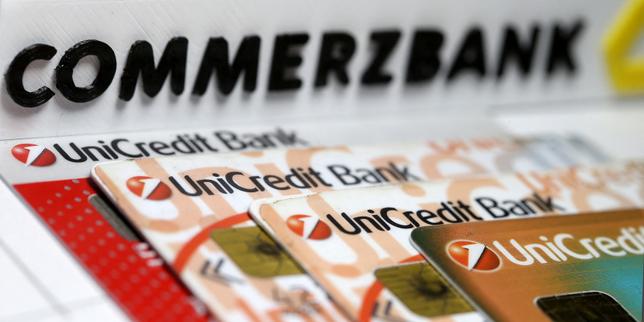
The lights inside the glass towers of Frankfurt do not usually blink at midnight. In the German banking district, order is a religion, and surprises are considered a failure of planning. But on a crisp autumn evening, a series of digital alerts rippled through the upper echelons of Commerzbank, Germany’s second-largest private lender. The numbers on the screens made no sense. Then, they made perfect, terrifying sense.
Andrea Orcel had struck again.
To understand the panic currently vibrating through the German financial establishment, you have to look past the spreadsheets and into the psychology of a corporate chess match. UniCredit, the Italian banking giant helmed by Orcel, had quietly accumulated a massive stake in its German rival. It did not just buy shares on the open market; it used complex financial derivatives—the Wall Street equivalent of a stealth submarine—to lock down nearly 40 percent of Commerzbank.
Money is rarely just about numbers. It is about sovereignty. It is about pride. For Germany, Commerzbank is not merely a financial institution; it is the economic backbone that funds the Mittelstand, the thousands of family-owned manufacturing companies that form the bedrock of the nation's wealth. To see an aggressive, fast-moving Italian competitor virtually park its tanks on the lawn of a German institution felt less like a standard corporate merger and more like a bloodless invasion.
Consider the view from a small machine-tool factory in Baden-Württemberg. Let us call the owner Hans. For three generations, Hans’s family has built precision components. When his grandfather needed to expand the factory floor in 1974, he did not pitch a venture capital firm in London; he walked down the street to the local Commerzbank branch. The loan officer knew the family, knew the town, and understood that German manufacturing moves in decades, not fiscal quarters.
To Hans, the news from Frankfurt is not an abstract tickersymbol adjustment. It feels like a direct threat to his way of life. If a mega-bank managed from Milan holds the steering wheel, will they still care about a medium-sized factory making specialized valves in the German countryside? Or will Hans become a line item on a spreadsheet optimized for pan-European efficiency?
This is the invisible friction driving the conflict. It is the clash between localized, deeply rooted economic traditions and the relentless, borderless march of global capital.
The strategy deployed by UniCredit was breathtakingly audacious. Typically, when a company wants to acquire a rival, it announces its intentions, offers a premium, and endures months of agonizing regulatory scrutiny. Orcel chose a different path. By utilizing financial instruments to secure the right to buy shares without immediately triggering public disclosure laws, UniCredit built a dominant position in the shadows. By the time the German government—which still held a significant legacy stake in Commerzbank from a financial crisis bailout—realized what was happening, the trap was already sprung.
Berlin was furious. The political establishment viewed the move as an aggressive, uninvited raid. German Chancellor Olaf Scholz publicly criticized the hostile maneuver, signaling that the state would not sit idly by while a national champion was swallowed whole.
But anger is not a financial strategy.
Why would an Italian bank risk national outrage to capture a German lender? The answer lies in a fundamental truth about modern Europe: its banks are too small to survive the future.
American banking behemoths like JPMorgan Chase and Bank of America boast valuations and balance sheets that dwarf their European counterparts. They use this massive scale to invest billions in artificial intelligence, digital infrastructure, and global lending power. Europe, fractured by national borders and stubborn cultural divides, possesses a scattered banking sector where even the largest institutions struggle to compete on the global stage.
Orcel’s vision is simple, even if his methods are ruthless. He wants to build the first truly pan-European banking titan. By combining UniCredit’s existing strength with Commerzbank’s massive German footprint, he creates a financial superpower capable of standing toe-to-toe with Wall Street.
It is a compelling argument on paper. But capitalisms do not always speak the same language.
The German financial model relies heavily on consensus. Labor unions hold immense power, occupying seats on corporate boards and ensuring that worker protection matches shareholder profit in priority. The prospect of an outsider taking the reins sends shivers through the labor ranks. Thousands of jobs could be duplicated, streamlined, or erased in the name of synergy. Stefan Wittmann, a key representative of the Verdi trade union on Commerzbank’s supervisory board, made the resistance explicit: they would fight any takeover attempt with every tool at their disposal.
Imagine the atmosphere inside the Commerzbank headquarters right now. Employees who have spent decades navigating a predictable, stable corporate culture are suddenly updating their resumes. Executives are pulling late nights, consulting with defense advisers, searching for a "White Knight"—another suitor, perhaps French or German, who might offer a friendlier alternative to the Italian advance.
But friendly alternatives are scarce when someone already holds 40 percent of your cards.
The conflict exposes a deep, uncomfortable hypocrisy at the heart of the European project. For decades, European leaders have preached the gospel of a unified single market. They created a single currency, erased physical borders, and urged businesses to think across boundaries. Yet, the moment a major cross-border corporate takeover actually occurs, national defenses go up. The old tribal instincts return.
This is the psychological core of the battle. Is Europe a genuine economic union, or is it merely a collection of distinct nations sharing a currency until things get complicated?
If UniCredit succeeds, it sets a precedent. It proves that national champions are no longer untouchable, and that European consolidation can be forced from the outside rather than negotiated politely over espresso. If Commerzbank manages to repel the assault, it will signal a retreat into financial nationalism, a declaration that some corporate fortresses are simply too German to fall.
The stalemate cannot last. Every tick of the market clock costs money, and tension of this magnitude eventually breaks.
Late at night, when the trading floors are empty and the algorithms rest, the glass towers of Frankfurt still look imposing. They symbolize decades of economic dominance, stability, and unyielding pride. But pride is a fragile shield against a competitor who understands that in the modern world, power belongs to those who move fastest in the dark. The final chapters of this confrontation will not be written in regulatory filings or political speeches, but in the quiet decisions of investors who must choose between the comfort of old national borders and the cold, lucrative promise of a borderless continent.
Across the Alps, the lights in Milan are still burning.