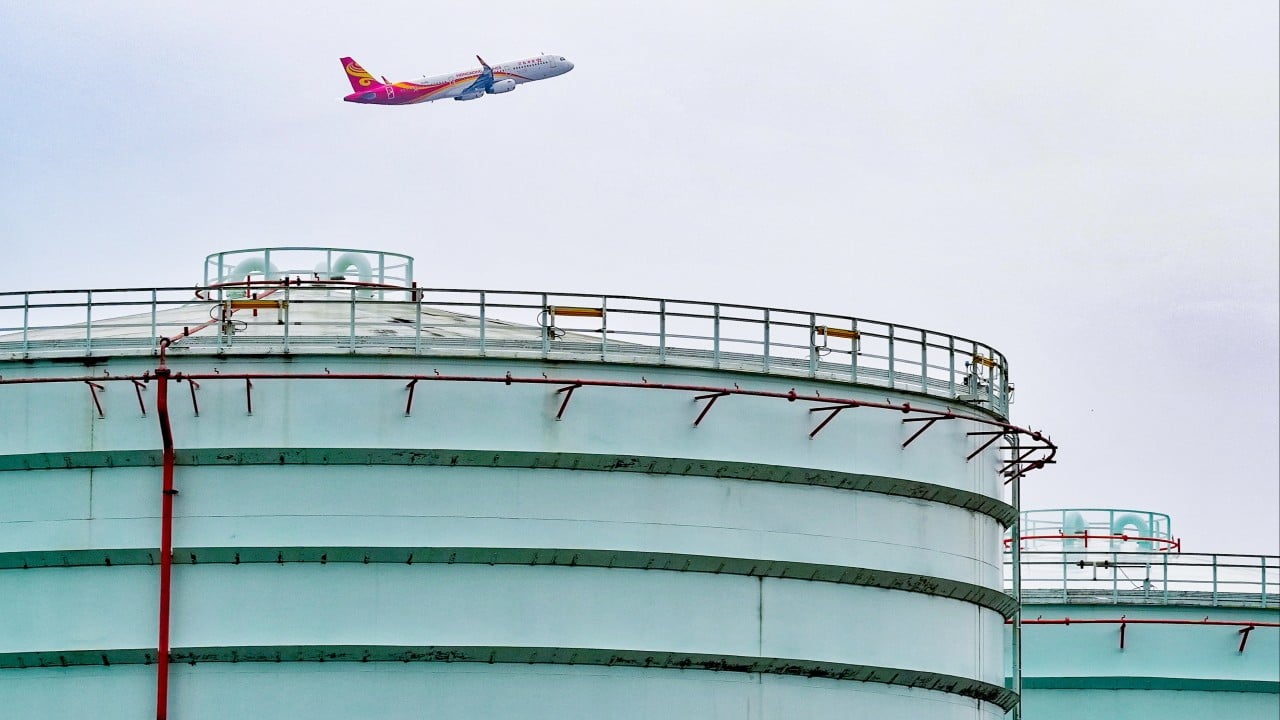
The kerosene smell is usually a sign of progress. At Hong Kong International Airport (HKIA), that faint, sharp scent drifting across the tarmac signifies the heartbeat of global trade. But lately, the air feels different. It feels heavy with the weight of logistics—or the lack thereof.
Consider a cargo pilot named Elias. He isn't real, but he represents a very real set of calculations happening every hour in the flight decks of wide-body freighters. Elias sits in a cockpit overlooking the South China Sea, staring at a fuel gauge that has suddenly become a ticking clock. In the old days—six months ago—he would land, hook up to the hydrant, and fill his tanks to the brim for the long haul to Anchorage or Frankfurt. Today, he’s being told he can only take half. Maybe less.
Hong Kong is grappling with a sudden, jarring shift in its aviation ecosystem. A localized fuel crisis, triggered by supply chain bottlenecks and a radical reshuffling of flight schedules, has turned one of the world's most efficient hubs into a giant jigsaw puzzle where the pieces no longer fit.
The Ghost in the Tank
The problem isn't that the world has run out of oil. The problem is one of timing and geography. Hong Kong’s jet fuel supply relies on a delicate relay of tankers and storage facilities. When a major supplier faces a hiccup—be it a refinery maintenance issue or a geopolitical ripple—the buffer vanishes.
Airlines are being forced to "tanker" fuel. This is an industry term for carrying extra weight from the origin point so you don't have to buy it at the destination. It sounds like a simple workaround. It isn't. Fuel is heavy. Carrying more of it requires burning even more of it just to stay in the air. It’s a vicious, expensive cycle that drives up carbon emissions and eats into the razor-thin margins of the logistics world.
For the average passenger, this might manifest as a delayed gate departure or a "technical stop" in a city they never intended to visit. For the global economy, it’s a seizure in the neck of a bottle.
The Rejigged Sky
To manage the shortage, authorities have begun a massive "rejigging" of flight volumes. They are moving pieces on a board that spans the entire planet. High-consumption long-haul flights are being scrutinized. Short-haul regional hops are being consolidated.
This isn't just about spreadsheets; it's about the ripple effect. When you move a flight from 10:00 AM to 4:00 PM to balance the fuel draw at the terminal, you aren't just changing a time on a screen. You are breaking a dozen connections. You are ensuring a belly full of fresh salmon from Norway doesn't make it to a restaurant in Central. You are making sure a critical semiconductor from Taiwan sits in a humid warehouse for six extra hours.
The airport is trying to maintain its status as the world’s premier cargo gateway, but you cannot run a gateway if the gate is half-rusted shut. The volume shift is an attempt to keep the blood flowing, even if the pulse is slowing down.
The Weight of a Choice
The math of flight is unforgiving. Lift, weight, thrust, and drag.
$L = \frac{1}{2} \rho v^2 S C_L$
When fuel is scarce at the destination, every variable in that equation becomes a point of stress. If a plane has to carry its return fuel on the way in, it has to shed something else to stay under its maximum takeoff weight. That "something else" is usually cargo.
Imagine a logistics manager at a major electronics firm. They have 50 tons of new smartphones ready to ship. The airline calls. Because of the fuel situation in Hong Kong, the plane needs to carry extra fuel for the outbound leg. They can now only take 30 tons of cargo. The other 20 tons stay on the tarmac. This is the invisible stake of the crisis. It’s not just a "flight rejig." It is a systematic de-loading of the global economy.
The Silent Tarmac
Walk through Terminal 1 during the peak hours, and the tension is palpable if you know where to look. It’s in the way the ground crews huddle over tablets, checking the latest NOTAMs (Notices to Air Missions). It’s in the way the catering trucks have to wait because the fueling priority has shifted.
The irony is that Hong Kong has spent billions on its Third Runway System. The infrastructure is there. The concrete is poured. The lights are shimmering. But infrastructure is a body without a soul if you can't feed the engines.
Aviation experts are watching the "volume shift" with a mix of curiosity and dread. If this becomes the new normal, Hong Kong risks losing its crown to regional rivals like Singapore or Shenzhen. Logistics is a business of least resistance. Once the water starts flowing around an obstacle, it rarely flows back.
The Human Cost of Logistics
We often think of global trade as an automated process, something handled by algorithms and giant ships. But it is powered by people who are currently very tired.
The dispatchers who have to tell a crew their 12-hour shift is now a 14-hour shift because of a refueling detour. The warehouse workers in Kwai Chung who see their shifts canceled because the planes aren't coming in. The families waiting for a relative whose flight was canceled because the airline couldn't secure the "uplift" required to make the journey across the Pacific.
There is a specific kind of silence that falls over an airport when things aren't moving. It’s a heavy, expectant silence. It’s the sound of a billion-dollar machine waiting for a liquid that was, until very recently, taken for granted.
The Calculation of Survival
The "rejigging" is a survival tactic. By spreading out the demand, the airport authorities are trying to prevent a total "dry out"—a scenario where a plane lands and literally cannot leave.
This requires a level of cooperation between competing airlines that is almost unheard of. It’s a truce called in the face of a common enemy: the empty tank. They are sharing data, staggering arrivals, and in some cases, trading fuel allocations like a high-stakes game of poker.
But how long can a hub survive on a diet of "just enough"?
The transition is messy. It’s a series of "technical stops" in Manila or Taipei just to get enough juice to reach Los Angeles. It’s a logistical dance performed on a floor that is constantly shifting. Every time a flight is rejigged, a small piece of the world’s clockwork skips a beat.
The End of the Cheap Mile
For decades, we lived in an era of the "cheap mile." You could ship anything, anywhere, for almost nothing. You could fly across the world on a whim. The fuel crisis in Hong Kong is a signal that the era of the effortless mile might be closing.
It isn't just about a temporary shortage. It’s about the vulnerability of our connections. We have built a world that assumes the kerosene will always flow, that the tankers will always arrive on time, and that the gauges will always read "full."
The current volume shift is a warning. It’s a tremor before a potential quake. As the sun sets over the Lantau hills, casting long shadows across the parked jets, the lights of the airport flicker on. They look as bright as ever. But down below, in the veins of the airport, the pressure is dropping, and the people tasked with keeping the world moving are running out of room to maneuver.
The next time you see a plane high above, a silver needle threading the clouds, don't just think about where it's going. Think about what it had to leave behind just to get off the ground.
The gauges don't lie, and they are telling us that the journey is getting heavier.