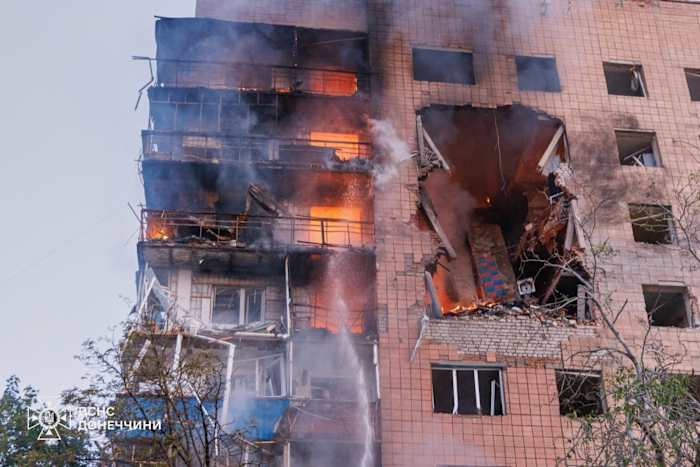
Silence has a sound when you are waiting for air raid sirens. It is a high-pitched hum in the back of your teeth, the nervous system straining to hear what the sky might drop next.
In Moscow, the dark was broken not by thunder, but by a buzzing as persistent as a swarm of locusts. Four hundred unmanned aerial vehicles. Four hundred plastic, fiberglass, and metal engines humming across the black expanse toward the heart of the Russian capital. It was one of the largest coordinated long-range strikes of the war, a relentless wave designed to force a superpower to look up from its front lines and stare directly into its own vulnerability.
Hundreds of miles south, under the yellow streetlights of Kyiv, a different kind of tension hung in the freezing air.
Crowds gathered. Signs fluttered in hands stiffened by winter winds. Ukrainian citizens, weary after years of relentless bombardment and grinding sacrifice, were taking to the streets to challenge their own government. Volodymyr Zelenskyy, the wartime president whose fatigue-green fleece had become an iconic symbol of national defiance, found himself facing a domestic storm while sending a fleet of fire toward his enemy's front door.
War is rarely a clean story of forward motion. It is a complex, terrifying balance of internal friction and external pressure.
The Hum Above the Ring Road
Imagine standing on a balcony on the outskirts of Moscow at three in the morning.
The air is bitter. Traffic on the outer ring road is sparse. Then, somewhere far above the treeline, a sound begins. It starts like a lawnmower running three blocks away. It builds until the air vibrates.
Anti-aircraft batteries ignite. Tracer rounds streak red and orange into the dark, slicing through cloud cover. Explosions rattle windowpanes in suburban high-rises. For millions of residents who spent months treating the conflict as a distant reality televised on state news, the war had crossed the horizon and arrived at their doorstep.
Military analysts often speak of long-range strikes in terms of operational suppression or air defense exhaustion. But the true target of four hundred drones flying simultaneously toward a capital city is psychological.
It is an unequivocal message.
Every interceptor missile launched by defense batteries costs millions of dollars. Every cheap drone sent across the border forces command structures to make agonizing choices about where to place their shields. If air defenses are pulled back to protect power grids, fuel depots, and government buildings in the capital, the soldiers on the front lines in the Donbas are left exposed.
The math of modern warfare is brutal, unforgiving, and deeply human.
Voices in the Square
While the sky burned over Russia, the streets of Kyiv told another story.
Demonstrators gathered near government buildings, their breath pluming in the cold air. They were not protesting the defense of their homeland. They were not demanding surrender. They were demanding accountability.
War reshapes a society completely. It demands everything from its people, their sons, their daughters, their heat, their light, their livelihoods. When people give everything, their tolerance for internal missteps vanishes entirely.
Protesters spoke of economic strains, mobilization policies, and governance concerns that had been simmering beneath the surface of national unity. For months, political rivalries had been set aside in the name of total survival. But as the war dragged into another hard year, the social contract between the state and its citizens faced unprecedented stress.
Zelenskyy’s leadership faced a delicate trial.
How does a war leader maintain national cohesion when the very democracy he fights to preserve demands the right to criticize him in the middle of a existential crisis?
Suppressing dissent destroys the core values that separate a free society from an authoritarian neighbor. Allowing political division during an active war risks fracturing the state from within. It is a tightrope suspended over a precipice.
The Dual Front
Look at the map not as a collection of borders, but as a pressure gauge.
On one side, a massive, long-range aerial operation calculated to demonstrate endurance, projection, and strategic reach to foreign allies and internal adversaries alike. On the other, a government navigating the friction of free citizens exercising their voices in a city routinely targeted by ballistic missiles.
This dual reality reveals the central paradox of modern defensive warfare.
A nation fighting for its sovereignty must simultaneously wage a high-tech conflict across hundreds of miles while tending to the fragile, democratic heart of its own people. Victory cannot simply be measured by military hardware successfully reaching a distant coordinate. It is measured by whether the society standing behind those weapons remains whole when the smoke clears.
Consider what happens next.
Military commanders calculate battery depleted rates, radar coverage, and drone manufacturing pipelines. Politicians count votes, weigh public sentiment, and adjust policy under the blinding spotlight of international media.
And ordinary citizens on both sides of the border look up at the dark sky, wondering when the quiet will finally return.
The drones will be repaired, redesigned, or replaced. The anti-aircraft shells will be replenished. But the human energy driving both the protests in the streets of Kyiv and the defense of the nation is finite.
The winter wind carries the low, distant rumble of another air raid warning. In the cold, hands tighten around signs, and fingers hover over launch buttons. The story of this war is not written solely in the high sky or behind closed doors in official chambers. It is written in the endurance of human beings caught between the desire for freedom and the heavy, relentless cost required to keep it.