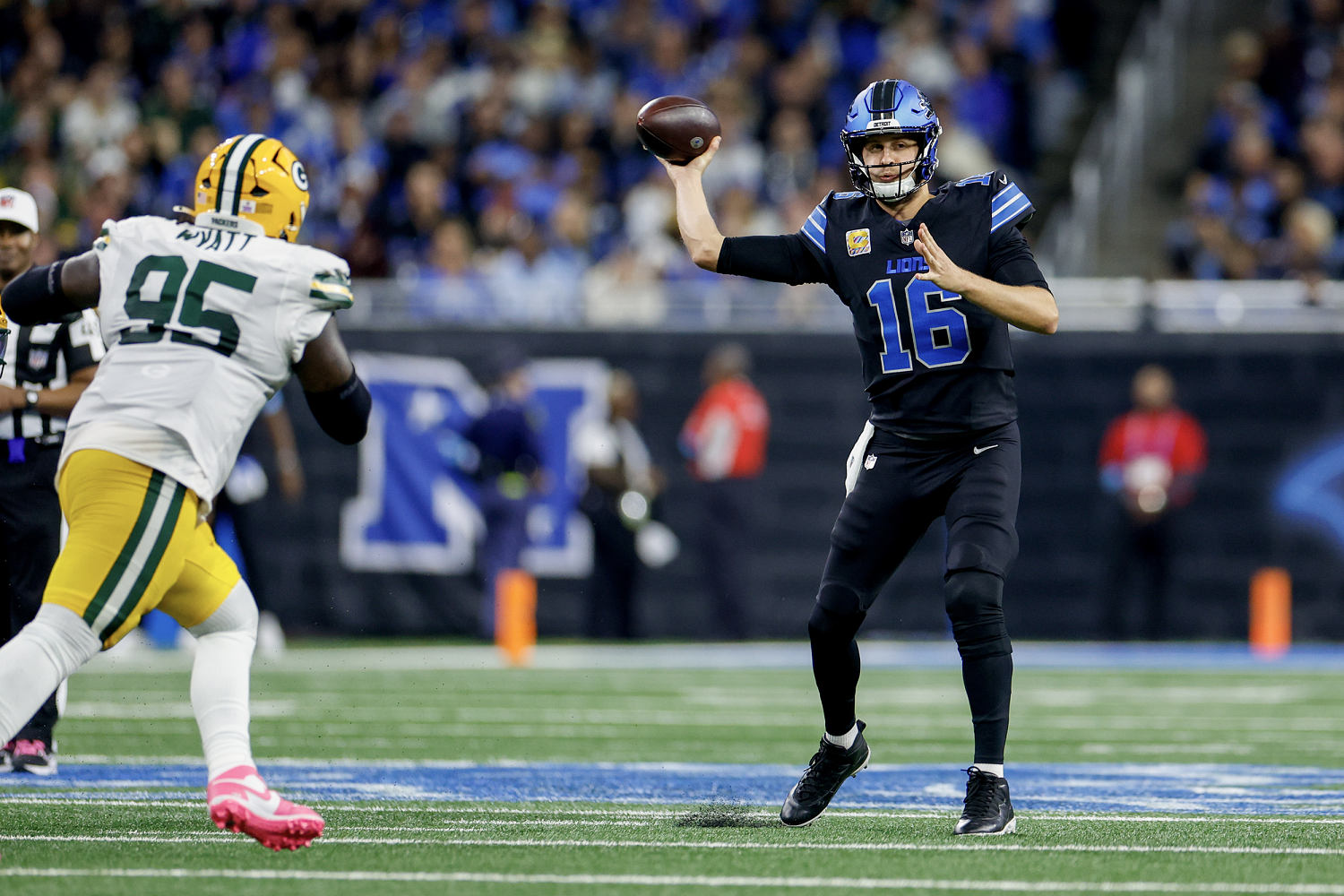
Professional football outcomes in mid-season rarely hinge on raw talent acquisition; they are governed by tactical asymmetry, environmental leverage, and the mitigation of physical decline through cognitive processing. Analyzing the seventh week of an NFL schedule—specifically high-leverage divisional matchups in Detroit and the sustained winning trajectories of veteran quarterbacks like Aaron Rodgers—requires stripping away narrative media tropes and examining the underlying operational mechanics. When a high-variance, aggressive offensive system meets a divisional rival in an indoor environment, and a late-career quarterback continues to extract wins despite declining physical metrics, two distinct strategic frameworks are at work: structural mismatch exploitation and risk-adjusted efficiency.
The Structural Anatomy of a Divisional Matchup in Detroit
Divisional games operate under different game-theory constraints than non-conference matchups. Familiarity compresses the strategic advantage of exotic formations, shifting the decisive variables toward execution speed, personnel leverage, and environmental control. Playing in Detroit introduces a deterministic baseline: zero wind, controlled temperature, and a fast artificial surface. This removes atmospheric variance, turning the contest into a pure test of schematic design and athlete-to-athlete matchups.
Environmental Determinism and Explosive Play Generation
Outdoor venues introduce weather-induced friction that disproportionately penalizes vertical passing attacks and precision route-running. Inside Ford Field, the coefficient of friction on the turf remains constant, maximizing the acceleration profiles of edge rushers and slot receivers.
- Pass Rush Get-Off Velocity: Defensive ends experience zero slippage at the snap. Offensive tackles cannot rely on heavy grass or slick surfaces to slow down speed-to-power conversions. Protection schemes must account for faster time-to-pressure metrics, forcing quarterbacks to process reads within a strict 2.3-to-2.6-second window.
- Route-Tree Geometry: Wide receivers executing sharp horizontal breaks—such as deep digs, out-cuts, and whip routes—maintain full momentum. Defensive backs in off-man coverage face an immediate mechanical disadvantage because reacting to a receiver's plant-and-drive requires compensating for human reaction latency (roughly 150 to 200 milliseconds) on a surface that offers maximum traction to the offensive player.
- Kicking Game Expansion: The absence of crosswinds extends the functional field-goal range by approximately five to seven yards. This alters fourth-down decision-making matrices between the opponent's 35- and 42-yard lines, reducing the expected value (EV) of aggressive fourth-down attempts when a high-probability three-point conversion is available.
The Divisional Familiarity Tax
When two franchises meet twice annually, coaching staffs possess exhaustive tape on how opposing coordinators respond to specific personnel groupings. The standard approach of relying on base tendencies fails because defenders anticipate the primary read before the snap.
To overcome the familiarity tax, successful offensive coordinators in Detroit utilize tendency-breakers built on identical pre-snap presentation. By aligning in 12 personnel (one running back, two tight ends) or 21 personnel (two running backs, one tight end) and utilizing pre-snap motion, the offense forces the defense to declare its coverage shell—identifying whether the secondary is rotating into Cover 1, Cover 3, or a split-safety Cover 2/Cover 4 structure.
If the defense loads the box to stop a heavy run tendency, the offense checks into play-action concepts that attack the vacated intermediate zones behind the linebackers. Conversely, if the defense deploys light boxes with two high safeties to prevent explosive plays, the offense executes zone-blocking schemes designed to generate four to five yards per carry, bleeding the clock and restricting the opposing offense's total possessions. The winner of a divisional duel in this environment is rarely the team with the most creative playbook; it is the team that minimizes negative plays (sacks, holding penalties, and turnovers) while maximizing red-zone touchdown conversion rates.
The Cost Function of the Aging Elite Quarterback
The continued winning output of a veteran quarterback like Aaron Rodgers presents an analytical paradox to casual observers who equate quarterback play strictly with mobility, arm velocity, and volume yardage. As an elite quarterback enters the later stages of a career, physical degradation is inevitable. Escape velocity from the pocket declines, off-platform throws lose top-end torque, and the physical toll of absorbing hits increases the probability of performance dips late in games.
Yet, winning persists because the quarterback's operational model shifts from physical creation to pre-snap elimination and post-snap efficiency. This transition can be modeled as a cost function where the veteran actively minimizes high-variance mistakes to offset a reduction in physical ceiling.
Pre-Snap Processing as a Substitute for Mobility
A young quarterback relies on athleticism to survive a busted protection scheme or a disguised blitz. A veteran with two decades of pattern recognition neutralizes the threat before the ball is snapped.
- Protection Sliding and Hot-Route Automation: By reading the alignment of the defensive front, the depth of the linebackers, and the leverage of the nickel cornerback, the veteran identifies unblocked rushers prior to the snap. Rather than attempting to outrun a free rusher, the quarterback adjusts the offensive line's slide protection or silently signals a hot route to the nearest receiver, converting a potential seven-yard sack into a five-yard completion.
- Hard-Count Manipulation: Utilizing cadence variations exploits the hyper-aggressiveness of defensive linemen. Drawing an offsides penalty generates a "free play"—a zero-risk scenario where the offense can launch a low-probability vertical shot downfield knowing that an interception or incompletion will be nullified by the five-yard penalty. Over the course of a 17-game season, generating even four or five free plays significantly skews Expected Points Added (EPA) per dropback.
- Coverage Diagnosis via Motion: Sending a running back or receiver across the formation forces defenders to either travel with the man (signaling man coverage) or pass the assignment off (signaling zone coverage). Knowing the coverage shell before the snap eliminates half the field from the quarterback's progression, accelerating release times and rendering the opposing pass rush irrelevant.
Risk-Adjusted Ball Placement and Turnover Suppression
Winning in the NFL correlates more strongly with turnover differential than almost any other team metric. A single interception in scoring position creates a swing of seven to ten expected points. Late-career winning quarterbacks obsessively guard against catastrophic variance through precise ball placement.
Instead of throwing into tight windows over the middle of the field—where deflections lead to interceptions and receivers absorb punishing hits—the veteran favors back-shoulder throws along the boundary and low-and-away placement against man coverage. A back-shoulder pass relies on timing and leverage rather than separation. The receiver works vertically, forcing the defensive back to turn his hips and run, before abruptly stopping to catch a ball thrown to his outside shoulder. Even if the receiver fails to secure the catch, the defender's back is to the ball, reducing the interception probability to near zero.
The Limitations of the Veteran Efficiency Model
While pre-snap mastery and turnover suppression sustain high win rates, this operational model carries distinct structural vulnerabilities that opposing defensive coordinators can exploit. No strategic framework is without failure points.
- Susceptibility to Simulated Pressures: Modern defensive schemes combat pre-snap diagnosis by showing a six-man blitz look at the line of scrimmage, only to drop two defensive linemen into underneath coverage zones while rushing a defensive back from the blind side. This disguises the true rush origin and clogs the hot-route lanes the veteran relies upon for quick outlets.
- Collapse Under Interior Pressure: Edge pressure can be mitigated by stepping up into the pocket. Interior pressure—generated by dominant defensive tackles collapsing the A- and B-gaps—destroys the quarterback's throwing platform. Without the youthful agility to bail out of the back of the pocket and reset feet on the run, an older quarterback facing immediate interior penetration is forced to throw off-balance or absorb a drive-killing sack.
- Dependency on Receiver Sight-Adjustments: A cerebral quarterback's system requires wide receivers to read the same defensive leverage post-snap and adjust their routes simultaneously. If a receiver runs a vertical go-route when the safety's depth dictates a back-shoulder stop, the result is an uncontested interception that appears to be a wild overthrow. The system's ceiling is capped by the cognitive alignment of the surrounding skill players.
Integrating Game Theory into Weekly Roster and Scheme Deployment
Understanding both the high-tempo divisional dynamics in Detroit and the efficiency mechanics of a veteran quarterback reveals a unified truth about mid-season NFL strategy: winning is a function of controlling variance.
In a high-scoring, fast-track divisional game, controlling variance means possessing the ball last, converting third-and-medium situations through precise route combinations, and avoiding red-zone turnovers. In a game managed by an aging elite quarterback, controlling variance means shortening the game through efficient early-down runs, capitalizing on defensive penalties, and forcing the opponent to drive 80 yards without making a single mistake.
Tactical Imperatives for Coaching Staffs
To replicate these winning conditions or counter them directly, coaching staffs must execute specific operational adjustments during the mid-season grind:
- When facing an explosive offense indoors: Do not attempt to match explosive plays with reckless aggression unless your personnel holds a clear athletic advantage on the perimeter. Deploy split-safety shells (Cover 2 Man or Quarters) to cap vertical routes, forcing the opponent to execute 10-to-12-play drives. Rely on the mathematical reality that the probability of an offensive penalty, dropped pass, or missed block increases exponentially with every additional snap in a drive.
- When defending a veteran processing quarterback: Abandon static coverage looks. Utilize late-clock safety rotations—shifting from a single-high look to a two-high shell just as the play clock hits five seconds—to invalidate the quarterback's pre-snap check. Prioritize interior pass-rush stunts over wide edge rushes to muddy the pocket and prevent the quarterback from stepping into throws.
- When managing an aging quarterback's workload: Reduce pure dropback volume on early downs. Integrate under-center play-action concepts that force linebackers to hesitate for a fraction of a second, creating clean throwing windows in the intermediate middle without requiring the quarterback to hold the ball beyond 2.5 seconds.
The Definitive Strategic Play for Mid-Season Contenders
Teams entering Week 7 and beyond must abandon preseason identity assumptions and audit their offensive and defensive structures strictly through the lens of variance management. If your roster possesses superior athletes in an indoor divisional environment, push the tempo, attack the intermediate zones with multi-receiver crossers, and force the opponent into a track meet where physical mismatches compound over four quarters. Conversely, if your competitive advantage rests on veteran quarterback cognition rather than raw roster speed, compress the game: prioritize third-down conversion efficiency, eliminate negative plays through rapid pre-snap hot-route adjustments, and force your opponent to beat themselves through impatience and turnover-inducing risks.