If you think your digital marketing campaign is safe just because your company is headquartered in Ohio or Texas, you're about to get a very expensive wake-up call from the state of New York.
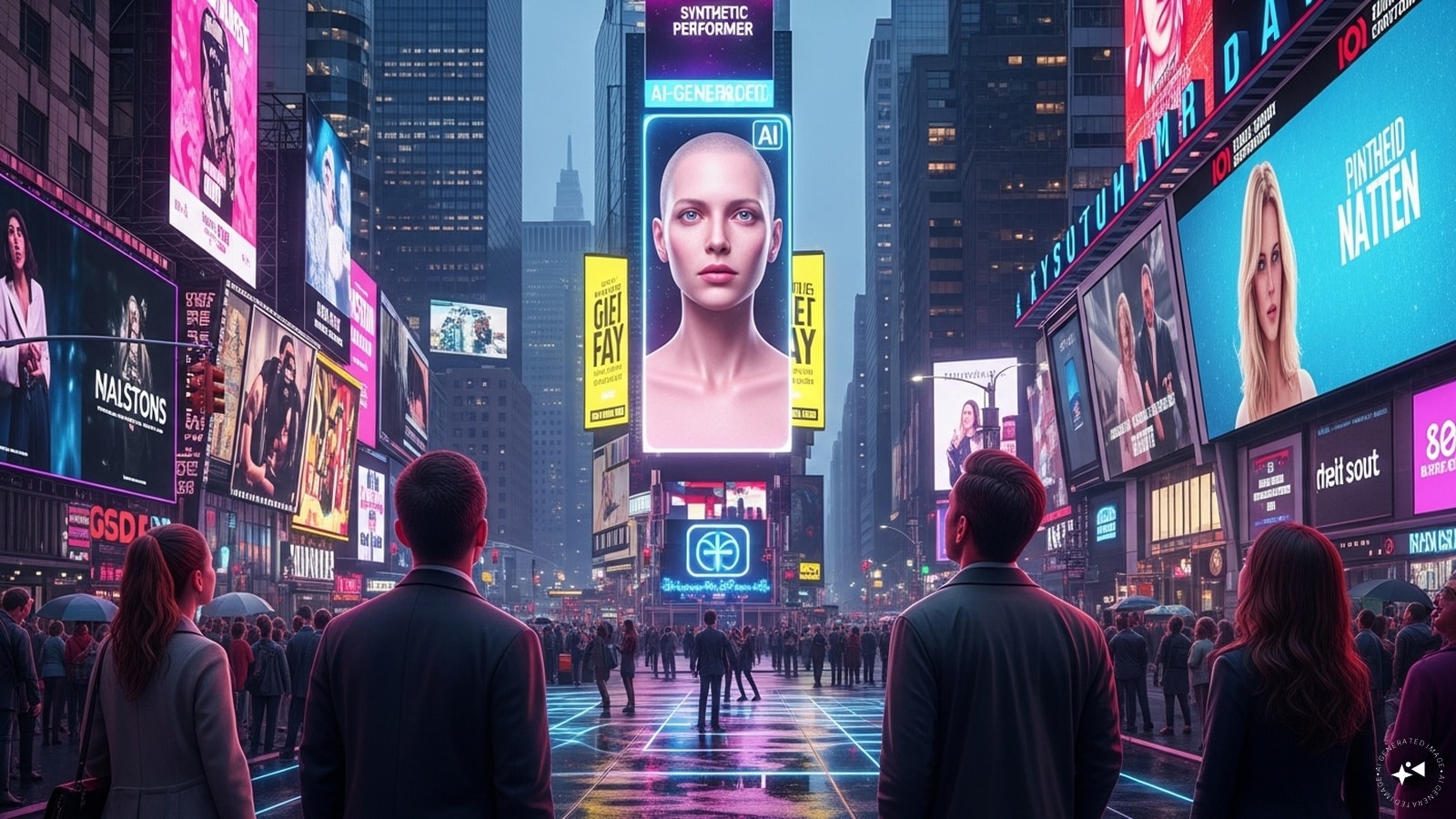
As of June 9, 2026, New York official Synthetic Performer Disclosure Law is officially active. This isn't a vague set of guidelines or a corporate pledge. It's a hard legal mandate codified under New York General Business Law Section 396-b. If your ad runs on a New York screen—whether that's a billboard in Times Square, a Meta ad targeting Brooklyn zip codes, or a TikTok video showing up on a Manhattan teen's feed—and it features an AI-generated human without a clear label, you're breaking the law.
The state is ready to hand out civil penalties of $1,000 for your first slip-up. Every single violation after that will cost you $5,000.
This changes how brands approach asset creation, programmatic buying, and legal compliance. Let's look at what this law actually says, where the hidden traps are, and how you can protect your business from getting buried in state fines.
What Counts As A Synthetic Performer
The biggest mistake you can make right now is assuming this law only applies to hyper-realistic video deepfakes of famous celebrities. It's much broader than that.
The statute specifically targets the use of a "synthetic performer." The state defines this as any digital asset created or modified by a computer using generative AI or a software algorithm that gives the impression of a real human performing visually.
Basically, if a consumer looks at your ad and thinks they're seeing a real person, but that person actually came out of a Midjourney prompt or a software rendering tool, you're on the hook.
This isn't just about full-body videos either. Legal experts tracking the rollout note that the text doesn't differentiate between a main actor and background extras. If you use AI to generate a crowd of fake people sitting in a cafe behind your main product, you likely need a disclosure. Even isolated body parts are up for debate. If you use an AI tool to generate a synthetic hand wearing a luxury watch, that asset falls under the umbrella of a digital asset meant to give the impression of a human.
The Algorithm Trap
Notice the phrase "software algorithm" in the law text. New York legislators deliberately wrote this to look beyond standard generative AI tools. If you use traditional visual effects software to completely construct a non-existent human model from scratch, you might still trigger the disclosure rule. It is about the final visual output, not just the specific brand of software you used to click "generate."
The Legal Loopholes That Won't Save You
Whenever a new compliance law drops, the first instinct for many marketing agencies is to look for an easy way out. Let's dismantle a few common assumptions before they cost you thousands of dollars.
- "Our agency is based out of state." It doesn't matter. The law applies to commercial advertisements distributed to New York audiences. If you buy programmatic ad space that hits users inside New York boundaries, you have to comply.
- "We didn't know the image was AI." The law targets creators and producers who have actual knowledge of the synthetic asset. But you can't just play dumb. If your third-party agency built the asset, the liability chain will quickly trace back to the brand.
- "We only used AI to edit the background." This is one area where you can breathe a little easier. The law focuses on human performances. If you use AI to swap a cloudy sky for a sunny beach, or to generate a clean studio backdrop for a real physical product, you don't need a disclosure label.
The Real Exemptions
To keep the law from completely destroying the entertainment industry, lawmakers built in specific carve-outs. You don't need a label if the ad is directly promoting an "expressive work" like a movie, television show, streaming series, or video game, provided the ad reflects the actual content of that work.
Audio-only ads are also exempt from this specific law. If an AI voice reads a script on a Spotify ad or a podcast slot, Section 396-b doesn't apply. The same goes for using AI tools solely to handle language translation for a real human actor.
The Conspicuous Disclosure Headache
Here is where things get messy for creative directors. The state of New York explicitly demands a "conspicuous disclosure," but the text of the law completely fails to define what that looks like. There is no template. There is no mandatory font size, specific phrasing, or explicit screen placement written into the statute.
If you leave it to your design team to hide a tiny gray 6-point font disclosure in the bottom corner of a fast-moving video ad, you're asking for trouble.
Without explicit state guidelines, your best bet is to look at how the Federal Trade Commission handles its clear and conspicuous framework. To protect your brand from aggressive state attorneys, your disclosures should follow three basic rules.
Prominence
The text must be large enough and possess enough contrast against the background to be instantly noticed by an average consumer. White text on a pale background won't cut it.
Placement
Don't hide the disclosure behind a hyperlink, a drop-down menu, or deep within the text caption of a social media post. The disclosure needs to live directly on the visual asset itself.
Timing
For video ads, the label needs to remain on screen long enough to be read and understood. A blink-and-you-miss-it frame at the very end of a 15-second clip will likely get flagged during an enforcement sweep.
What should the text actually say? You don't have to use the rigid legal jargon "This ad features a synthetic performer." Consumers don't talk like that anyway. Most brands adapting to the rule are opting for clear, direct phrases like "AI-generated image" or "Features synthetic talent" placed clearly in a corner of the frame.
How to Audit Your Creative Pipeline Right Now
You can't afford to wait for a state inspector to flag your active campaigns. You need a proactive compliance system established between your brand and your creative partners.
Review Active Campaigns Immediately
Go through every active asset currently serving impressions in the Northeast region. If an ad features a human face or body, verify its origin. If it came out of an AI generator, pull the asset, add a clean disclosure overlay, and re-upload it.
Update Master Vendor Contracts
Do not take your production partners at their word. Update your contracts with freelance creators, production houses, and ad agencies. Require them to formally declare if they utilized synthetic human assets in the final deliverables.
Build a Multi-State Asset Strategy
Because New York is the first state to cross this finish line, you have a choice to make regarding your media buying. You can either create two versions of your ads—one labeled for New York audiences and one unlabeled for the rest of the country—or you can adopt a blanket policy of transparency across all markets. Given that California and several other states are already drafting similar bills, building a universal AI disclosure template into your design workflow now will save you massive re-work costs later this year.
The era of passing off synthetic models as real people without anyone noticing is officially over in America's biggest media market. You don't have to stop using generative tools, but you absolutely have to stop hiding them. Fix your creative assets today, or prepare to start paying the state of New York $5,000 per mistake.


