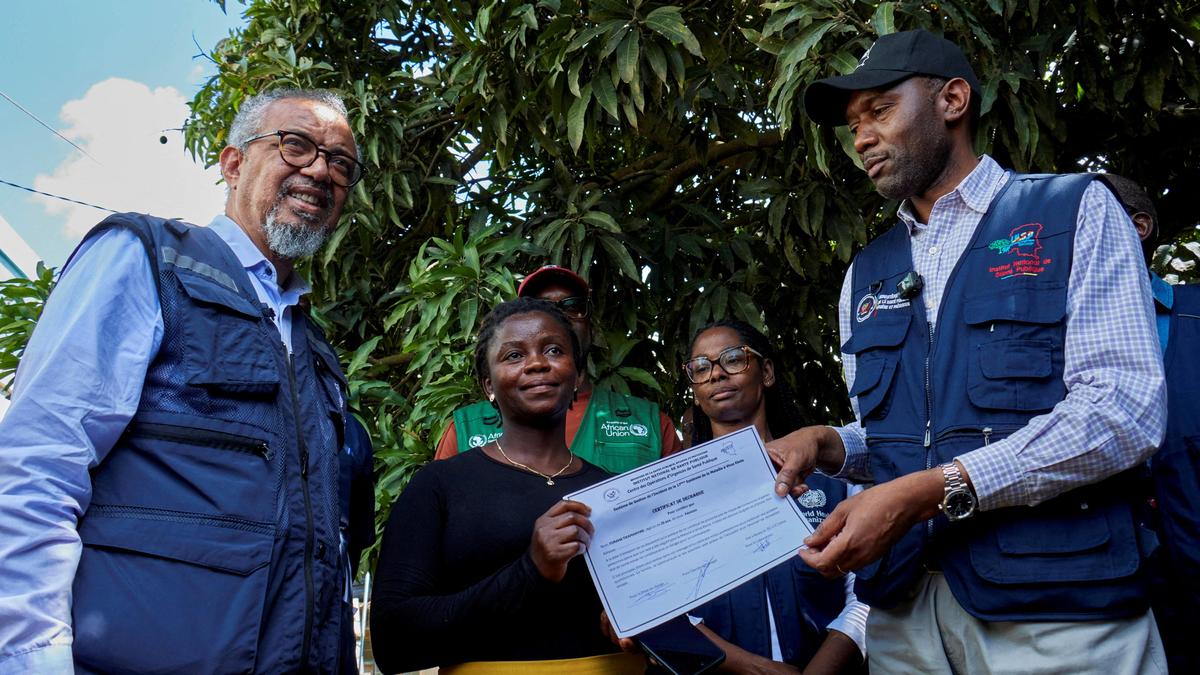
Five people just walked out of a hospital in Bunia alive, and honestly, it is the best news the Democratic Republic of Congo has seen in weeks.
Four nurses and a laboratory worker, all infected while fighting on the front lines, received certificates of recovery from World Health Organization (WHO) Director-General Tedros Adhanom Ghebreyesus. For a disease that people normally associate with a swift death sentence, these recoveries are a massive win. One of the survivors, a nurse named Bulambulu, couldn’t stop grinning when talking to reporters, describing his survival as an "indescribable joy." Another recovered nurse, Ezo Étienne, recalled the exact moment his head started spinning during ward rounds, knowing instantly that something was deeply wrong.
They beat the odds. But behind the celebrations at the newly opened clinic in Ituri province, global health officials are quietly sweating.
The reality is that this specific Ebola outbreak is different, and it is spreading fast. Over 282 cases are confirmed, 42 people are dead, and more than 1,100 suspected cases are under active investigation across Congo and neighboring Uganda. While individual recoveries show that early medical intervention works, the bigger epidemiological picture is getting messy. Suspected cases have already triggered emergency isolation protocols as far away as Brazil and Italy.
The Problem With the Bundibugyo Strain
Most people hear "Ebola" and think of the Zaire strain. That is the variant responsible for the horrific West African epidemic years ago, and it is the one we have highly effective, licensed vaccines for.
This is not that strain.
The current crisis is fueled by the Bundibugyo strain, a rare version of the Ebola virus. It has no approved vaccine. It has no licensed antiviral treatment. When you get hit by Bundibugyo, doctors cannot reach for a proven cure. They rely entirely on aggressive symptomatic support. They pump you full of intravenous fluids, manage your blood pressure, keep your oxygen up, and treat secondary infections.
Historically, Bundibugyo carries a case fatality rate of up to 50%. Right now, data shows the mortality rate in this outbreak sits below 25%, which means the medical teams on the ground are doing an incredible job with the limited tools they have. But treating patients effectively requires getting them into a clinic immediately.
That is where everything breaks down.
Why Containment Is Failing in the Conflict Zones
You cannot fight a virus effectively if you cannot safely walk down the street. The heart of this epidemic sits in eastern Congo, specifically Ituri, North Kivu, and South Kivu. It is one of the most volatile regions on the planet.
Dozens of armed militias, including the Rwanda-backed M23 rebel group, control major chunks of territory. Millions of people are constantly on the move, fleeing violence or traveling between informal gold-mining camps like Mongbwalu, a major virus hotspot. The geography alone makes contact tracing a nightmare, but the security situation makes it nearly impossible.
Consider these numbers from the Congolese Ministry of Health.
- The current contact tracing coverage rate is a dismal 45%.
- Health workers are managing to follow up with barely one in five identified contacts on any given day in certain zones.
- The laboratory positivity rate is hovering near 46%, a screaming red flag that massive numbers of infections are going completely undetected because people cannot or will not get tested.
To make matters worse, international aid cuts from wealthy nations over the past year have left local teams severely underfunded. Responders don't have enough basic personal protective equipment (PPE), face shields, testing kits, or even proper body bags for safe burials. Decades of conflict have also bred deep community mistrust. Some terrified residents, wary of outsiders, have thrown stones at health volunteers and attacked clinics.
When the WHO declared this a Public Health Emergency of International Concern, they openly admitted the virus was outrunning the global response. Uganda has already reported nine cases, including a fatal one in Kampala, and has taken the drastic step of closing its border with Congo. That move goes completely against WHO guidance, but it shows just how terrified local governments are of regional collapse.
What the False Alarms in Brazil and Italy Are Telling Us
As the virus builds momentum locally, the ripples are hitting the international flight grid. Over the weekend, health authorities in South America and Europe scrambled to isolate travelers showing classic hemorrhagic fever symptoms.
In Brazil, a 37-year-old Congolese man landed in São Paulo with a severe fever, triggering immediate isolation protocols. He eventually tested positive for meningitis. In Rio de Janeiro, another traveler coming from Uganda caused a similar panic before testing positive for malaria. Over in Italy, an identical scare occurred in Sardinia's capital, Cagliari, when a passenger flying back from Congo was hospitalized with matching symptoms, though Italian officials confirmed early Monday that his initial tests came back negative.
None of these international cases turned out to be Ebola. But we shouldn't find comfort in those negative test results.
Instead, look at what those scares actually prove. They prove that the global transmission network is wide open. A person can catch the virus in a remote mining town in Ituri, walk past a broken exit screening point, board a flight in Kinshasa or Entebbe, and land in Europe or South America before showing a single symptom.
The internal incubation period for Ebola lasts anywhere from 2 to 21 days. Because initial symptoms mirror common tropical diseases like malaria, or everyday infections like influenza, identifying a traveler on a flight is incredibly difficult. Jean Kaseya, the head of the Africa Centres for Disease Control and Prevention, warned plainly that regional and international spread is no longer a future threat—it is actively happening.
How to Protect Yourself and Monitor the Situation
If you travel internationally or manage corporate travel logistics, stop panicking, but start paying attention. The risk to the general public in places like the United States, Europe, or South America remains incredibly low. Ebola does not spread through the air like Covid-19 or the common flu. It requires direct contact with the bodily fluids of a person who is actively showing severe symptoms, or contact with contaminated surfaces.
If your work or personal life requires travel near East Africa or Central Africa, implement these immediate steps.
- Map Out Travel Exceptions: Avoid unnecessary transit through the eastern provinces of the DRC (Ituri, North Kivu, South Kivu) and western Ugandan border regions.
- Verify Institutional Support: If you are an aid worker or contractor deploying to the region, ensure your organization has guaranteed medical evacuation protocols and direct access to independent, functional PPE supplies. Do not rely on local stockpiles.
- Monitor the Flight Screenings: Keep tabs on international health advisories. While the WHO explicitly opposes travel and trade restrictions with Congo and Uganda, individual nations are starting to enforce independent entry screening, mandatory health declarations, and 21-day isolation windows for individuals arriving from high-risk zones.
The recoveries in Bunia show that human resilience and basic clinical medicine can beat this virus. But hoping for individual survival stories isn't a public health strategy. Until international funding fills the gaps for basic protective gear and local security corridors are established to track down the other 55% of missing contacts, this outbreak will continue to simmer on the edge of a wider crisis.