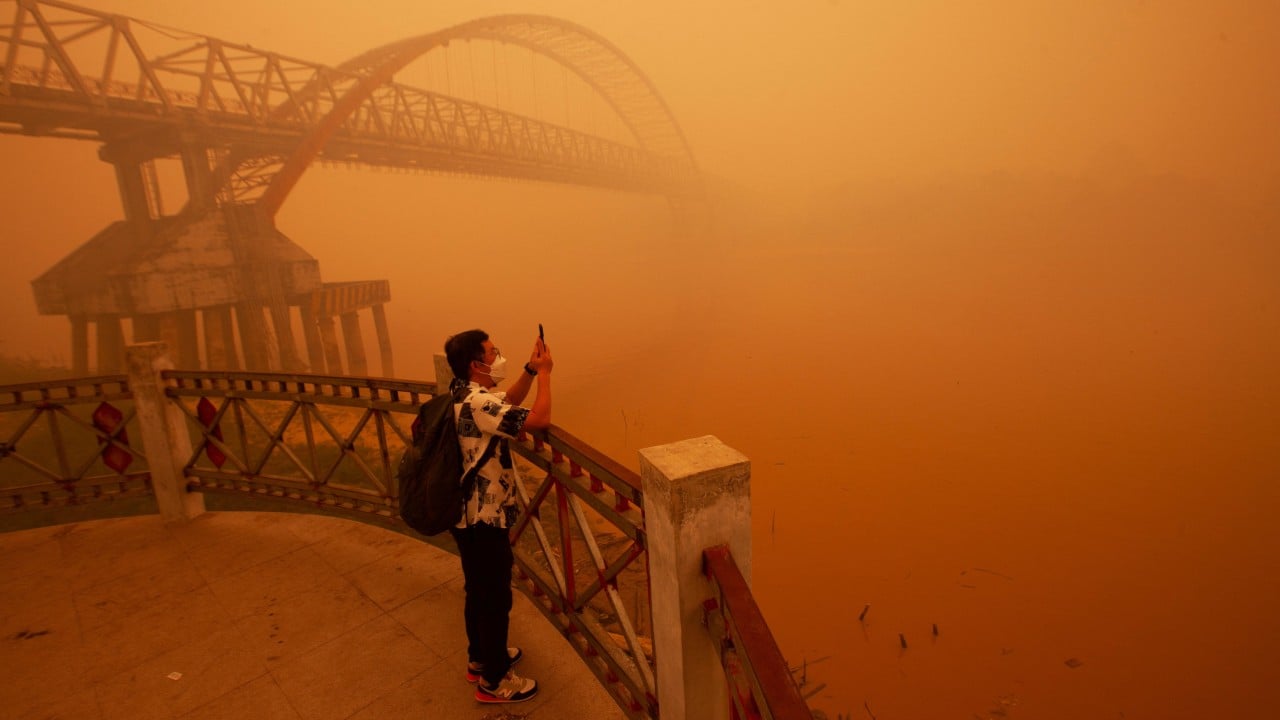
The sun in Pekanbaru does not rise so much as it bleeds through a bruised yellow ceiling.
You taste it before you see it. That metallic, charred tang clings to the back of your throat at six in the morning when you open the front door to check if the delivery driver left milk. By seven, the streetlamps are still glowing amber. By eight, the schoolyard is empty, and a toddler with a blue plastic inhaler sits on a tiled porch in her pajamas, her chest rising and falling in shallow, frantic clicks.
I know that sound. I have sat on porches in Southeast Asia during dry season monsoons when the air felt like wet wool stuffed into your sinuses, when your eyes watered for no reason and your shirt smelled like a campfire even though you hadn't been near a flame for weeks. You start checking air quality indices the way people in coastal towns check storm surge alerts. Numbers climb past two hundred, three hundred, into hazardous territory where every breath carries microscopic particles of burned peat, soot, and sulfur straight into your alveoli.
Here is the twist that stops most outsiders cold: the people screaming loudest for legal action against the Indonesian government aren't sitting in plush boardrooms in Orchard Road or Putrajaya. Many of them are Indonesians themselves—doctors, activists, parents in Sumatra and Kalimantan—urging Singapore and Malaysia to drag Jakarta into international court.
Think about the emotional logic of that plea. When your own capital city hesitates, when diplomatic niceties and national pride keep a crisis bottled up inside polite press releases, you look across the Strait of Malacca and ask your neighbors to do what your own system struggles to enforce.
Smoke Has No Passport
Wind does not care about sovereignty.
Monsoon shifts in late summer and early autumn routinely push plumes from land-clearing fires in Sumatra and Borneo across the narrow waters toward Peninsular Malaysia, Sarawak, Sabah, and Singapore. One afternoon a high-rise in Kuala Lumpur has a crisp blue backdrop; the next morning the Petronas Towers look like pencil sketches smudged by a thumb.
In Singapore, school principals cancel outdoor PE, elderly residents keep windows sealed with damp towels, and air purifiers hum in every living room until the filters turn gray. Across the border in Malaysia, schools shutter by the hundreds when Air Pollutant Index readings spike into unhealthy or very unhealthy bands, leaving working parents scrambling and children staring at ceilings instead of blackboards.
(Note: The following portrait of a family in Riau is a hypothetical composite built to ground real conditions documented across haze-affected Indonesian provinces.)
Consider a hypothetical father named Hendra living outside Pekanbaru, working part-time hauling freight while his six-year-old daughter battles recurring bronchitis. Every autumn, the smoke arrives like an uninvited relative who refuses to leave. Hendra doesn't read diplomatic cables between ministries. He reads the color of his daughter's lips when she coughs after midnight. When he hears that citizens and civil society groups are calling on Singapore and Malaysia to sue Indonesia over cross-border smoke, his reaction isn't anger at his neighbors. It is relief that someone outside the echo chamber might force real accountability.
Why would a nation's own citizens welcome a lawsuit from abroad?
Because polite regional cooperation has felt, to millions of lungs, like a polite way to lose time. The ASEAN Agreement on Transboundary Haze Pollution—signed in 2002 and ratified by Indonesia in 2014—was meant to anchor shared monitoring, early warning, and mutual assistance. Yet in practice, regional diplomacy leans heavily on non-interference and consensus. When official statements dispute whether smoke actually crossed a border or blame El Niño alone, families coughing in the dark feel gaslit by geography.
Why Peat Burns Like Coal
If you picture a forest fire, you probably picture flames racing through treetops, scorching bark and leaves before rain puts them out.
Peatland is different. Deeply different.
(Metaphor alert: Think of tropical peat not as wood, but as a giant, waterlogged sponge made of thousands of years of half-rotted leaves and roots, holding massive stores of carbon underground.)
Drain that sponge with canals so land can be cleared quickly for plantations—whether palm oil, pulpwood, or speculative land grabs—and the water table drops. Once dry, peat turns into tinder. Worse, it burns underground for weeks or months, smoldering beneath the surface even after surface flames are doused or light rain falls. That slow, stubborn underground burn is why haze can linger stubbornly across a region long after a single spark is lit.
Smallholders and big concessions alike have historically used fire because clearing dense vegetation with machinery or labor costs more and takes longer. When dry winds arrive, a small, controlled burn escapes into dried peat, turning a localized clearing method into a regional public health emergency.
Indonesian authorities have not stood completely still over the years. Agencies deploy water-bombing aircraft, build canal-blocking dams to re-wet peat, enforce moratoriums, and fine companies found responsible for fires on their concessions. On paper, enforcement tools exist. In lived reality, enforcement across vast, remote landscapes is grueling, uneven, and easily outpaced by economic incentives and seasonal droughts.
And here is where honesty matters: this isn't a cartoon villain story with a single switch to flip. Land tenure disputes are tangled. Local livelihoods are tied to agricultural income. Weather patterns like El Niño dry out soils far beyond any single ministry's control. Admitting how messy and entrenched the root causes are doesn't excuse the harm—it explains why people are desperate for stronger legal teeth.
What a Lawsuit Could Actually Do
When people say "sue Jakarta," legal experts usually pause and ask: which court, under what law, and against whom?
International law is not a single global police force with a gavel ready to fine a sovereign nation into compliance overnight. Unlike domestic courts where a judge can freeze a bank account or issue an arrest warrant, international tribunals generally require state consent or specific treaty jurisdiction.
Still, legal pressure rarely works in a straight line. Even when a formal interstate lawsuit faces steep jurisdictional hurdles, the threat of litigation—or parallel avenues such as domestic courts, cross-border civil claims, consumer or supply-chain pressure on buyers of palm oil and timber, and diplomatic escalation—changes the calculation.
Let's be candid about the tension between Singapore, Malaysia, and Indonesia. Neighboring governments walk a tightrope. Singapore has previously passed domestic legislation—its Transboundary Haze Pollution Act—aimed at holding companies accountable for causing or contributing to severe haze in Singapore, though enforcing extraterritorial legal actions against foreign firms and accessing evidence across borders has proven thorny in practice. Malaysia faces its own domestic political sensitivities, agricultural interests, and diplomatic priorities with Jakarta.
When ordinary people urge Singapore and Malaysia to sue Indonesia, they are often expressing a moral demand disguised as a legal strategy: Stop treating seasonal smoke as an act of God. Treat it as a preventable wrong with real victims.
The Invisible Bill in Every Breath
Governments count costs in billions of dollars—lost tourism, canceled flights, hospital visits, lower productivity, damaged crops. World Bank assessments of past severe haze episodes in Indonesia have put economic losses in the tens of billions of dollars, a staggering share of GDP for a single season.
Numbers like that sound abstract until you translate them into human hours.
A nurse working double shifts in a clinic in Jambi or Kuching. A delivery rider in Singapore squinting through gritty air. A student falling behind in math because asthma kept her home for three weeks in October. A shopkeeper wiping gray ash off display tables every morning before unlocking the door.
The most dangerous part of fine particulate pollution—especially PM2.5, particles small enough to slip deep into the lungs and enter the bloodstream—is how quietly it works. You don't always feel the long-term cardiovascular or respiratory strain on the day it happens. You just feel tired. Your throat scratches. You tell yourself it's nothing, because what else can you do when the sky itself looks like cigarette smoke?
Over time, those "nothing" days add up. Families spend hard-earned savings on inhalers, doctor visits, and air filters. Trust frays—not just between neighboring capitals, but between citizens and the institutions meant to protect clear air.
Breathing Room Before the Next Wind
Real change rarely comes from a single dramatic courtroom victory alone. It comes when three forces pull in the same direction at once: strict, transparent enforcement on the ground; real financial consequences for companies that burn or fail to protect peat; and honest regional cooperation that puts public health ahead of diplomatic face-saving.
Re-wetting drained peatlands works. Satellite monitoring and open concession maps help pinpoint where fires start and who holds the land. Holding supply chains accountable—so buyers reward zero-burn, peat-safe practices rather than looking the other way—hits where incentives actually live.
None of that is glamorous. None of it trends for twenty-four hours and disappears. It takes patience, funding, and political spine long after the skies clear and the news cameras move on.
Because that is the trap of seasonal crises: once the rain comes and the visibility returns to twenty miles, everyone exhales—and forgets how hard it was to breathe two weeks ago.
The wind will blow again next year. The only real question is whether the next time the sky turns the color of old brass, the region will still be trading press releases over choked lungs—or whether neighbors will finally have built a system strong enough to keep the fire from ever catching.