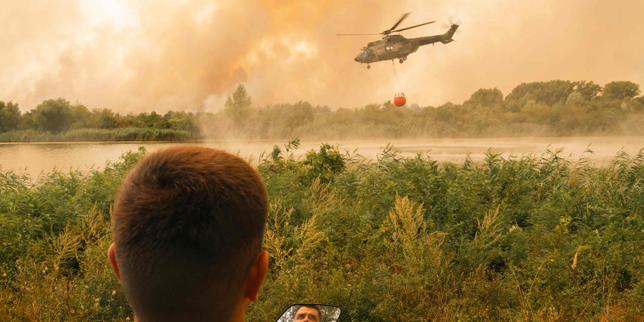
The headlines are breathless. They frame the arrival of a Russian Ilyushin Il-76P in Niš, Serbia, as a dramatic geopolitical tightrope act. They talk about "balancing acts" and "diplomatic dilemmas." They focus on the theater of the flight path—how the bird crossed Bulgarian airspace, how it navigated sanctions—as if a humanitarian mission during an environmental catastrophe is a strategic masterstroke of clandestine maneuvering.
Stop looking at the theatrics. Look at the incompetence.
The real story isn't the presence of a Russian aircraft. The real story is the spectacular, pathetic failure of the European Union’s Civil Protection Mechanism to handle a predictable summer hazard. When an interior ministry official in Belgrade admits that they reached out to Moscow solely because "no firefighting aircraft of this capacity are available within the EU," you aren't witnessing a geopolitical chess match. You are witnessing a systemic collapse of regional infrastructure.
The Illusion of Capacity
We are told that international cooperation is the backbone of modern disaster management. Yet, when the heat rises and the vegetation dries, the "Mechanism" turns out to be nothing more than a glorified spreadsheet of empty hangars.
Europe has spent decades patting itself on the back for creating bureaucratic frameworks for solidarity. But solidarity is worthless if you have no iron to put in the air. While Serbia is not an EU member, it is integrated into this framework. It has even contributed its own assets to help other nations, like Spain, earlier this summer. The reward for this cooperation? An empty inbox when the Deliblatska Peščara reserve started turning into an inferno.
If you are a regional planner, you don't build a strategy on "hoping your neighbors have a plane to spare." You build it on redundant, local capability. The fact that an entire continent—one with a combined GDP that dwarfs anything in its immediate vicinity—cannot source an aerial tanker when the mercury hits forty degrees Celsius is not a failure of diplomacy. It is a failure of basic procurement.
The Geopolitical Red Herring
Observers are obsessed with why Russia sent the plane and why Serbia accepted. They want to turn this into a story about President Putin or Serbia’s refusal to sanction Moscow.
Imagine a scenario where the aircraft belonged to a private logistics firm based in Florida or a state-owned enterprise in Brazil. Would the headlines be different? Of course they would. Because the obsession isn't with the fire. It is with the branding. The desperation of the Serbian authorities to protect their land and their people superseded the optics of who owns the tanker. That is not a "balancing act." That is pragmatism.
The political class in Brussels and the talking heads in the media are terrified of this narrative because it strips away the moral binary they’ve spent years constructing. They want you to believe that the world is divided into clean, integrated blocs that can solve any problem through the right committee meeting. The reality is that fire does not care about your sanctions list, your accession negotiations, or your "strategic partnerships." Fire requires water, and if you haven't bought the plane, you don't get to dictate who lands on your runway to deliver it.
The Failure of the Status Quo
Let’s dismantle the "EU Civil Protection" narrative. It is a reactive model. It operates on the assumption that you can move assets across borders like pawns on a board. This works fine for small-scale floods or localized civil unrest. It fails catastrophically during climate-driven events where every nation is under pressure simultaneously.
When every house on the street is on fire, you cannot rely on the neighborhood’s shared fire truck. You need your own.
Serbia’s reliance on Russian aid is a symptom of a broader European disease: the belief that outsourcing critical capabilities to an international collective is an efficient use of resources. It isn't. It is an abdication of national responsibility. When the dust settles on the Deliblatska Peščara blaze, the lesson won't be about the efficacy of Russian aerial support. The lesson will be that Europe has prioritized administrative integration over functional sovereignty.
We are watching the slow-motion breakdown of a model that confuses connectivity with security. If the continent wants to survive the next decade of extreme weather, it needs to stop checking the diplomatic passport of its relief teams and start building, buying, and maintaining the heavy hardware required to hold back the tide of nature.
Stop asking why the Russians were invited. Start asking why the rest of the neighborhood arrived empty-handed.
EU firefighting limitations and Russian assistance
This video provides a succinct overview of the aerial resource shortages facing the EU and the context behind Serbia's decision to seek assistance from Russia.
http://googleusercontent.com/youtube_content/1