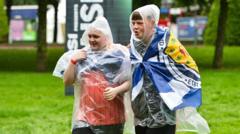
Rain in Glasgow is not an atmospheric detail. It is a baseline condition of existence. It does not fall so much as it occupies the air, a heavy, familiar dampness that hangs over the Clyde and settles deep into the grass of Glasgow Green. Under normal circumstances, a Friday afternoon of relentless drizzle is a cue to retreat indoors, to find the sanctuary of a pub with a coal fire or at least a dry radiator.
But today is not normal. Today, the rain is just a backdrop to a strange, beautiful collision of cultural obsessions. Expanding on this idea, you can find more in: The Anatomy of a Canceled Retrospective Strategic Vulnerability in Cultural Institutions.
Walk through the gates of the TRNSMT festival this afternoon and the visual geography is entirely disorienting. Usually, a music festival has a distinct uniform: bucket hats, glitter, vintage windbreakers, and neon. Today, that aesthetic has been entirely subverted. Thousands of people are walking through the thickening mud wearing the deep navy blue of the Scottish national football team. Saltires are pinned across shoulders like capes. The traditional Tartan Army has effectively staged a hostile, joyful takeover of a indie-rock festival.
The reason is a logistical quirk of geography and time zones. Across the Atlantic, in Boston, the Scottish national team is about to step onto the pitch for their second Group C match of the 2026 World Cup against Morocco. Because of the five-hour time difference, kick-off is slated for 11:00 PM British Summer Time. Observers at E! News have also weighed in on this matter.
Instead of clearing the park after the headliners take their final bows, the organizers are turning the country’s largest music event into its largest open-air football stadium. The main stage screen, usually reserved for larger-than-life close-ups of guitar solos, will become a massive, glowing beacon broadcasting the match to tens of thousands of soaked, ecstatic believers.
To understand why this matters, you have to understand the specific anxiety of being a Scottish football fan. For decades, following the national team has been an exercise in beautifully choreographed heartbreak. There is a generation of adults who grew up listening to their parents talk about the legendary tournaments of the 1970s and 80s as if they were ancient mythology, campfire stories told to comfort children who had only ever known near-misses and qualification failures.
Consider a fan like Callum, a hypothetical twenty-something from Govan. He spent his teenage years watching tournament football as a neutral observer, picking a random country to support every two years because his own never made the cut. Then came the breakthrough. The sudden, emotional realization that Scotland could actually compete on the global stage again. When the team secured a dramatic victory in their opening match earlier this week, the collective release of tension across the country was palpable. It wasn’t just a win; it was an exorcism of decades of sports-induced pessimism.
Now, the stakes are painfully real. A win tonight against Morocco doesn't just keep the dream alive; it pushes Scotland into territory they haven't seen in generations.
The promoters realized early on that trying to fight the World Cup was a losing battle. If they closed the gates at 11:00 PM, thousands of music fans would simply sprint to the nearest pub, overloading the city's infrastructure and missing the communal experience. Instead, they leaned into the chaos. They opened up special late-entry tickets, allowing a second wave of fans—those who care far more about a midfielder’s work rate than a singer’s vocal range—to stream into the festival grounds starting at 7:30 PM.
The transition from a pure music festival to a sporting pressure cooker is happening in stages. Right now, the air smells of crushed grass, wet denim, and cheap beer. On the smaller stages, the bands are playing through the dampness, their amplifiers humming against the moisture. Nile Rodgers and CHIC brought a brief, defiant burst of disco sunshine to the afternoon, forcing people to move simply to stay warm. Wolf Alice delivered a wall of sound that seemed to temporarily push back the gray clouds hanging low over the trees.
But as dusk approaches, the musical narrative is shifting to accommodate the athletic one. Richard Ashcroft is taking the stage, his melancholic, anthemic rock serving as the perfect transitional soundtrack for a crowd that is slowly pivoting from artistic appreciation to collective nervous tension.
The real magic, however, lies in the human architecture of the pre-match build-up. The organizers haven't just thrown a feed of the game onto a big screen; they have built a cultural bridge. Broadcaster Sean McDonald is tasked with anchoring the emotional weight of the crowd, keeping tens of thousands of restless, cold people focused on the shared purpose.
Beside him on the stage will be Rose Reilly. For the younger fans in the audience, her name might require a quick phone search in the mud, but to the purists, she is royalty. She is the only Scottish person to ever win a World Cup, a feat she achieved in 1984 while playing for the Italian women’s national team during an era when women's football was effectively banned by the Scottish authorities. Her presence on the stage is a quiet, powerful reminder of resilience, a living proof that footballing glory is not entirely foreign to the Scottish soul.
As the clock ticks closer to eleven, the indie-rock covers will give way to something far more visceral. George Bowie is scheduled to drop a set of classic, unapologetic dance anthems, the kind of music that has soundtracked Glasgow nights out for decades. It is a tactical choice: keep the crowd moving, keep the blood flowing, and transform the damp chill of a Scottish summer night into a roaring, sweating engine of collective energy.
The ultimate crescendo before the whistle blows will belong to Cammy Barnes. He opened the main stage hours ago to a smattering of early arrivals holding umbrellas. Before kick-off, he will walk back out into the dark, carrying his bagpipes.
There is an old cliché that the bagpipes are a polarizing instrument, but when the first notes of Flower of Scotland cut through the cold air of Glasgow Green, the debate ends. It is an ancient, mournful song that somehow transforms into a battle cry when sung by forty thousand people who have been drinking in the rain since lunchtime. The goal is to create a literal sea of saltires, a visual declaration of support that will stretch from the front barrier all the way back to the historic winter gardens.
It is easy to look at an event like this with a cynical eye. You can see it as a commercial masterstroke, a clever way to sell more tickets and keep the beer taps running for an extra three hours. You can look at the logistical nightmare of tens of thousands of people trying to find late-night buses and trains out of the city center after midnight and wonder if it is worth the hassle.
But that cynicism misses the entire point of why we gather in fields in the first place.
Music and football do the exact same thing to the human brain: they offer a brief, terrifying, beautiful escape from the mundane reality of the Tuesday morning alarm clock. They allow adults to stand in the pouring rain, shoulder-to-shoulder with strangers, and scream until their throats are raw over something that ultimately has no bearing on their rent, their health, or their daily struggles. It is the joy of voluntary vulnerability.
The rain is turning the ground into a soup of mud that will destroy thousands of pairs of shoes by tomorrow morning. Nobody cares. The crowd is thickening, the navy shirts are glowing under the festival lights, and the giant screen is flickering to life with the pre-game feed from Boston.
Tonight, Glasgow Green isn't just a park, and TRNSMT isn't just a music festival. It is a collective holding of breath, a city bound together by a thin thread of hope, waiting to see if a decades-old curse can finally be broken under the floodlights.