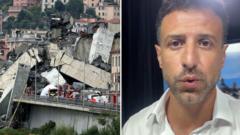
On July 16, 2026, an Italian courtroom in Genoa delivered a verdict that many feared would never arrive. Nearly eight years after a massive section of the Morandi highway bridge crumbled during a summer rainstorm, killing 43 people, the first major step toward legal accountability has been taken. Thirty defendants, including the former chief executive of motorway operator Autostrade per l'Italia (ASPI), Giovanni Castellucci, were found guilty of multiple counts of manslaughter and negligent disaster. Castellucci was sentenced to 12 years in prison.
The ruling marks a watershed moment for a country whose crumbling infrastructure has long been a source of national anxiety. Yet, this verdict is far from a final victory. Under Italy’s complex, three-tiered judicial system, those convicted will remain free during years of mandatory appeals. More critically, the corporate entities that owned and maintained the bridge have already paid their way out of the criminal courtroom. The trial did not merely expose the technical failures of a single bridge; it laid bare a systemic national failure where public safety was traded for private profit.
The Illusion of the Morandi Wonder
The Morandi Bridge was once hailed as an engineering triumph. Opened in 1967, the flyover was a vital artery connecting northern Italy to the French Riviera. Designed by the celebrated engineer Riccardo Morandi, it utilized an innovative and highly experimental structural system.
Morandi’s design relied on concrete-encased stay cables. The theory was elegant. By tensioning the internal steel cables and wrapping them in prestressed concrete, the steel would be protected from the corrosive, salty sea air blowing in from the Gulf of Genoa.
But the reality was a nightmare.
Concrete cracks. When tiny fissures formed in the external concrete sheath, moisture and industrial pollution seeped inside. The steel cables began to corrode, hidden entirely from the naked eye. Inspectors could not see the damage because the very concrete meant to protect the steel acted as a shroud, masking the decay.
By the late 1970s, Morandi himself recognized the vulnerability of his creation. In 1979, he published a paper warning of the accelerated aging of the bridge and urged a rigorous, continuous program of preventive maintenance.
His warnings went largely ignored.
The Fatal Economics of Privatization
The structural vulnerability of the Morandi Bridge was only half the problem. The catalyst for the disaster was the privatization of Italy's highway network in the late 1990s.
In 1999, the state-owned toll road network was leased to Autostrade per l'Italia, which eventually came under the control of Atlantia, an infrastructure giant dominated by the wealthy Benetton family. The logic of privatization promised efficiency and modernization. The reality was a predatory financial model.
"From 1993 onward, the problem was known. We had three identical pylons. Two had already shown the same defect, and no one seriously asked whether the third one had it as well."
— Raffaele Caruso, attorney representing the families of the victims
Under the terms of the concession, ASPI enjoyed guaranteed toll increases while bearing the responsibility for maintenance. However, the regulatory oversight from Italy's Ministry of Infrastructure was notoriously weak, often staffed by former employees of the very companies they were supposed to regulate.
This regulatory vacuum created a perverse incentive structure. Every euro spent on structural maintenance was a euro taken directly out of the pockets of shareholders. Conversely, deferring maintenance artificially inflated the company's financial performance, boosting stock prices and executive bonuses.
The Paper Trail of Deliberate Neglect
The prosecution in Genoa spent four years presenting an overwhelming paper trail that proved ASPI managers knew the bridge was in danger of collapsing. This was not a sudden, unpredictable natural disaster. It was a slow-motion catastrophe decades in the making.
During the 1990s, when the bridge was still under state control, engineers noticed severe degradation on two of the bridge’s three main pylons. Remedial work was carried out on those pylons, reinforcing the stay cables with external steel stays.
Pylon nine, the one that would ultimately collapse on August 14, 2018, was left untouched.
Morandi Bridge Pylon Maintenance History:
+------------+--------------------+-------------------------+
| Pylon No.  | Inspection Alert   | Maintenance Action      |
+------------+--------------------+-------------------------+
| Pylon 10   | Yes (1990s)        | Reinforced with stays   |
| Pylon 11   | Yes (1990s)        | Reinforced with stays   |
| Pylon 9    | Yes (2009/2015)    | Postponed repeatedly    |
+------------+--------------------+-------------------------+
Internal documents revealed that a 2009 survey commissioned by ASPI raised urgent warnings about the state of pylon nine, calling for intensive maintenance and yearly health checks. Nothing of substance was done. Instead, the company merely replaced traffic dividers with heavier concrete barriers, actually increasing the dead load on the weakened structure.
In 2015, another technical survey described the bridge as being in "dire conditions". Closure of the bridge was discussed, but local politicians and ASPI executives resisted the logistical and financial fallout of rerouting traffic. The necessary structural repairs were repeatedly pushed back. When the bridge collapsed, the vital reinforcement works for pylon nine were scheduled to begin the following year.
They ran out of time.
How the Corporate Giants Escaped the Dock
While the convictions of Castellucci and 29 other individuals represent a degree of accountability, the corporate entities responsible for the system itself managed to escape the trial virtually unscathed.
In 2022, as the criminal trial was beginning, ASPI and its engineering subsidiary, SPEA, reached a plea deal with the prosecutors. The companies agreed to pay a combined settlement of roughly 30 million euros ($34 million).
This sum is a pittance.
For a corporate infrastructure giant, 30 million euros is a rounding error. By paying this fine, ASPI and SPEA avoided being tried as corporate defendants. This spared them from potentially catastrophic legal consequences, including being banned from securing lucrative public contracts.
Even more galling to the victims' families was the subsequent financial restructuring. Following the disaster, the Italian government forced Atlantia to sell its stake in ASPI. But instead of expropriating the concession as a penalty for gross negligence, the government led a consortium to buy the shares back for over 8 billion euros, effectively handing the Benetton family and other investors a massive payout.
The public took back the crumbling bridge and the massive liability of rebuilding it, while the private investors walked away with billions.
A Flawed Justice System and the Long Wait for Closure
The verdict delivered in Genoa is only the opening salvo of a legal process that could drag on for another decade.
In Italy, a defendant is not considered guilty until all stages of the appeals process are exhausted. The 12-year sentence handed to Giovanni Castellucci is a "first-instance" ruling. His defense team has already announced plans to appeal, arguing that the collapse was due to an undetectable, fifty-year-old design defect rather than lack of maintenance.
Because of the notoriously slow pace of Italian justice, there is a very real danger that many of the remaining charges against the other defendants will simply expire under the statute of limitations before a final verdict is reached. Indeed, several lesser charges, such as the forgery of safety documents, have already been dismissed for this exact reason.
For the families of the 43 victims, the court’s decision is a cold comfort. They have spent years sitting in courtroom hearings, listening to corporate executives deny responsibility while pointing fingers at dead engineers and historical design flaws.
The new bridge, designed by renowned architect Renzo Piano and opened in 2020, stands as a sleek monument to modern efficiency. But the glittering steel structure cannot mask the rot that remains at the heart of Italy's privatized public services. Until the state fundamentally reforms its regulatory oversight and holds the corporate structures themselves criminally liable, the tragedy of the Morandi Bridge will remain not an isolated accident, but an inevitable consequence of a system that values profit margins over human lives.