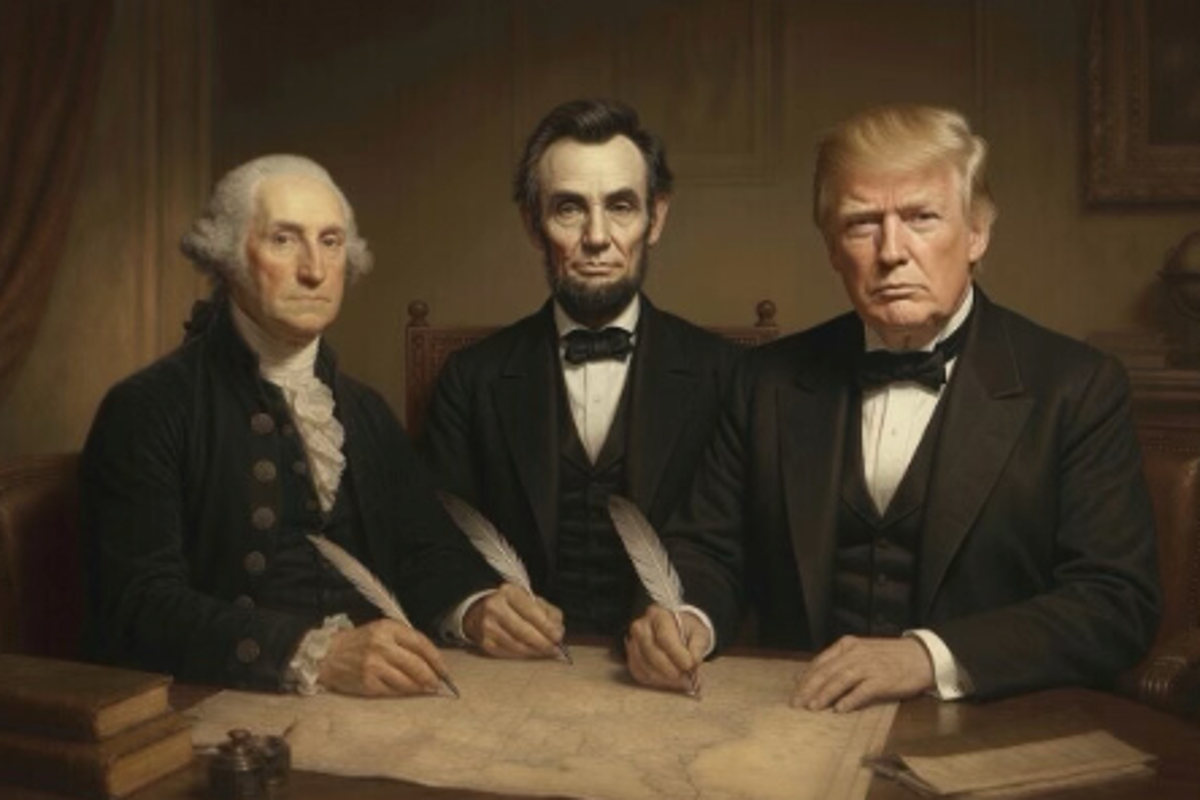
Donald Trump wants to share stone with George Washington and Abraham Lincoln. That ambition is not merely a quirk of online communication or an isolated social media blunder; it is a meticulously engineered exercise in historical revisionism. When digital artifacts circulate placing his visage alongside the founding fathers, observers often dismiss them as fleeting curiosities. They are wrong. This visual juxtaposition represents a calculated strategy to reframe contemporary polarization as a historic struggle on par with the Revolutionary War or the Civil War.
Understanding this phenomenon requires moving past the superficial shock value of AI-generated images or campaign memes. We must examine the mechanics of political iconography and how modern populism rewrites the American presidency. For an alternative look, consider: this related article.
The Architecture Of Digital Mythmaking
Visual iconography operates on a subconscious level. Long before a voter reads a policy paper or evaluates a legislative record, they absorb images. For years, political operatives across the spectrum have utilized digital manipulation to elevate their principals. Yet, the Trump campaign and its digital ecosystem have weaponized this tactic with unprecedented scale.
By superimposing his face onto monuments or positioning himself alongside Mount Rushmore granite, the messaging bypasses logical scrutiny. It activates archetypal imagery. The average citizen recognizes Washington as the reluctant general and Lincoln as the martyr of union. Placing a modern figure into that visual lineage creates an implicit argument. It suggests that contemporary political battles carry the same existential weight as the preservation of the republic itself. Further analysis on this matter has been shared by The Guardian.
History tells us that legitimate presidential legacy takes decades to settle. Historians rely on archives, declassified documents, and the cooling of partisan passions to evaluate a term in office. Digital mythmaking bypasses this lengthy validation process entirely. It manufactures instant tradition. A graphic posted on a social media feed becomes a substitute for historical consensus.
Why Mount Rushmore Matters
The choice of Mount Rushmore is uniquely potent. Carved into the Black Hills of South Dakota, the monument represents an idealized pantheon of American leadership. It features Washington, Jefferson, Theodore Roosevelt, and Lincoln. Each represents a specific pillar of national mythos: birth, expansion, development, and preservation.
When a living politician inserts themselves into this stony conversation, they are claiming a seat at the table of national destiny. This is not casual hubris. It is a strategic narrative choice. It tells supporters that the movement transcends standard partisan politics. It frames the leader not as a temporary occupant of the Oval Office, but as a permanent fixture of the American story.
Critics scream about norm-breaking. Supporters cheer the audacity. Both reactions miss the point. The images function as tests of loyalty and anchors for identity. If you accept the premise that the leader stands alongside Washington, you must also accept that standard institutional rules no longer apply to them.
The Historical Precedent Of Self-Mythology
Self-aggrandizement in American politics is hardly a modern invention. Early presidents sat for portraits designed to evoke Roman senators. Andrew Jackson cultivated the image of the rough-hewn frontiersman fighting entrenched elites. Theodore Roosevelt actively managed his own legend as a rough rider and conservationist hero.
However, the speed and decentralized nature of digital media change the equation.
- Past eras relied on controlled portraiture, official biographies, and monument commissions that took generations to complete.
- The digital era allows for instantaneous creation, distribution, and validation of alternative realities.
Consider how previous administrations handled iconography. Official photographers captured candid moments of gravitas. Press secretaries managed the narrative through traditional journalistic channels. Today, the intermediary layer has evaporated. A politician can project themselves onto Mount Rushmore at midnight, and millions of citizens will view it before the morning news cycle begins.
This direct-to-consumer mythmaking creates a parallel reality. Within this space, historical facts are malleable. If an image appears authentic to the untrained eye, it achieves functional truth for the believer. The line between satire, aspiration, and propaganda blurs until it disappears entirely.
The Psychological Mechanics Of Exceptionalism
Why do voters embrace these hyperbolic comparisons? The answer lies in the psychology of national decline and renewal.
Populist movements thrive on the belief that a once-great nation has fallen into decay due to corrupt elites. To counter this narrative, the movement requires a figure of mythic proportions. A standard politician cannot vanquish a deeply entrenched establishment. It requires a titan.
When a leader poses alongside Lincoln or shares a digital canvas with the founding fathers, they are signaling strength to an anxious electorate. The message is simple. Ordinary leadership is insufficient for extraordinary times.
This dynamic explains the resilience of support despite continuous controversy. Every attack from traditional institutions confirms the myth. If the establishment hates the leader, it must be because the leader threatens their power, much like the populists of the past challenged the old order. The comparison to Washington and Lincoln thus serves as a shield. It absorbs criticism and converts it into evidence of historic persecution.
The Media Trap
Mainstream journalists frequently fall into a predictable trap when covering these digital stunts. They fact-check the obvious. They write earnest articles explaining that Donald Trump is not, in fact, carved into South Dakota granite, and they detail the historical differences between his administration and Lincoln's presidency.
This approach fails because it misunderstands the audience.
Voters do not look at a digital composite of Mount Rushmore and calculate its literal truth. They understand it as a symbol. By treating the image as a factual error rather than a rhetorical device, the press allows the subject to dictate the terms of engagement. The coverage becomes another episode in the ongoing cultural war, deepening the divide rather than illuminating the underlying strategy.
A more effective analytical approach requires shifting the focus from the absurdity of the image to the utility of the myth. Who benefits from this framing? What policy discussions does it obscure? How does it alter the baseline of acceptable political discourse?
When we ask these questions, the landscape clears. The fictional posts are not anomalies. They are the core product.
The Long-Term Cost To Democratic Norms
The normalisation of hyper-partisan mythmaking carries a steep institutional price. When the highest office in the land is continually framed through the lens of foundational epic poetry, compromise becomes impossible. You do not compromise with forces of existential evil, nor do you negotiate away the legacy of George Washington.
Politics devolves into a zero-sum struggle between absolute good and absolute corruption.
Institutions depend on a shared baseline of reality to function. If the public square fractures into competing ecosystems where a president can be digitally enshrined alongside founding fathers with zero pushback from their base, democratic oversight erodes. Checks and balances require a citizenry that agrees on basic rules of accountability.
As digital generation tools become more sophisticated, the line between reality and manufactured myth will only blur further. Tomorrow's political operatives will not rely on crude photo-manipulation. They will generate hyper-realistic immersive scenarios where leaders direct historical events in real time.
The ambition to stand next to Washington and Lincoln is just the beginning of a much larger campaign to rewrite the past in order to control the future. The granite may be fake, but the erosion of shared reality is entirely real.