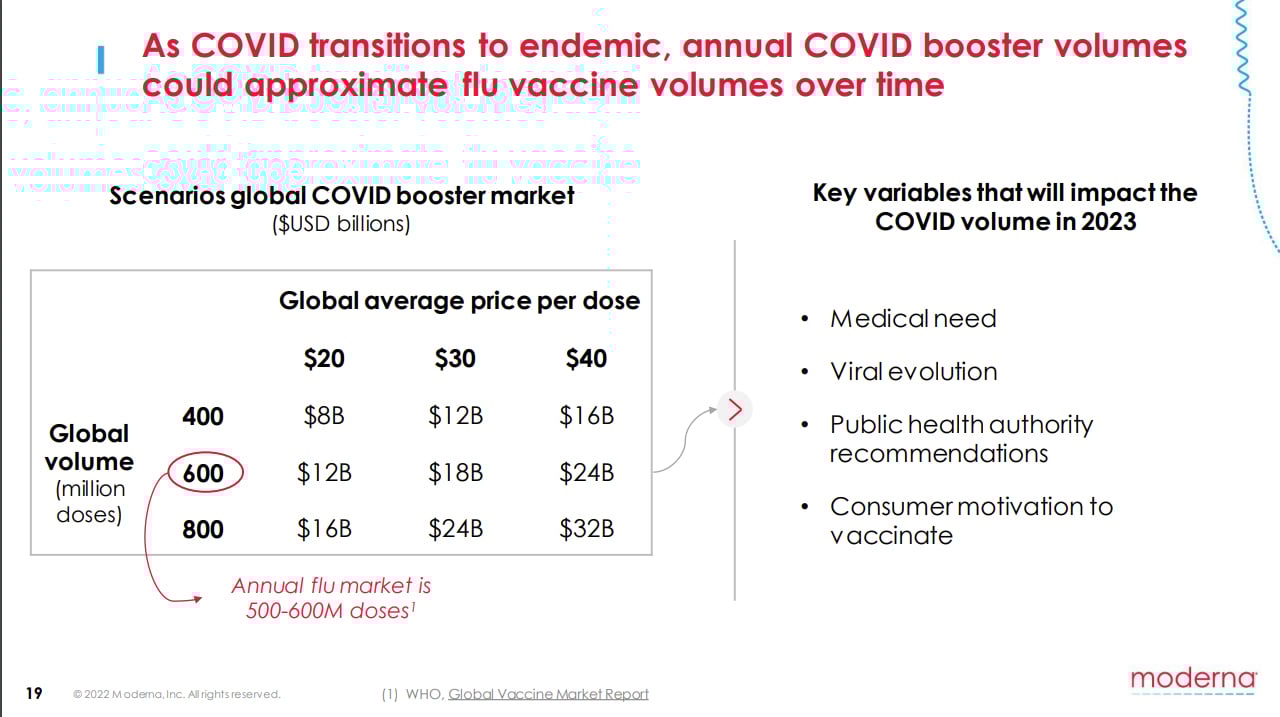
Market reactions to biotechnology catalysts often expose systemic flaws in how capital allocates risk. When Moderna shares experience sharp upward volatility following pipeline updates or clinical readouts, the financial media routinely invokes the psychological shorthand of pandemic mania. This classification is lazy. It mistakes a complex adaptive system response for emotional contagion. Treating market enthusiasm or panic as mere sentiment ignores the underlying mechanical drivers of biotech asset valuation.
Understanding why these valuation spikes recur requires moving past historical nostalgia and examining the structural realities of commercializing messenger RNA technology post-emergency use authorization. The primary driver of these recurring market episodes is not irrational exuberance, but rather a persistent structural mispricing of platform optionality versus single-asset cash flows. Traditional equity valuation models struggle to price platforms that can theoretically reconfigure their core manufacturing logic within weeks, yet face extended clinical validation pathways for every individual target.
The Valuation Mechanics of Platform Biopharma
To decode why Moderna triggers rapid speculative accumulation followed by steep mean reversion, one must examine the fundamental tension in its business model. Single-product biopharmaceutical companies derive valuation from a linear equation: addressable market size multiplied by clinical probability of success, discounted by time to commercialization. Platform companies like Moderna break this linear equation.
When a clinical update suggests a non-COVID pipeline candidate, such as a personalized cancer vaccine or respiratory syncytial virus combination shot, is advancing, the market faces a pricing dilemma. Analysts often apply historical single-asset discount rates to an asset that benefits from shared manufacturing infrastructure and established safety databases. This creates a recurring valuation distortion.
Linear Asset Model: Target Market x Clinical Probability = Valuation
Platform Asset Model: (Core Manufacturing Engine) x (n Addressable Indications) = Exponential Optionality
The error in treating this dynamic as pandemic mania lies in misidentifying the inputs. During the public health emergency, volume demand was guaranteed by government advance purchase agreements. Today, volume demand is governed by competitive procurement dynamics, seasonal adoption rates, and private insurance reimbursement schedules. When a headline sparks a rally, speculators are pricing an instantaneous return to government-backed bulk purchasing, while institutional capital is attempting to recalculate terminal cash flows under standard commercial friction. This divergence in time horizons generates high-volatility price swings.
The Commercial Cost Function Post Emergency Authorization
Transitioning from an emergency-use supplier to a commercial-market competitor fundamentally alters a firm's operational cost function. During crisis conditions, distribution logistics, regulatory pathways, and marketing expenditures were heavily subsidized or bypassed by state intervention. The return to baseline market conditions introduces three distinct friction points that investors routinely underwrite incorrectly.
First, customer acquisition costs have shifted from centralized state-level procurement officers to fragmented pharmacy benefit managers, primary care networks, and individual payors. This requires sustained commercial overhead that dampens operating margins.
Second, the erosion of pricing power due to competitive entrants in the respiratory vaccine space changes the gross margin profile. When a market features a single dominant provider, pricing functions as a markup over marginal cost. With multiple platforms achieving regulatory clearance, pricing power shifts toward the buyer, forcing firms to compete on co-pay assistance, distribution efficiency, and bundling strategies.
Third, research and development capital allocation becomes less forgiving. Emergency funding allowed for parallel track development where clinical phases overlapped with manufacturing scale-up. Returning to standard regulatory compliance means incurring the full cost of sequential Phase one, Phase two, and Phase three trials without guaranteed procurement backstops.
The Mechanics of Clinical Readout Volatility
The triggers for market mania typically stem from binary clinical readouts. In traditional therapeutics, a Phase two data release provides a clear indicator of efficacy for a specific molecular entity. In mRNA applications, a positive readout carries dual implications that markets routinely misinterpret. It validates both the specific therapeutic candidate and the broader physiochemical delivery mechanism, such as lipid nanoparticle formulations.
When a pipeline asset succeeds, the market prices the immediate indication while simultaneously inflating the probability of success for dozens of preclinical programs sharing the same delivery vehicle. This is mathematically aggressive. Two distinct therapeutic targets utilizing identical delivery lipid nanoparticles may face completely different cellular environments, immune evasion tactics, and target expression densities. A successful oncology readout does not de-risk a rare disease metabolic program to an equal degree, yet market sentiment frequently prices them as correlated binary bets.
This systemic misallocation of probability accounts for the rapid spikes and subsequent corrections. Sophisticated market participants recognize that an effective delivery system reduces chemical discovery friction, but it does not bypass biological validation hurdles. Each new tissue target presents unique pharmacokinetic barriers that capital markets tend to overlook during sentiment surges.
Pipeline Diversification and Capital Allocation Efficiency
Evaluating the long-term viability of a high-volatility platform requires looking past clinical headlines and analyzing return on invested capital across distinct therapeutic buckets. The capital allocation strategy for an mRNA pioneer typically splits into three categories with disparate risk profiles.
+---------------------------+-----------------------------------+-----------------------------------+
| Category                  | Capital Intensity                 | Risk Profile                      |
+---------------------------+-----------------------------------+-----------------------------------+
| Respiratory Franchise     | High commercial, Low R&D          | Commodity pricing, High volume    |
+---------------------------+-----------------------------------+-----------------------------------+
| Oncology Vaccines         | High R&D, Complex trial design    | Binary clinical, High margin      |
+---------------------------+-----------------------------------+-----------------------------------+
| Rare Disease / Metabolic  | Moderate R&D, Small patient pools | High regulatory hurdle, Niche     |
+---------------------------+-----------------------------------+-----------------------------------+
The respiratory franchise functions as the cash-generation engine, subsidizing the high-burn exploratory divisions. However, relying on seasonal respiratory vaccines exposes the firm to weather-driven epidemiological variance and shifting public health recommendations. If a particular winter season features lower disease severity or lower vaccine uptake, top-line cash flows contract rapidly, leaving less capital for exploratory pipeline advancement.
Conversely, individualized neoantigen therapies in oncology represent a structural shift from mass manufacturing to patient-specific batch production. This changes the supply chain architecture entirely. Instead of producing millions of identical vials in centralized facilities, the manufacturing process requires localized or highly agile modular cleanrooms capable of sequencing a patient tumor biopsy, synthesizing the specific mRNA sequence, and releasing the batch within a strict clinical turnaround window. The capital expenditure required to transition a supply chain from bulk production to batch-of-one manufacturing creates a margin compression phase that equity markets frequently punish, mistaking operational transition costs for core business failure.
Structural Bottlenecks in Delivery Optimization
Beyond clinical efficacy and commercial distribution, the core technological ceiling for mRNA platforms remains intracellular delivery. The lipid nanoparticle protects the fragile transcript from extracellular ribonucleases and facilitates cellular uptake via endocytosis. However, systemic administration currently results in preferential accumulation within the liver and spleen due to the natural clearance mechanisms of the reticuloendothelial system.
Expanding the addressable market beyond hepatic targets into pulmonary, central nervous system, or direct intratumoral applications requires engineering novel delivery vehicles with distinct surface properties, ionizable lipids, and targeting ligands. Each modification to the lipid nanoparticle formulation alters the toxicity profile, immune stimulation characteristics, and manufacturing stability.
Market commentators observing a Moderna stock surge rarely factor in these bio-physicochemical constraints. They assume that mastering intramuscular delivery for a viral antigen translates linearly to intravenous delivery for systemic gene editing or targeted oncology. The reality is that formulation chemistry is highly non-linear. A minor structural change to a single lipid component can destabilize the entire encapsulation process or trigger unexpected inflammatory responses in human trials.
Capital Deployment and Strategic Execution
To sustain valuation without relying on periodic bouts of retail-driven market mania, platform biopharmaceutical enterprises must enforce strict capital discipline. The historical abundance of pandemic-era liquidity fostered an environment where exploratory programs could be funded concurrently without rigorous cost-benefit triage.
As cost of capital remains elevated and public markets demand clear paths to profitability, the strategic imperative shifts toward pruning low-probability pipeline assets and concentrating resources on indications with clear regulatory precedents and established pricing corridors. Management teams must resist the temptation to leverage peak valuation periods solely for secondary share offerings without matching those capital raises to clear, milestone-driven R&D targets.
The operational playbook moving forward requires treating the platform not as an infinite option generator, but as a bounded manufacturing engine where every target selection undergoes rigorous unit-economic validation before entering clinical phases. Only by anchoring valuations to cash-flow generation models that account for commercial competition, delivery bottlenecks, and shifting payor dynamics can the sector break the boom-and-bust cycle of speculative sentiment.