The traditional oral prosthetics supply chain is built on a high-friction, multi-tiered manufacturing model that fundamentally excludes low-income populations. Approximately 72 million adults in the United States lack dental insurance, and public programs like Medicare systematically omit routine adult prosthodontic coverage. When the cost of a single arch of conventional dentures ranges from 1,000 to 4,000 dollars, the financial barrier is insurmountable for vulnerable demographics. Humanitarian interventions traditionally struggle to bridge this gap because conventional denture fabrication requires a long lead time, typically spanning six to twelve weeks and requiring four to five distinct clinical appointments.
By applying computer-aided design (CAD) and additive manufacturing directly to localized, pop-up point-of-care networks, the delivery timeline contracts from months to hours. The operational framework designed by Connor Gibson for Remote Area Medical (RAM) serves as a baseline for analyzing how decentralization and digital workflows can bypass structural failures in the healthcare market.
The Three Pillars of Additive Prosthodontic Intervention
Disrupting a highly centralized manufacturing process within a mobile, temporary field environment requires a complete restructuring of the delivery lifecycle. The process depends on three core operational pillars:
- Intraoral Digitization: Replacing physical alginate impressions with handheld 3D intraoral scanners or rapid digital conversion tools. This eliminates the need for shipping stone models to physical commercial laboratories, removing structural latency from the very first step.
- Decentralized CAD Modeling: Shifting the design phase to digital dental software. A trained technician can manipulate dental anatomy, manage occlusion lines, and establish standard parameters for the upper and lower arches on a computer interface within minutes.
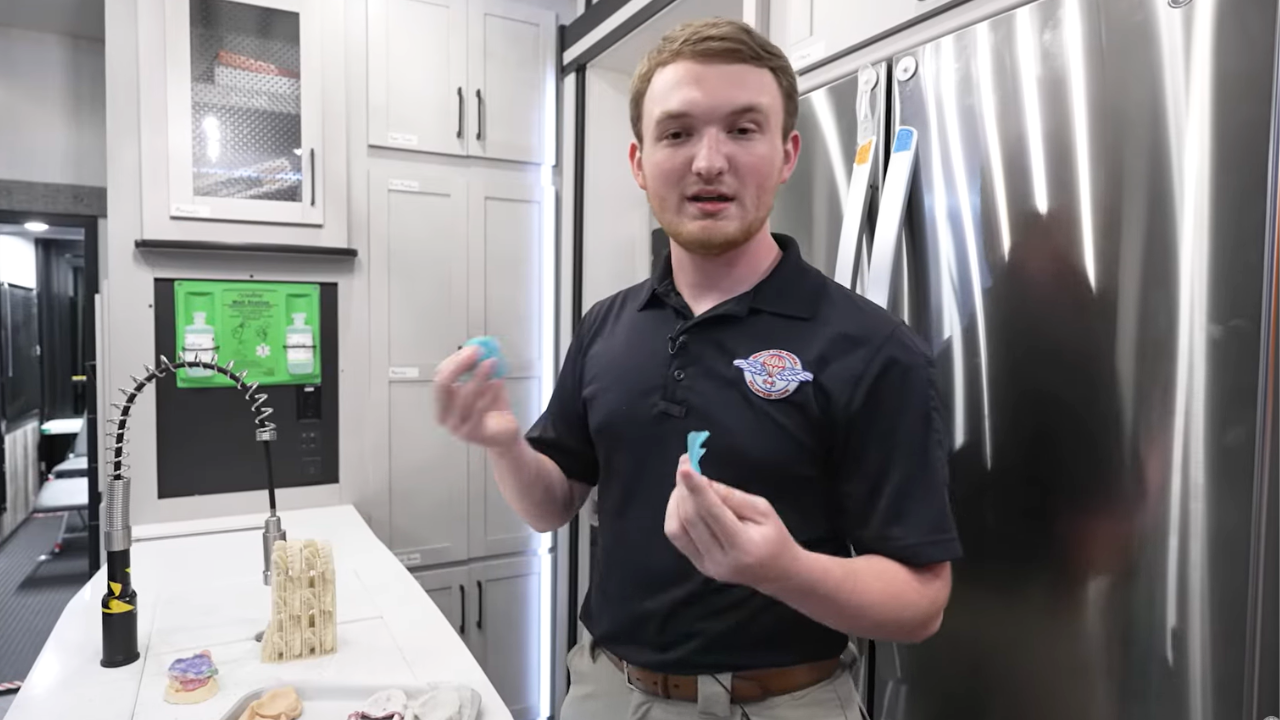
- Point-of-Care Additive Manufacturing: Deploying ruggedized, mobile 3D printers directly inside a mobile vehicle or field lab. Utilizing biocompatible photopolymer resins, these units print completely functional, custom-fitted dentures on-site.
This structural shift bypasses the traditional sub-assembly loops of the dental industry. The primary bottleneck in humanitarian dental missions has never been a lack of volunteer clinical staff; it has been the physical turnaround time of laboratory manufacturing. By collapsing the lab into a mobile trailer, the field clinic transforms from a diagnostic screening center into a vertically integrated production facility.
The Cost Function and Operational Bottlenecks of Traditional vs. Digital Workflows
To understand why traditional systems fail the underinsured, one must analyze the total cost function of fabrication. Traditional manufacturing is heavily weighed down by labor, logistics, and material overhead.
Conventional Cost = (Clinical Chair Time × 5 Visits) + (Lab Technician Labor) + (Logistics & Shipping) + (Material Waste)
In contrast, the digital cost function optimizes for both time and material:
Digital Cost = (Clinical Chair Time × 1 Visit) + (Digital Design Time) + (Raw Resin Volume)
The primary economic leverage point is the reduction of clinical chair time. In a standard dental practice, a patient must return for initial impressions, final impressions, bite registration, a wax try-in, and final delivery. For a patient relying on a weekend humanitarian pop-up clinic, a multi-week, multi-visit protocol is logistically impossible.
The digital workflow introduces a different set of production boundaries, however. In a single-weekend clinic, the system faces severe throughput constraints. The manufacturing limit is governed by the physical print speed of the 3D printers, the curing time of the biocompatible resins, and the design capacity of the technician. Under optimal conditions, a single operator managing a fleet of mobile printers running 24 hours a day faces a hard ceiling. For example, during a peak operational weekend, the maximum throughput achieved under this model stands at roughly 35 completed prostheses. This throughput is explicitly bound by the print bed surface area and the UV-curing cycles required to ensure the biocompatibility and structural integrity of the final product.
Root Causes of Systemic Failure in Adult Prosthodontics
The immense demand seen at mobile health screenings—where patients frequently wait in line overnight—stems from specific structural failures within the broader medical economy.
First, dental care is treated as an isolated, elective luxury rather than an integrated component of systemic health. Edentulism (complete tooth loss) triggers a compounding series of biological and economic failures. The loss of masticatory function forces a shift toward cheap, highly processed, carbohydrate-heavy diets, which directly accelerates metabolic diseases, type 2 diabetes, and systemic inflammation.
Second, the labor pool for traditional dental laboratory technicians is shrinking, driving up commercial lab fees. Traditional denture fabrication is a artisanal craft requiring years of technical training in wax rim manipulation, tooth positioning, and acrylic flasking. As fewer technicians enter the field, the cost of commercial laboratory services rises, pushing retail prices further out of reach for low-income consumers.
Digital workflows alter this equation by decoupling the manufacturing process from manual artisan skill. An engineer or technician using digital design software can master the structural parameters of dental anatomy through intensive, software-specific training, bypassing the traditional multi-year laboratory apprenticeship.
Systemic Limitations and Technical Risk Factors
While point-of-care 3D printing offers an elegant solution to the deployment bottleneck, scaling the model introduces distinct technical risks and operational constraints.
- Material Longevity vs. Milled PMMA: Printed dentures utilize photopolymer resins cured via light polymerization. While these materials are highly accurate, they historically exhibit lower impact strength and higher wear rates compared to industrially cured polymethyl methacrylate (PMMA) discs used in high-end commercial milling machines.
- Anatomical Adaptation and Ridge Resorption: Patients who have been edentulous for years undergo severe alveolar ridge resorption (the shrinking of the jawbone). Designing functional dentures for highly resorbed ridges requires advanced clinical troubleshooting that standard digital design software algorithms cannot fully automate.
- Post-Processing Infrastructure: A 3D-printed denture cannot go straight from the print bed into a patient's mouth. It must undergo isopropyl alcohol washes to remove uncured monomer, followed by precise thermal and UV post-curing cycles. Any deviation in post-processing threatens the chemical stability of the device, risking patient exposure to residual unreacted monomers.
- Infrastructure Dependability: Operating a high-tech digital lab out of a mobile trailer requires stable electrical power, climate control to maintain resin viscosity, and clean environments to prevent dust contamination during the printing process. Grid failures or generator fluctuations at rural field sites present a constant threat to production continuity.
Strategic Play: Scalable Decentralization
To move this model from an exceptional weekend feat to a predictable, repeatable healthcare delivery system, the operation must transition from a centralized technician model to an asynchronous, hub-and-spoke production network.
The immediate tactical play requires separating the physical patient interface from the digital design environment. Mobile field clinics should focus entirely on high-throughput intraoral data collection and final delivery. The captured 3D structural files should be instantly uploaded via satellite uplink to a distributed network of remote digital designers.
By removing the design bottleneck from the field trailer, the on-site team can dedicate 100 percent of local hardware capacity to raw manufacturing and post-processing. This shift maximizes print-bed utilization rates and increases weekend clinic throughput exponentially, transforming a localized engineering triumph into a highly scalable template for public health intervention.