The air in Beijing during the early hours of the half-marathon was crisp, the kind of cold that bites at a runner’s lungs and turns every exhale into a ghostly plume. Thousands of human hearts were thumping in unison, a collective drumbeat of adrenaline and nerves. But among the sea of Lycra and carbon-plated shoes, one participant felt nothing. No pre-race jitters. No burning in the quads. No desperate need for a gel pack at mile ten.
His name—if you can call a serial number a name—is Tiangong.
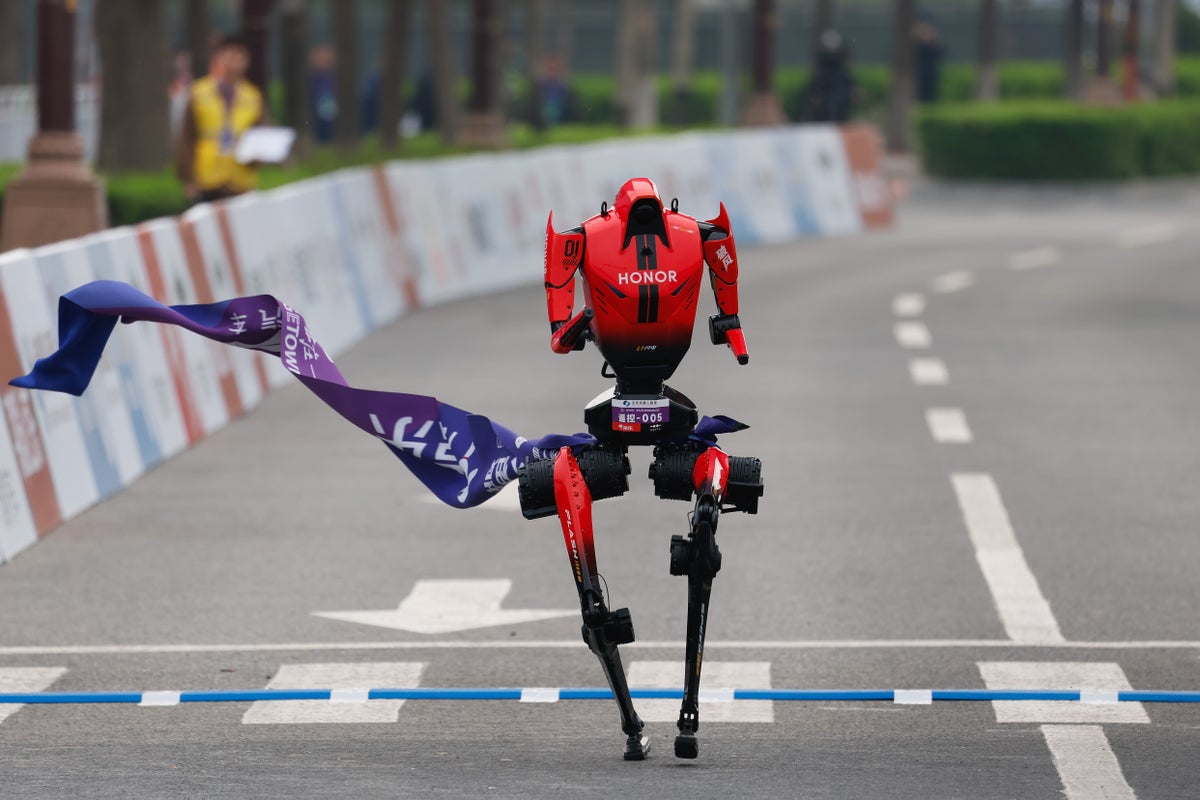
He is a humanoid robot developed by the Beijing Humanoid Robot Innovation Center. On this particular morning, he wasn't just a lab experiment or a tech demo gathering dust in a silicon valley showroom. He was a competitor. When the starting gun cracked, he moved. Not with the fluid, graceful stride of an Olympian, but with a rhythmic, relentless clatter of actuators and sensors.
By the time he crossed the finish line, the clock showed one hour, five minutes, and 22 seconds.
It was a world record for a humanoid robot. More importantly, it was a moment that shifted the ground beneath our feet. For decades, we have viewed the marathon as the ultimate expression of human endurance, a battle of will against biology. Now, the biology is optional.
The Ghost in the Machine
To understand why a 1:05:22 half-marathon matters, you have to look past the titanium limbs. Most robots are specialists. We have machines that can flip pancakes with surgical precision and others that can weld car chassis until the sun goes down. But running is different. Running is a chaotic, vertical dance of controlled falling.
Every time a human foot hits the pavement, the brain processes a dizzying array of data: the slope of the asphalt, the slickness of a stray puddle, the subtle shift in wind resistance. We do this subconsciously. For a machine, this is a mathematical nightmare.
Tiangong stands roughly 163 centimeters tall and weighs about 43 kilograms. He is light, but he is dense with computation. During the race, his onboard "brain" was performing trillions of calculations per second just to keep from toppling over. Imagine trying to balance a broomstick on your finger while sprinting through a crowd. Now imagine you are the broomstick, and you have to balance yourself.
The engineers didn't just program a "running" mode. They taught him to perceive. Using high-precision Vision Sensors and Inertial Measurement Units (IMUs), Tiangong adjusted his torque and stride length in real-time. He wasn't just following a script. He was reacting to the world.
The Loneliness of the Long Distance Robot
There is a specific kind of suffering that happens around mile nine of a half-marathon. Your glycogen stores are cratering. Your brain starts screaming at you to stop. This is the "human element" we celebrate—the grit.
Watching Tiangong, there is a strange, unsettling absence of that struggle. He reached a top speed of 12 kilometers per hour. To a pro runner, that’s a comfortable training pace. To a machine, it is a triumph of stability. But as he moved past human runners, there was no heavy breathing. No sweat stinging his eyes.
Consider a hypothetical runner named Chen. Chen has trained for six months for this race. He’s managed his macros, bought the $300 shoes, and sacrificed his Saturday mornings. At mile twelve, Chen is in a dark place. He looks to his left and sees a faceless hunk of metal gliding along at a perfect, unchanging cadence.
The machine isn't trying to beat Chen. It doesn't even know Chen exists. It is simply executing a series of commands designed to optimize center-of-mass trajectory. That indifference is what makes the feat so haunting. It’s not that the robot is better than us yet; it’s that it doesn't care about the victory.
A History of Moving Parts
This isn't the first time we’ve seen a robot try to run, but it is the most convincing. We’ve come a long way from the early 2000s, where humanoid robots were slow, clunky boxes that fell over if they encountered a stray power cord.
The evolution has been exponential.
- 2000s: Robots like ASIMO could walk, but running involved "flight phases" that usually ended in a heap of expensive scrap metal.
- 2010s: Boston Dynamics introduced Atlas, showing us that robots could do parkour and backflips in controlled environments.
- 2024-2026: We entered the era of general-purpose humanoids. Tiangong is part of a new wave—machines designed to operate in the same spaces we do, using the same tools we use.
The half-marathon record is a benchmark. It proves that the "actuator gap"—the difference between a mechanical motor and a human muscle—is closing. Human muscles are incredibly energy-efficient and capable of explosive power. Historically, motors were either strong and heavy or light and weak. Tiangong’s "electric-only" drive system manages to find a middle ground, pushing 43 kilograms of frame at a clip that would leave most weekend warriors in the dust.
The Invisible Stakes
Why do this? Why build a machine to run 13.1 miles? It’s not about the medals.
The real goal is much more utilitarian. If a robot can navigate the unpredictable terrain of a public road race, it can navigate a disaster zone. It can walk through a collapsed building where the floor is uneven and covered in debris. It can climb stairs in a nursing home to deliver medicine. It can move through a world built for humans, by humans, without requiring us to rebuild that world to accommodate wheels.
But there is a secondary, perhaps more profound, implication. We are witnessing the birth of a new kind of companionship—or competition.
If we can bridge the gap in movement, the gap in utility follows quickly behind. The Beijing Humanoid Robot Innovation Center isn't just looking for a trophy. They are open-sourcing parts of Tiangong’s software and hardware architecture. They want a world where these machines are ubiquitous.
The record in Beijing—one hour and five minutes—is fast. For context, the human world record for a half-marathon is 57:30, set by Yomif Kejelcha. Tiangong is still roughly eight minutes behind the fastest human on Earth.
Eight minutes.
In the world of technology, eight minutes is a blink of an eye. Two years ago, these machines could barely trot for a hundred meters. Today, they are finishing half-marathons. Tomorrow, they will be faster. They won't need to taper their training. They won't get shin splints. They will simply receive a software update that optimizes their ankle flick by 2%, and suddenly, the human record will be a relic of the past.
The Finish Line
When Tiangong crossed the finish line in Beijing, there was no jubilant celebration. He didn't collapse into the arms of a coach. He didn't wrap himself in a national flag. He simply slowed to a halt, his cooling fans whirring quietly against the morning air.
The spectators cheered, but there was a flicker of something else in their eyes. Curiosity? Sure. But also a quiet realization.
We have always defined ourselves by our physical limits. We are the species that runs. We are the persistence hunters who outlasted the mammoth. Now, we have created something that doesn't need to persist because it never tires.
As the sun rose higher over Beijing, the human runners continued to trickle in. They were exhausted, salt-stained, and triumphant. They felt the ache in their bones and the surge of endorphins that comes with pushing a biological machine to its breaking point.
Tiangong stood nearby, powered down, his sensors dark. He had the record, but he missed the point of the race entirely.
The tragedy of the perfect runner is that it can never understand the joy of the finish line. It only understands that the task is complete. We are still the only ones who know what it means to be tired, and for now, that is the one thing the machine cannot take from us.
The pavement was still cold. The metal was silent. The race was over, but a much longer journey had just begun.