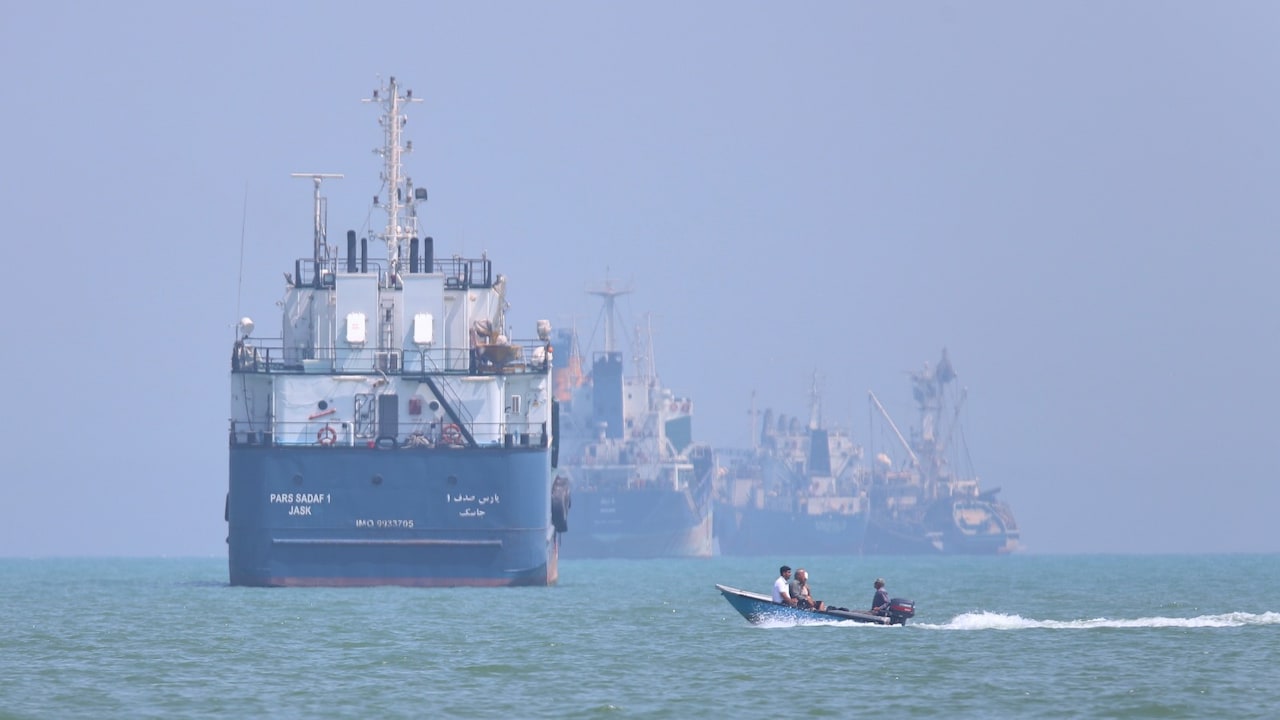
The coffee in a ship’s galley is always too hot or too stale. On a fully laden crude carrier drawing nineteen meters of water in the Strait of Hormuz, nobody complains about the coffee. They drink it out of habit, eyes fixed on the gray-green horizon where the cliffs of Oman meet the hazy sky of Iran.
To the rest of the world, this stretch of water is a statistic. It is twenty-one miles wide at its narrowest choke point. It is the transit route for a fifth of the world’s liquid petroleum. It is a line on a map that dictates the price of a gallon of gasoline in Ohio or the cost of running a factory in Yokohama.
But if you are standing on the bridge of a three-hundred-meter tanker, the Strait is not a statistic. It is a tightening in the chest. It is the knowledge that beneath your boots lie two million barrels of highly volatile energy, and beneath the hull lies an unpredictable floor of geopolitical friction.
Then comes the flash.
The Sound of Two Worlds Colliding
The United Kingdom Maritime Trade Operations agency issued the alert with its usual clinical brevity. An unidentified vessel, hit by an unknown missile. No claims of responsibility. No immediate declarations of war. Just a coordinate, a time stamp, and a plume of black smoke rising into the humid Gulf air.
When a missile strikes an oil tanker, the sound is the first thing that betrays the senses. It is not the clean, cinematic explosion of Hollywood. It is a dull, metallic shudder that vibrates through the soles of the crew’s shoes before the noise even registers in their ears. The steel of a supertanker is thick, but against modern ordnance, it feels as fragile as an eggshell.
Imagine a hypothetical third mate named Mikhail. He is twenty-four, from a quiet port city on the Black Sea, working a six-month contract to send money back to his mother. When the hull shudders, he does not think about global energy security. He does not think about international maritime law or the shifting alliances of the Middle East. He thinks about the fire main pressure. He thinks about whether the watertight doors behind the engine room held.
The immediate aftermath of an attack at sea is defined by an eerie, frantic focus. The alarm bells ring, a mechanical wail that competes with the roar of the ventilation systems. Crew members don their heavy fire-fighting suits in temperatures hovering near forty degrees Celsius. Their breath rattles inside their masks. Every person on board knows that if the fire reaches the cargo tanks, there will be no rescue. There will only be a column of flame visible from space.
This is the human reality behind the news ticker. The world sees a spike in Brent crude futures. The men on board see a wall of smoke and a long way home.
The Choke Point Illusion
We like to believe the modern economy is a digital, weightless thing. We trade currencies on invisible networks and buy goods with the tap of a thumb. But the physical world remains stubborn, heavy, and remarkably vulnerable.
The Strait of Hormuz is the ultimate proof of this vulnerability. It is a geographical funnel through which the lifeblood of industrial civilization must flow. On one side lies the Arabian Peninsula, on the other, Iran. The shipping lanes themselves—the actual highways used by these massive vessels—are only two miles wide in each direction, separated by a two-mile buffer zone.
Navigating it is an exercise in high-stakes precision during peacetime. When the region grows tense, it becomes a psychological gauntlet.
Consider the mechanics of a modern tanker. These are not nimble craft. A fully loaded Very Large Crude Carrier can take miles to come to a complete stop even if the engines are thrown into full reverse. They cannot dodge an incoming projectile. They cannot hide. On a radar screen, they appear as massive, slow-moving targets, glowing brightly against the dark backdrop of the sea.
When an unknown missile finds its mark, it shatters the illusion of safety that keeps global trade moving. Ship owners look at the map and recalculate risk. Insurance underwriters in London pick up their phones and rewrite premiums. A single piece of flying metal can add hundreds of thousands of dollars to the cost of a single voyage within an hour.
But the economic math always trickles down to the individual human beings who have to walk the deck.
The Geography of Anxiety
The mystery of the strike is perhaps the most corrosive element of the entire event. When a state actor claims an attack, there is a protocol, however grim. There are diplomatic channels, retaliatory postures, and predictable escalations.
An unknown missile, however, creates a vacuum of accountability. It breeds a specific kind of paranoia among the mariners who ply these waters. Was it a drone launched from a hidden coastal cove? A sea-skimming missile fired from a rogue fast-attack craft? Or a tragic case of mistaken identity in an increasingly crowded electromagnetic environment?
The sea hides its secrets well, and the initial reports from maritime agencies rarely offer comfort. They offer only warnings. Exercise extreme caution. Maintain a vigilant lookout. Report any suspicious activity.
For the crews of the dozens of tankers lined up to enter the Gulf, those warnings translate into sleepless nights. They stand watch on the wings of the bridge, scanning the dark water with night-vision binoculars, looking for the telltale wake of a small boat or the sudden flare of a rocket motor. The ocean at night is vast and black, but in the Strait, every shadow looks like a threat.
The industry calls this an asymmetric threat. A group with a weapon worth a few thousand dollars can effectively paralyze or severely disrupt a vessel worth a hundred million dollars, carrying a cargo worth twice that. It is an imbalance that defies conventional military logic.
The Ripple on the Shore
The true impact of an attack in the Strait of Hormuz behaves like a stone dropped into a still pond. The splash occurs in the Gulf, but the ripples expand until they wash up on shores thousands of miles away.
Within hours of the UK Maritime Trade Operations alert, the machinery of global commerce began its adjustment. The numbers on screens in Singapore, New York, and London shifted. These are the abstract expressions of fear.
But let us follow those numbers to their logical conclusions.
In a manufacturing town in Germany, a factory manager looks at the rising cost of energy inputs and wonders if he needs to cut the evening shift. In a farming community in India, a tractor driver watches the price of diesel creep upward, knowing it will eat into the razor-thin margin he relies on to feed his family.
We are all connected to the Strait of Hormuz by an invisible cord of oil and gas. When someone pulls on that cord with a missile strike, the tension is felt everywhere. The global supply chain is not a machine; it is a living, breathing ecosystem that responds instantly to trauma. And an attack on a tanker is a profound trauma to the system.
Yet, the ships keep coming. They have to.
The Reluctant Sentinels
There is an old maritime saying that the water finds every leak. In the modern world, conflict finds every vulnerability.
As the damaged tanker is towed toward a safe anchorage, its hull scorched and its crew exhausted but alive, another vessel enters the Strait. Its captain will have read the same alerts. The crew will have seen the smoke on the horizon. They will know that the water they are entering is, for now, an active zone of hostility.
They will press on regardless. The world's appetite for energy does not pause for a investigation, and the contracts that govern these voyages leave little room for hesitation.
The true story of the Strait of Hormuz is not found in the statements issued by governments or the analysis of defense experts. It is found in the quiet resolve of the merchant mariners who continue to steer these colossal islands of steel through the narrow gaps of geography and politics. They are the reluctant sentinels of our modern life, keeping the lights on in cities they will never visit, risking everything for a livelihood that grows more precarious with every passing flash of light on the horizon.
The gray-green cliffs of Oman remain silent as the next tanker approaches the turn.