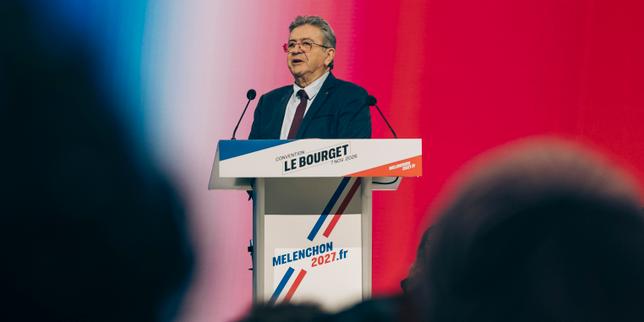
When Jean-Luc Mélenchon stepped onto the stage in Le Bourget on November 7, 2026, to outline his foreign policy vision for France’s 2027 presidential election, he ignited a political firestorm that quickly spiraled beyond diplomatic strategy. Within days, the leader of La France Insoumise (LFI) found himself fending off accusations from Paris to Kyiv that he was parroting Kremlin talking points. His counteroffensive was blunt. Speaking in the Creuse department on November 11, Mélenchon accused the French media and political rivals of having "rigged his words" (truqué ses paroles).
The clash exposes far more than a routine campaign spat. It reveals a calculated communication strategy designed to insulate LFI’s non-aligned doctrine from mainstream scrutiny while fracturing the French left ahead of 2027. By turning a substantive dispute over international law and military occupation into a referendum on media integrity, Mélenchon attempted to shift the battlefield from the ruins of eastern Ukraine to the familiar terrain of domestic populist grievance.
What Was Actually Said at Le Bourget
To understand why the backlash was so swift, you have to look at the exact mechanics of Mélenchon’s November 7 speech. Addressing thousands of supporters, the LFI founder pledged that, if elected president, he would enter "frankly into the settlement of the Russian invasion of Ukraine". He framed his stance around two core pillars: mutual security guarantees across all European nations, including Russia, and a strict refusal to accept territorial concessions decided solely from above by world powers.
Then came the flashpoint. Mélenchon declared that his movement would not accept peace terms involving border changes "without asking the populations concerned whether they agree to be on this side of the border or the other". He went further, denouncing what he called the complacency of political elites who forget "the rights of the population of Donbas, who have the right to know whether they want to be Ukrainian or Russian, if the question is posed in an agreement between the two nations".
The reaction was immediate and ferocious. Foreign Minister Jean-Noël Barrot went on RTL radio to accuse Mélenchon of acting as "quite simply the spokesperson for the Kremlin," arguing that Moscow spends immense energy trying to convince world leaders that Donbas is fundamentally Russian. Barrot declared that Mélenchon had "permanently disqualified himself" from the presidency.
Simultaneously, Raphaël Glucksmann, the Socialist Party and Place Publique contender for 2027, accused Mélenchon on BFMTV of reciting "in an absolute manner the talking points provided by the Kremlin for years and years". Former President François Hollande piled on via X, comparing Mélenchon’s stance to Donald Trump’s approach—an arrangement with Moscow resulting in Vladimir Putin’s absorption of eastern Ukraine.
Kyiv did not stay silent either. Gueorguiï Tykhy, spokesperson for Ukraine’s Ministry of Foreign Affairs, pointed out that Ukrainians had already settled their borders during the December 1991 independence referendum, when over 90 percent of voters—including majorities in every region of Donbas—backed an independent Ukraine within its internationally recognized borders. Referendums held under military occupation, Tykhy noted, are tools of annexation, not expressions of popular will.
The Anatomy of the Media Accusation
Four days after Le Bourget, standing before the pacifist war memorial in Gentioux-Pigerolles and later at a rally in La Souterraine, Mélenchon executed a classic rhetorical pivot. Rather than conceding any ambiguity in his formulation, he blamed the press. "We must stop rigging everyone's words, otherwise we no longer understand each other, we can no longer speak," he told the crowd. On Facebook, he went even further, questioning whether an external directive had instructed newsrooms to lie about his statements.
This is not an improvised defense. Throughout his career, Mélenchon has treated mainstream media hostility not as an occupational hazard, but as structural proof of his anti-establishment credentials. When journalists and opponents zeroed in on his call to consult the Donbas population, LFI’s communication apparatus argued that the press had deliberately stripped away the conditional framing of his remarks.
According to Mélenchon’s defense, he never endorsed Russia’s sham 2022 annexation referendums. His starting premise, reiterated in subsequent press briefings, is that Ukraine’s borders are not open to discussion. The proposed consultation of local populations, his camp insists, would only apply if a negotiated peace treaty between Kyiv and Moscow already envisioned altering borders—a direct critique of diplomatic proposals floated in late 2025 by Washington and European capitals that allegedly entertained top-down territorial compromises.
Where the Defense Breaks Down
The problem with claiming your words were rigged is that video recordings exist. Critics did not invent the phrase "the rights of the population of Donbas, who have the right to know whether they want to be Ukrainian or Russian". Nor did newsrooms fabricate what was conspicuously absent from the Le Bourget speech.
As analysts and even sympathetic observers quickly noted, Mélenchon spoke at length about consulting Donbas residents without mentioning a prerequisite withdrawal of Russian occupation forces. In international law and basic political reality, that omission is fatal.
Consider the demographic and security facts on the ground in Donetsk and Luhansk—the two oblasts comprising Donbas:
- Massive depopulation: Prior to 2014, Donbas was home to more than 7 million people. According to estimates cited by political scientist Anna Colin Lebedev of Paris-Nanterre University, at least half of that population has vanished due to war, displacement, and death.
- Systematic cleansing of pro-Ukrainian voices: Residents loyal to Kyiv have largely been killed, imprisoned in Russian detention facilities, or forced to flee to government-controlled Ukraine or abroad. Meanwhile, Moscow has actively repopulated occupied cities with Russian citizens and bureaucrats.
- Absence of civic infrastructure: Conducting a legitimate plebiscite requires free press, independent observers, opposition parties, and physical safety for voters. Under Russian military administration, publicly advocating for Ukrainian sovereignty carries severe prison sentences or worse.
By framing the issue around whether current residents of Donbas want to be Russian or Ukrainian, Mélenchon’s rhetoric implicitly validated the demographic engineering achieved by twelve years of Russian military aggression. Even within LFI’s own written program, L’Avenir en commun, the wording refers more broadly to a "vote of the populations concerned"—a deliberately elastic phrase that leaves unanswered whether displaced refugees from 2014 and 2022 would be included, or whether Ukraine’s constitution, which requires a nationwide referendum for any territorial change, would be bypassed entirely.
Why This Fracture Threatens the Left in 2027
In previous election cycles, LFI could weather foreign policy controversies by rallying the broader left around domestic socioeconomic grievances. Ahead of 2027, that firewall has collapsed.
The backlash against Mélenchon’s Ukraine remarks did not come exclusively from government ministers or centrist rivals. It erupted inside the French left itself, exposing an ideological chasm that makes a repeat of the 2022 NUPES coalition or the 2024 New Popular Front extraordinarily difficult.
When Mediapart co-founder Edwy Plenel—hardly a tool of the Macronist establishment—shared a stinging communiqué from the European Network for Solidarity with Ukraine (RESU) dismantling Mélenchon’s Donbas proposal, it signaled a turning point. The critique from the pro-Ukrainian left was surgical: invoking the "right of peoples to self-determination" inside an active military occupation turns an emancipatory principle into an alibi for imperial conquest.
For Raphaël Glucksmann, whose entire 2027 candidacy is built on European strategic autonomy, robust support for Kyiv, and a clean break from LFI’s geopolitical ambiguity, Mélenchon’s speech was a gift. Following the inconclusive left-wing primary debates in September and October 2026, Glucksmann and Socialist figure Jérôme Guedj have categorically ruled out any electoral alliance with La France Insoumise. Ukraine is no longer a secondary policy disagreement; it has become the primary moral litmus test dividing social democrats from Mélenchon’s movement.
The Strategic Logic Behind Mélenchon’s Stubbornness
A seasoned observer of French politics knows that Jean-Luc Mélenchon rarely makes accidental rhetorical blunders. Every word at Le Bourget was weighed against a specific electoral calculation for 2027.
First, Mélenchon is betting on war fatigue. As the conflict in Ukraine grinds into its fifth year following the 2022 full-scale invasion—and as diplomatic talks in Abu Dhabi sputter while Russian bombardments continue—a significant segment of the French electorate is anxious about escalation, defense spending, and economic blowback. By positioning himself as the uncompromising candidate of peace who flatly refuses direct French military involvement against Russia, Mélenchon is speaking directly to anti-war voters who feel unrepresented by the consensus in Paris and Brussels.
Second, he is competing directly with Marine Le Pen and the Rassemblement National for working-class and peripheral voters who view NATO and European Union foreign policy with deep skepticism. In late November 2026, while Emmanuel Macron was attacking Le Pen for wanting to halt aid to Ukraine, Mélenchon sought to occupy the anti-interventionist space from the left—framing his stance not as submission to Moscow, but as Gaullist-style non-alignment paired with internationalist principles.
Third, attacking the media serves as an essential mobilization tool for LFI’s base. When party activists go door-to-door distributing campaign literature, they need a simple counter-narrative when confronted with headlines calling their leader a Kremlin stooge. Telling supporters that corporate journalists deliberately distorted a nuanced peace proposal transforms defensive embarrassment into righteous indignation.
The Cost of Post-Truth Campaigning
Yet this strategy carries a severe structural risk for 2027. By crying "media manipulation" every time his own verbatim quotes generate blowback, Mélenchon erodes his credibility with the exact sliver of moderate, undecided voters he would need to reach a presidential runoff—let alone win one.
Voters do not need an editorial board to spot the contradiction between defending national sovereignty and proposing territorial plebiscites under the shadow of an invading army. Nor do they miss the irony of a candidate who champions international law while dismissing the 1991 Ukrainian referendum that already settled the legal status of Donbas.
In 2022, Mélenchon came within roughly 420,000 votes of reaching the second round of the presidential election. Five years later, the geopolitical environment has hardened, and the margin for rhetorical sleight of hand has vanished. Blaming journalists for quoting a public speech accurately may rally the faithful in La Souterraine, but it cannot erase the record from Le Bourget—or bridge a left that has fundamentally split over what solidarity actually means when borders are redrawn by force.