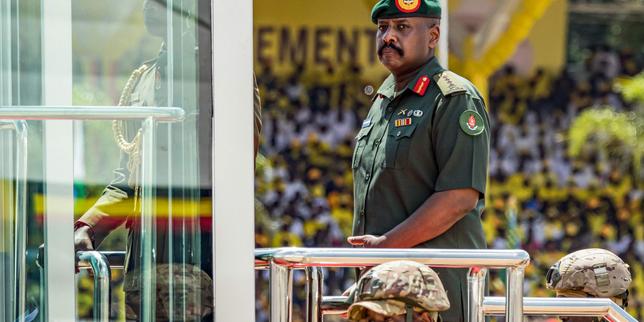
Independent media operations in hybrid regimes face a predictable, structural bottleneck: the state’s transition from legal harassment to physical asset seizure when narrative control threatens regime survival. The ongoing military encirclement of the Daily Monitor, Uganda’s primary independent media outlet owned by the Nation Media Group (NMG), represents a calculated economic and operational shutdown rather than a random act of censorship. By deploying the military to physically occupy printing presses and editorial offices, the state bypasses prolonged judicial processes to achieve immediate information containment.
Understanding this dynamic requires breaking down the state-press conflict into structural pillars. Regimes balance the international cost of overt censorship against the domestic risk of unchecked reporting. When internal intelligence suggests a critical threshold of public unrest is near, the cost-benefit analysis shifts, making military intervention the preferred tool for systemic containment.
The Three Pillars of State-Imposed Operational Friction
State intervention against independent journalism operates on three distinct levels, moving from low-cost bureaucratic hurdles to high-cost physical disruptions.
1. Statutory and Regulatory Compulsion
The first line of containment involves tax audits, licensing delays, and local regulatory non-compliance notices. These levers create a baseline level of operational friction, draining financial resources through legal defense fees and administrative delays. This step allows the state to maintain a veneer of rule-of-law compliance while systematically weakening the media house’s balance sheet.
2. Digital and Financial Strangulation
When statutory pressure fails to alter editorial policy, the mechanism shifts to economic deprivation. The state restricts government advertising—frequently the largest revenue stream for domestic media houses—and exerts pressure on private corporations to withdraw sponsorship. Concurrently, digital infrastructure faces targeted throttling, DDoS attacks, or outright internet blackouts to limit the reach of critical digital reporting.
3. Physical Asset Seizure and Operational Paralysis
The final and most disruptive pillar is direct kinetic intervention. By physically occupying printing facilities and newsrooms, the state targets the core physical distribution network. For a legacy print operation, an interruption in the physical print run causes immediate, unrecoverable revenue losses from circulation and daily advertising slots, while fixed overhead costs remain constant.
The Economics of Narrative Containment
To understand why the Ugandan military targets the physical infrastructure of the Daily Monitor, one must analyze the economic cost function of independent media survival.
Independent media houses operate on high fixed costs (printing presses, distribution fleets, specialized editorial staff) and variable revenues (newsstand sales, real-time programmatic advertising). A military blockade creates an artificial operational halt.
The financial damage of a 24-hour physical shutdown can be modeled by analyzing the immediate loss of circulation revenue combined with contractual penalties for unpublished advertisements. Because print advertising is tied to specific publication dates, missing a single print run nullifies the revenue for that day entirely; it cannot be recouped by printing double the volume the following day. Meanwhile, fixed operational costs—such as staff salaries, newsprint storage, and building leases—continue to accumulate.
This creates an unsustainable cash burn rate. The state uses this economic pressure to force management into structural compromises, such as firing specific investigative journalists or issuing public retractions, as a condition for removing the blockade.
Operational Countermeasures for Independent Media Risk Mitigation
When a media entity faces physical encirclement, standard crisis management protocols are insufficient. Survival depends on pre-engineered operational redundancies designed to decentralize editorial power and preserve revenue-generating capabilities.
Decentralized Cloud Infrastructure
Independent newsrooms must decouple their content management systems (CMS) and digital publishing engines from physical newsrooms. If editorial staff are locked out of their primary offices, the digital publication pipeline must remain functional via secure, distributed cloud networks hosted in neutral jurisdictions.
Redundant Print and Distribution Networks
For print-dependent business models, relying on a single centralized printing press creates a single point of failure. Media conglomerates must establish reciprocal printing agreements with secondary commercial printers or regional partners. If the primary press is seized, layout files can be rerouted securely to alternative facilities, preserving the physical distribution network.
Transition to Multi-Platform Digital Delivery
Because physical distribution is highly vulnerable to military checkpoints, media houses must aggressively build out diversified digital delivery channels. This includes encrypted mobile applications, peer-to-peer distribution networks, and decentralized content delivery networks (CDNs) that can bypass national firewalls and local internet blockades.
Strategic Asset Realignment
The tactical reality for the Nation Media Group and similar independent media syndicates in East Africa is that the traditional print-first business model is an existential liability under authoritarian pressure. Physical assets are easy targets for state security apparatuses looking to choke off dissent.
Media executives must immediately shift capital allocation away from heavy physical infrastructure and toward decentralized digital architectures. This requires transforming the newsroom from a localized physical asset into a distributed global network. Editorial talent must be equipped to operate remotely using end-to-end encrypted communication channels, while server infrastructure must leverage edge computing to prevent centralized shutdowns. Only by eliminating physical vulnerabilities can an independent media house survive the economic and kinetic friction imposed by a hostile state.