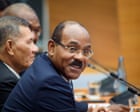
The re-election of Prime Minister Gaston Browne and the Antigua and Barbuda Labour Party (ABLP) for a third consecutive term—marking a potential twelve-year stretch of governance—is not a consequence of mere political popularity but the result of a calculated mastery of the small island developing state (SIDS) economic model. While general media narratives focus on "winning streaks," a rigorous analysis reveals that the ABLP’s dominance rests on three structural pillars: the weaponization of the Citizenship by Investment Program (CIP) as a primary fiscal engine, the strategic management of the public sector as an employment buffer, and the fragmentation of the opposition’s demographic reach.
The Fiscal Engine: Citizenship by Investment and Capital Flow
The survival of the Browne administration depends on the efficiency of the Citizenship by Investment Program. In a jurisdiction with limited natural resources and a volatile tourism sector, the CIP serves as the primary mechanism for non-tax revenue generation. This creates a specific feedback loop: the government requires high-speed capital to fund infrastructure projects which, in turn, justify the administration's "pro-growth" branding.
The 2023 electoral success was underpinned by the government’s ability to maintain liquidity despite global inflationary pressures. By positioning Antigua and Barbuda as a premier destination for high-net-worth individuals, the ABLP secured the funds necessary to subsidize utility costs and expand social safety nets—actions that correlate directly with voter retention in lower-income constituencies. The limitation of this strategy is its extreme sensitivity to international regulatory shifts. If the European Union or the United Kingdom implements stricter visa-free travel restrictions for CIP passport holders, the ABLP’s primary lever for economic stability will be compromised, leading to a rapid erosion of the domestic social contract.
The Employment Buffer: Public Sector Dependency
The ABLP’s grip on power is further solidified by the structure of the national labor market. In Antigua and Barbuda, the public sector is the largest employer. This creates a functional "incumbency advantage" where a significant portion of the electorate views their economic survival as intertwined with the continuity of the current administration.
This relationship is defined by two primary variables:
- Direct Employment Stability: Civil service positions and statutory body roles provide a level of security that the private tourism sector—subject to seasonal fluctuations and global health crises—cannot match.
- Infrastructure Spending as Job Creation: By prioritizing large-scale projects, such as the expansion of the VC Bird International Airport and port redevelopment, the government creates a temporary but high-visibility surge in construction jobs during election years.
The United Progressive Party (UPP), the primary challenger, struggled to overcome this structural barrier. Their platform, which emphasized fiscal reform and the reduction of government waste, was perceived by some as a threat to the very employment security that the ABLP had fostered through deficit spending. The UPP’s failure to provide a credible alternative for large-scale employment meant their message of "change" carried a high perceived risk for the average worker.
Demographic Fragmentation and the Rural-Urban Divide
An analysis of the 2023 voting patterns shows a deepening fracture in the Antiguan electorate. The ABLP’s victory was achieved with a significantly narrowed margin, indicating that their structural advantages are beginning to face diminishing returns. The ABLP maintains a stronghold in rural constituencies where traditional social networks and "parish politics" are most effective. In contrast, the UPP and the Barbuda People’s Movement (BPM) have gained ground in urban centers and on the sister island of Barbuda.
The Barbuda situation represents a specific failure of the ABLP's centralizing logic. The government’s push to move from communal land ownership to a private titles system—aimed at facilitating luxury tourism development—created a fundamental ideological rift. While the Browne administration views land privatization as a prerequisite for modernizing the economy, the local population views it as a dispossession of their historical rights. The BPM’s dominance in Barbuda is a direct reaction to this "growth at all costs" model.
The Cost Function of Governance
The Browne administration operates under a high cost of governance. To maintain its majority, it must continuously increase its output in three areas:
- Subsidies: Keeping water and electricity rates artificially low to offset the lack of a diverse energy grid.
- Debt Servicing: Managing the high debt-to-GDP ratio incurred from infrastructure loans, primarily from bilateral partners.
- Bureaucratic Expansion: Creating new administrative roles to satisfy the demands of a growing supporter base.
This creates a bottleneck. As the cost of maintaining the status quo rises, the government has less capital available for genuine innovation in sectors like AgTech or renewable energy. The 2023 election results, where the ABLP lost several seats and retained power by a slim majority, suggest that the electorate is beginning to weigh the benefits of these short-term subsidies against the long-term stagnation of the national debt.
Structural Weaknesses in the Opposition Framework
The UPP’s inability to unseat the ABLP, despite a favorable environment of post-pandemic economic frustration, can be traced to a lack of "Economic Realism." The opposition’s rhetoric often targeted corruption and mismanagement—valid criticisms that resonate with the intellectual elite and the diaspora—but failed to address the visceral fear of economic contraction among the local working class.
For an opposition party to successfully disrupt an incumbent in a SIDS environment, they must satisfy the "Transition Security Test." Voters must be convinced that a change in government will not result in a freeze on public sector wages or a collapse of the CIP-funded social programs. The UPP failed this test because they prioritized an audit of the past over a blueprint for the future. They focused on the how of the ABLP’s failures without detailing the how of their own success in a resource-constrained environment.
Externalities and Global Vulnerability
Antigua and Barbuda’s political stability is heavily contingent on external variables beyond the Prime Minister's control. The "Twin-Pillar" economy—Tourism and CIP—is hyper-vulnerable to:
- De-risking by Global Banks: The loss of correspondent banking relationships can paralyze the local economy, making it impossible for the government to process the very fees that keep the country solvent.
- Climate Elasticity: A single Category 5 hurricane can erase years of GDP growth. The ABLP’s strategy relies on "borrowing against the future" to rebuild in the present, a cycle that cannot be sustained indefinitely if the frequency of storms increases.
- OECD and EU Regulatory Pressure: The ongoing global push for a minimum corporate tax and increased transparency in "Golden Passport" schemes directly targets the competitive advantages that smaller jurisdictions like Antigua and Barbuda rely on.
The Strategic Forecast for the Fourth Term
Prime Minister Gaston Browne enters his next phase of governance with a mandate that is functionally broader but electorally thinner. The strategic priority for this term will not be "growth" in the traditional sense, but "consolidation and defensive diversification."
The government will likely pivot toward niche markets in the blue economy and green energy, not necessarily for environmental reasons, but to unlock "Green Finance" and "Blue Bonds." These financial instruments offer lower interest rates and longer grace periods than traditional commercial debt, providing a much-needed breathing room for the national treasury.
Furthermore, expect a hardening of the government's stance on land development in Barbuda. To satisfy the investors who provide the capital for the ABLP’s infrastructure-centric model, the administration must deliver on the promise of "cleared land." This will lead to increased friction with the BPM and potential legal challenges that will reach the Caribbean Court of Justice.
The long-term survival of the ABLP model depends on whether it can transition from a "liquidity-based" economy—where success is measured by the flow of cash from passports and tourists—to a "resiliency-based" economy. This requires a painful restructuring of the public sector and a diversification of the tax base, both of which are politically risky. If Browne fails to make this transition, the slim majority won in 2023 will likely be the high-water mark of his political career, leading to a fragmented parliament and a period of coalition governance that Antigua and Barbuda has not seen in decades.
The strategic play for the administration is to use the first 18 months of this term to aggressively refinance existing debt while global interest rates are volatile, locking in terms that allow for a "social dividend" payout in the final year of the term. For the opposition, the path forward requires moving beyond the "anti-corruption" narrative and developing a "Compensatory Economic Strategy" that guarantees the stability of the public sector while inviting private sector efficiency.


