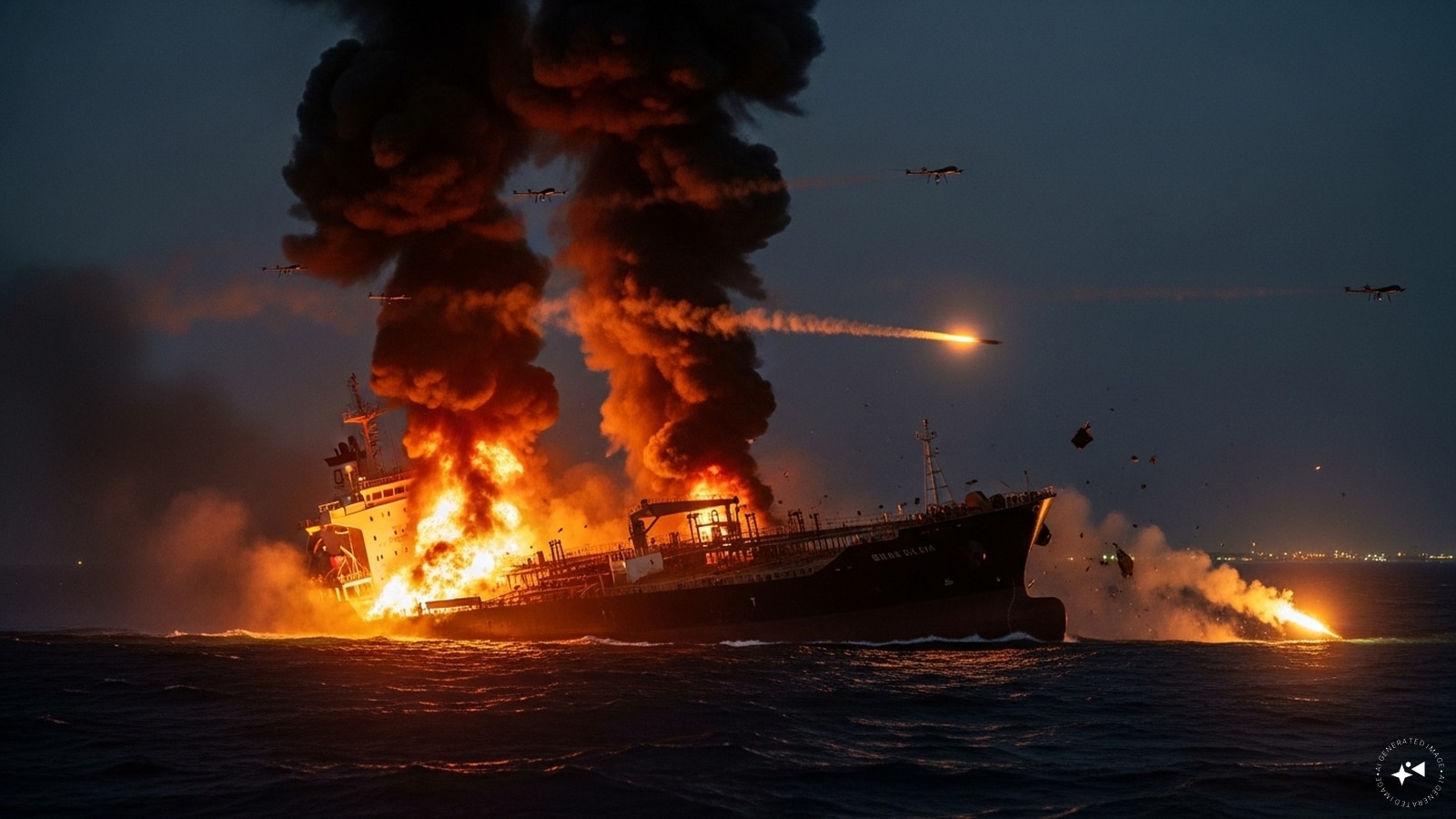
The interim 60-day memorandum of understanding between the United States and Iran is experiencing structural degradation within its first week. The kinetic exchanges on June 27, 2026—comprising an Iranian drone strike on Bahrain and the targeting of the commercial tanker KIKU in the Strait of Hormuz—are not random acts of aggression. They represent a calculated operational response to Friday night's American airstrikes. This sequence demonstrates the failure of the diplomatic framework to establish an effective deterrence equilibrium. Instead, both actors are trapped in a cycle where tactical preservation directly undermines strategic stability.
To evaluate this escalation, the conflict must be broken down into its core operational variables: maritime choke point mechanics, asymmetric retaliation asymmetry, and the structural flaws of the current transit framework.
The Choke Point Transit Function
The Strait of Hormuz handles approximately 20 percent of global seaborne crude oil. When Iran imposed an effective blockade following the joint U.S.-Israeli bombardment in February 2026, it altered the baseline cost of global energy logistics. The signing of the interim agreement last week was designed to lower this cost function by introducing a phased extraction of trapped vessels.
The primary structural flaw in the agreement lies in the contested governance of the waterway. The United States and its Gulf Cooperation Council allies define the strait as an international waterway governed by transit passage rights under international law. Conversely, Tehran treats the strait as internal or territorial waters subject to its absolute regulatory oversight. Ebrahim Azizi, head of the Iranian parliament’s national security commission, formalized this stance by stating that the strait is governed exclusively by Iranian rules.
This conceptual divergence manifests in two distinct operational bottlenecks:
- The Transit Fee Dispute: Iran aims to transition from a military blockade to an economic extraction mechanism by levying mandatory transit tolls on commercial shipping.
- The Escrow Route Alteration: The expansion of the shipping lane near the Omani coast by the U.S. Navy-led Joint Maritime Information Centre acts as a direct challenge to Iranian sovereignty claims. By establishing a dual-traffic corridor outside of primary Iranian radar and coastal missile coverage, the multinational coalition attempted to neutralize Tehran's primary geopolitical asset.
Thursday's initial strike on a container ship attempting to leave the Gulf was a direct enforcement action by Iran to signal that unauthorized egress carries an unsustainable risk profile. The subsequent U.S. airstrikes targeting Iranian coastal radar installations, missile batteries, and uncrewed aerial vehicle (UAV) storage sites on Friday night were intended to degrade the tactical capability required to enforce these rules.
The Asymmetric Retaliation Model
Tehran’s response on Saturday follows a established doctrine of proportional asymmetry. Because Iran cannot match the conventional blue-water naval power or precision strike capabilities of U.S. Central Command, it distributes its counter-strikes across geographically dispersed and politically sensitive nodes.
The Bahrain Vector
By directing a salvo of one-way attack drones at Bahrain, Iran targeted the political center of gravity for U.S. maritime operations. Bahrain houses the headquarters of the U.S. Navy’s Fifth Fleet and recently hosted U.S. Secretary of State Marco Rubio for a GCC ministerial conference that explicitly demanded the unconditional opening of the strait.
The strike on Bahrain serves a dual purpose. First, it demonstrates that host nations providing logistics or basing rights to American forces will incur direct costs. Second, it exposes the defensive limitations of regional integrated air and missile defense systems against low-altitude, low-radar-cross-section loitering munitions.
The Maritime Interdiction Vector
Simultaneously, the strike on the Panama-flagged tanker KIKU via an unidentified projectile serves to re-establish the risk premium for international commercial shipping. The strike targeted the bridge of the vessel. While the crew survived and environmental damage was averted, the attack achieved its strategic objective: the International Maritime Organization immediately suspended its coordinated evacuation program for the remaining 115 stranded merchant vessels.
The economic consequence is immediate. Shipping insurance underwriters price risk based on predictability. By proving that the U.S. security umbrella cannot guarantee the integrity of a vessel's command bridge even during an active ceasefire negotiation, Iran re-imposed the blockade mechanics without needing to deploy heavy naval surface combatants.
Structural Failures of the Ceasefire Framework
The rapid unraveling of the memorandum of understanding stems from an asymmetrical understanding of what a ceasefire entails. The diplomatic track, led on the American side by Vice President JD Vance, views the 60-day window as a period of freezing active hostilities to negotiate the disposal of Iran's highly enriched uranium stockpile and permanent maritime transit protocols.
The political leadership in Tehran, surviving a highly disruptive campaign that removed its senior leadership core four months ago, views the 60-day window as an active gray-zone theater. For Iran, negotiations do not occur in isolation from kinetic maneuvers; kinetic maneuvers are the primary mechanism used to alter the balance of power at the negotiating table.
This creates a structural instability. The U.S. administration operates under a doctrine where violations must be met with overt, conventional punishment to preserve deterrence. This was evident when President Donald Trump noted that the four shots fired at the cargo ship on Thursday would not go unanswered. However, each conventional strike by the United States forces the Islamic Revolutionary Guard Corps to execute a retaliatory cycle to avoid appearing strategically compromised to its domestic audience and regional proxies.
The tactical reality on the ground indicates that neither side desires a return to the full-scale combat operations seen in early 2026. A U.S. official confirmed that the Friday night strikes were contained and did not represent a permanent pivot back to sustained bombardment. Vice President Vance's public prompt for Tehran to use diplomatic channels rather than military escalation further highlights the administration's desire to keep the interim agreement alive.
The primary risk factor is no longer a deliberate decision by either superpower to initiate total war, but rather the presence of naval mines and active coastal radar targeting systems in a highly congested maritime corridor. The Joint Maritime Information Centre's warning regarding substantial mine risks means that even if a diplomatic understanding is reached on transit fees, the physical infrastructure of the strait remains highly volatile.
The next operational phase will depend entirely on how the U.S. Navy responds to the expanded Omani transit route. If the coalition attempts to force commercial traffic through the new lane under heavy naval escort, Iran will likely utilize localized minefields and swarm attacks via the IRGC Navy's fast-attack craft to disrupt the flow, bypassing direct engagements with American capital ships while continuing to extract a toll from the global energy supply chain.