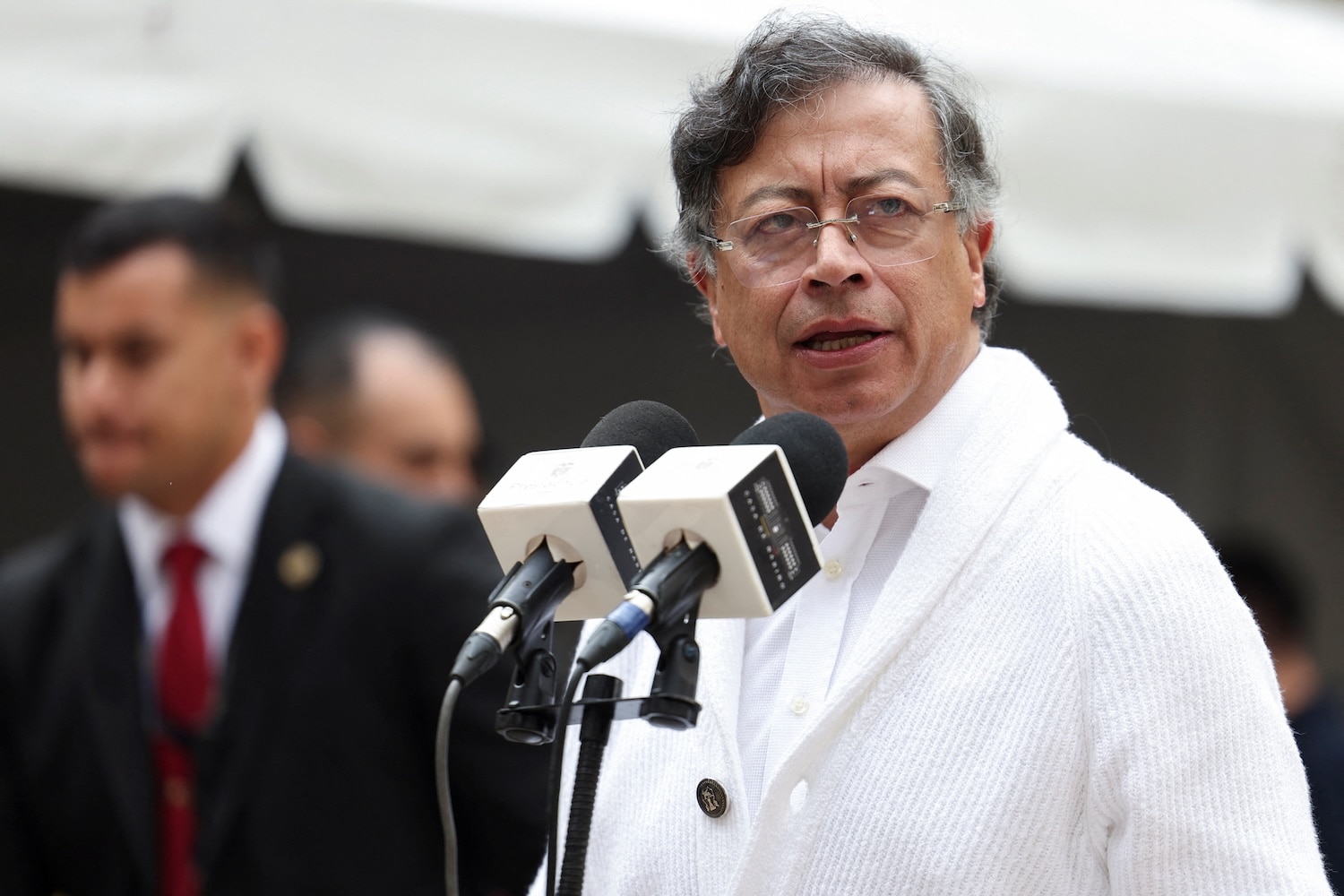
The convergence of domestic political vulnerability and overt foreign endorsement has altered the structural dynamics of Colombia’s upcoming presidential runoff. Outgoing President Gustavo Petro’s formal demand that US President Donald Trump cease interference in the June 21 election highlights a broader geopolitical friction. This friction is not merely a rhetorical dispute; it represents a calculated clash of asymmetric political strategies. The tension centers on the explicit endorsement of right-wing candidate Abelardo de la Espriella over the governing Historic Pact coalition's candidate, Iván Cepeda.
To evaluate the strategic weight of this confrontation, the situation must be broken down into its core components: the legal boundaries of national sovereignty, the mechanisms of external executive influence, and the domestic institutional stressors currently shifting the electoral landscape in Bogotá.
The Legal and Constitutional Framework of Foreign Interference
National elections operate under strict constitutional boundaries designed to isolate the domestic electorate from external influence. The tension between the Colombian executive branch and the US administration exposes a direct conflict between foreign narrative projection and national statutory prohibitions.
The Constitutional Prohibition Function
The legal basis for Petro's pushback rests on explicit statutory limits within the Colombian legal framework. The system establishes a strict barrier against foreign involvement through two primary vectors:
- Financial Isolation: The Colombian Constitution explicitly prohibits the introduction of foreign capital, assets, or resources into domestic political campaigns. This barrier is designed to prevent external state or corporate actors from altering the financial equilibrium of an election.
- Sovereign Determination: Under international law frameworks recognized by both republics, the formal endorsement of a specific candidate by a sitting foreign head of state tests the boundaries of non-intervention principles.
Petro’s public declarations emphasize that any attempt to alter voters' choices via external resources or concentrated messaging from abroad violates these statutory boundaries. The strategic challenge, however, is that while financial flows can be audited and blocked by electoral authorities, digital narrative projection remains highly porous.
The Asymmetric Leverage of the Executive Endorsement
The endorsement of Abelardo de la Espriella via digital channels functions as a form of low-cost, high-impact political leverage. The mechanics of this endorsement operate through a multi-tiered influence loop.
[External Executive Endorsement]
               │
               ▼
   [Narrative Amplification]
               │
               ▼
[Domestic Electorate Polarisation] ──► [Altered Voter Equilibrium]
The Transnational Endorsement Loop
The mechanism relies on structural alignment between a foreign executive and a domestic challenger. De la Espriella, holding dual US-Colombian citizenship and presenting an anti-establishment, security-first platform, provides a direct ideological partner for the US administration's regional strategy.
The strategy creates a dual-incentive structure. For the US administration, endorsing an aligned candidate offers a mechanism to project influence into Andean geopolitical affairs without deploying formal diplomatic sanctions or economic penalties. For the domestic challenger, the endorsement serves as a validation mechanism, signaling to conservative voters and business elites that a shift in executive power will immediately restore bilateral alignment with Washington.
The institutional cost of this strategy falls heavily on the sitting administration. Petro’s diplomatic leverage is structurally diminished by his lame-duck status—compelled by Colombia's single-term limit—and a series of escalating domestic crises. Consequently, the foreign executive's endorsements exploit an existing authority vacuum within the Colombian state apparatus.
The Convergence of Domestic Institutional Crises
The international diplomatic dispute does not occur in isolation; it intersects with an unprecedented institutional crisis within Colombia's borders. The structural stability of the election has been complicated by a parallel domestic bottleneck.
The Suspension Vector and Political Equilibrium
Days before the scheduled runoff, Representative Gloria Arizabaleta, chair of the House Impeachment Committee, issued a provisional order to temporarily suspend Petro from office. The stated objective of this legislative action was to prevent the sitting president from utilizing the state apparatus to campaign for his party's successor, Iván Cepeda.
This institutional move alters the electoral calculus in three distinct ways:
- Neutralization of Executive Advocacy: The suspension legally restricts Petro's ability to deploy state resources or official presidential platforms to counter the opposition's narrative, effectively diminishing the governing party’s defensive capabilities.
- The Victimization Premium: Conversely, the suspension provides the ruling Historic Pact with a powerful counter-narrative. Petro has framed the legislative order not as a valid institutional check, but as a coordinated, irregular effort to sabotage the transition of power, potentially mobilizing an unaligned block of voters who view the suspension as an overreach.
- Legal Interconnectivity: The presence of shared legal networks between the opposition leadership and the legislative figures driving the suspension creates a perception of institutional alignment. This perceived alignment deepens public distrust in the neutrality of the state transition mechanisms.
Strategic Trajectory and Regional Realignment
The outcome of the June 21 runoff between De la Espriella and Cepeda will dictate the immediate trajectory of Andean-US bilateral relations. The data-driven projection suggests two distinct geopolitical equilibria depending on the structural resolution of this electoral contest.
Scenario A: Conservative Consolidation and Alignment
A victory for De la Espriella re-establishes Colombia as the primary strategic anchor for US policy in South America. The policy execution under this scenario would prioritize a return to aggressive counter-narcotics frameworks, increased security cooperation, and an immediate reversal of Petro's progressive regional alignments, particularly regarding Middle Eastern and Latin American diplomatic positions. The limitation of this outcome is the high probability of domestic civil unrest from a highly mobilized, defensive left-wing base that views the election as structurally compromised.
Scenario B: Left-Wing Continuity and Structural Friction
A victory for Cepeda maintains the Historic Pact’s ideological framework but forces the administration into a highly defensive posture. Facing a US executive branch that has openly signaled opposition, a continued left-wing administration would confront narrowed credit pathways, heightened diplomatic scrutiny from Washington, and potential targeted economic measures. This friction would likely accelerate Bogotá's pivot toward alternative geopolitical partnerships, including expanded economic ties with Beijing and non-aligned bloc states, permanently altering the historical security architecture of the hemisphere.
The final phase of the campaign will not be decided by the legal merits of sovereign non-interference, but by which narrative captures the remaining unaligned electorate: the demand for internal security and international alignment championed by the opposition, or the defense of national sovereignty and institutional continuity asserted by the state.


