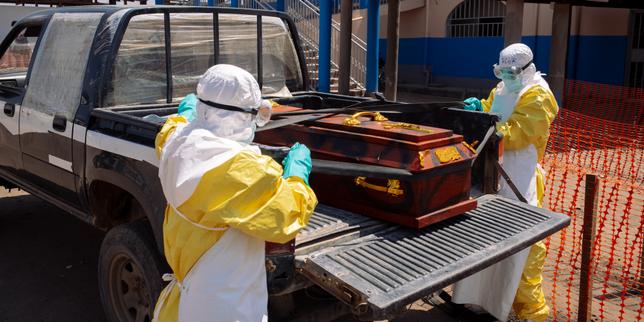
On June 3, 2019, the Democratic Republic of the Congo (DRC) officially surpassed 2,000 recorded cases of Ebola virus disease (EVD) in the North Kivu and Ituri provinces. This threshold represents the second-largest Ebola outbreak in history, and the first to occur within an active, protracted war zone. The central paradox of this crisis lies in the divergence between medical capability and epidemiological outcome: the intervention deployed rVSV-ZEBOV, an investigational vaccine boasting a clinical efficacy rate of approximately 97.5 percent, yet transmission velocity continued to accelerate. This divergence indicates that containment failure is not a product of therapeutic deficit. It is a system failure caused by the intersection of three highly volatile variables: security fragmentation, infrastructural deficits, and community trust erosion.
The Tri-Partite Failure Framework
To understand why the epidemic outpaced intervention efforts, we must analyze the containment response through a closed-loop system model. Traditional epidemiological models assume a stable, permissive environment where public health personnel can map transmission chains with high fidelity. In North Kivu, this assumption collapsed under the weight of three systemic pressures.
- Security-Induced Friction: The presence of over one hundred active armed groups—most notably the Allied Democratic Forces (ADF)—created direct operational blockades. The resulting violence did not merely endanger personnel; it severed the continuity of contact tracing.
- Infrastructural Deficits: The lack of paved road networks, stable electrical grids, and decentralized diagnostic facilities slowed the cycle time of identification, isolation, and treatment.
- The Trust Deficit: Decades of political marginalization and armed conflict primed the local population to view state-backed and international medical interventions with profound suspicion.
Deconstructing the Transmission Velocity Equation
The progression of the epidemic is governed by the effective reproduction number ($R_e$), defined as the average number of secondary cases generated by a single infectious individual in a population. To reduce $R_e$ below the critical threshold of 1.0, containment systems must optimize three distinct epidemiological variables:
- The Exposure Duration Factor ($D$): The average time an infected individual remains active in the community before isolation.
- The Transmission Probability ($\beta$): The likelihood of transmission per contact, heavily influenced by clinical hygiene standards and burial practices.
- The Contact Rate ($c$): The average number of susceptible individuals exposed to an infectious case.
In North Kivu, each of these variables experienced upward pressure due to specific systemic failures.
The exposure duration factor expanded due to delays in detection. The median time from symptom onset to isolation in an Ebola Treatment Center (ETC) remained at approximately five to six days throughout early 2019. During this window, individuals interacted with family members and visited local health facilities, transforming standard medical centers into primary transmission hubs.
Nosocomial transmission—infection acquired within healthcare facilities—accounted for up to 10 percent of all cases in certain zones. The local healthcare system in North Kivu consists of hundreds of informal, poorly regulated private clinics. These facilities lack personal protective equipment (PPE) and basic infection prevention and control (IPC) protocols. When an undiagnosed Ebola patient presents with generic febrile symptoms, the reuse of medical equipment and lack of barrier nursing techniques facilitate rapid cross-contamination.
The transmission probability was further elevated by traditional safe burial resistance. Standard operating procedures dictated by international agencies required secure, dignified burials conducted by trained teams. However, the enforcement of these protocols by armed escorts alienated grieving families, driving burials underground and maintaining high exposure rates during post-mortem washing rituals.
The Cold-Chain Bottleneck and Ring Vaccination Failure
The primary countermeasure of the response was the "ring vaccination" strategy. This protocol involves identifying a confirmed Ebola patient, mapping their primary contacts (the first ring), and subsequently vaccinating the contacts of those contacts (the second ring). For this strategy to succeed, two operational conditions must be met: rapid, exhaustive contact tracing within 48 hours of index case identification, and the preservation of vaccine thermal integrity.
The rVSV-ZEBOV vaccine requires continuous storage at temperatures between $-60^\circ\text{C}$ and $-80^\circ\text{C}$. Maintaining this ultra-cold chain in the equatorial climate of eastern DRC presents a severe engineering challenge. The response relied on specialized low-temperature freezers powered by unstable local grids and backup diesel generators. The logistics chain required transporting these sensitive biological assets via unpaved roads subject to washouts and ambushes.
When security incidents occurred, the cold chain was frequently compromised, forcing teams to abort vaccination campaigns or discard valuable doses. Furthermore, contact tracing efficiency hovered below 60 percent in highly volatile areas like Butembo and Katwa. When forty percent of a transmission ring remains unmapped and unvaccinated, the ring ceases to function as a barrier. The virus bypasses the immunological shield, finding path options through the unmapped population and continuing its exponential trajectory.
The Political Economy of Trust Deficit
Epidemiological models often treat public compliance as a static variable. In reality, trust is a highly dynamic economic resource. In the Kivu epidemic, the influx of international funding and highly visible resources created a localized economy of suspicion.
The population of North Kivu has suffered under systemic neglect and violence for a quarter of a century. The sudden arrival of hundreds of millions of dollars, armored vehicles, and foreign experts dedicated exclusively to a single disease—while malaria, cholera, and measles continued to kill far more citizens without attracting equivalent funding—generated a rational skepticism. This disparity led to the widespread belief that the epidemic was either fabricated or intentionally introduced for financial gain.
The political environment exacerbated this trust deficit. In December 2018, the national government postponed presidential elections in Ebola-affected zones (Beni and Butembo), citing the epidemic as the sole justification. This decision effectively disenfranchised over one million voters in an opposition stronghold, codifying the perception of Ebola as a political weapon deployed by the state.
The direct consequence of this politicization was active resistance. Response teams, ambulances, and treatment facilities became targets of coordinated attacks. In early 2019, major treatment centers in Katwa and Butembo were set on fire, forcing international organizations like Médecins Sans Frontières (MSF) to temporarily suspend operations. When containment infrastructure is physically destroyed, the containment loop is broken, leading to immediate spikes in undetected community transmission.
Analytical Reconceptualization: The Friction-Response Matrix
To quantify the operational limits of containment under these conditions, we can model the response capacity as a function of environmental friction. The traditional response model operates on a linear assumption: increased resources yield increased containment efficiency. The reality in conflict zones is non-linear, as defined by the following operational matrix:
- Low Friction (Permissive, stable environments):
- Contact tracing fidelity: $>90%$ tracking success.
- Primary intervention path: Rapid ring vaccination; centralized ETC isolation.
- Moderate Friction (Periodic civil unrest; predictable armed presence):
- Contact tracing fidelity: $70% - 90%$ tracking success.
- Primary intervention path: Targeted geographic vaccination; mobile health screening.
- High Friction (Active combat; targeted attacks on medical teams):
- Contact tracing fidelity: $<60%$ tracking success.
- Primary intervention path: Decentralized, community-led triage; empirical clinical treatment.
When friction enters the high-friction state, the standard centralized model fails. The concentration of medical resources into massive, highly visible, fortified ETCs turns these facilities into strategic targets and hubs of community resentment.
Operational Redesign: The Decentralized Containment Model
The stabilization and ultimate suppression of the epidemic require a structural transition from a centralized, defensive containment model to a decentralized, integrated model. To mitigate the friction identified in the North Kivu crisis, future responses must implement three core systemic shifts.
First, the transition from massive, isolated Ebola Treatment Centers to small, integrated health posts. By embedding Ebola isolation and treatment capacity directly into existing, trusted community clinics, the response strips the disease of its exceptionalism. This integration reduces the spatial distance patients must travel, minimizes the visibility of international intervention teams, and dramatically lowers the risk of targeted attacks.
Second, the deployment of local personnel to lead contact tracing and safe burial teams. The utilization of external security forces to enforce quarantine and burial protocols is counterproductive. It validates the narrative of state aggression. Training and compensating local youth, community leaders, and traditional healers to execute these tasks turns public health from an external imposition into a community-led defense.
Third, the adaptation of vaccination strategies to high-friction environments. When contact tracing is impossible due to displacement or active conflict, the rigid ring vaccination model must be abandoned in favor of geographic ring vaccination or blanket demographic targeting in high-risk zones. This shift sacrifices vaccine efficiency to achieve broader herd immunity in areas where granular mapping is a logistical impossibility.
By shifting the operational architecture of the response to align with these principles, public health agencies can decouple disease containment from the volatility of local conflict, preventing localized outbreaks from scaling into systemic humanitarian catastrophes.