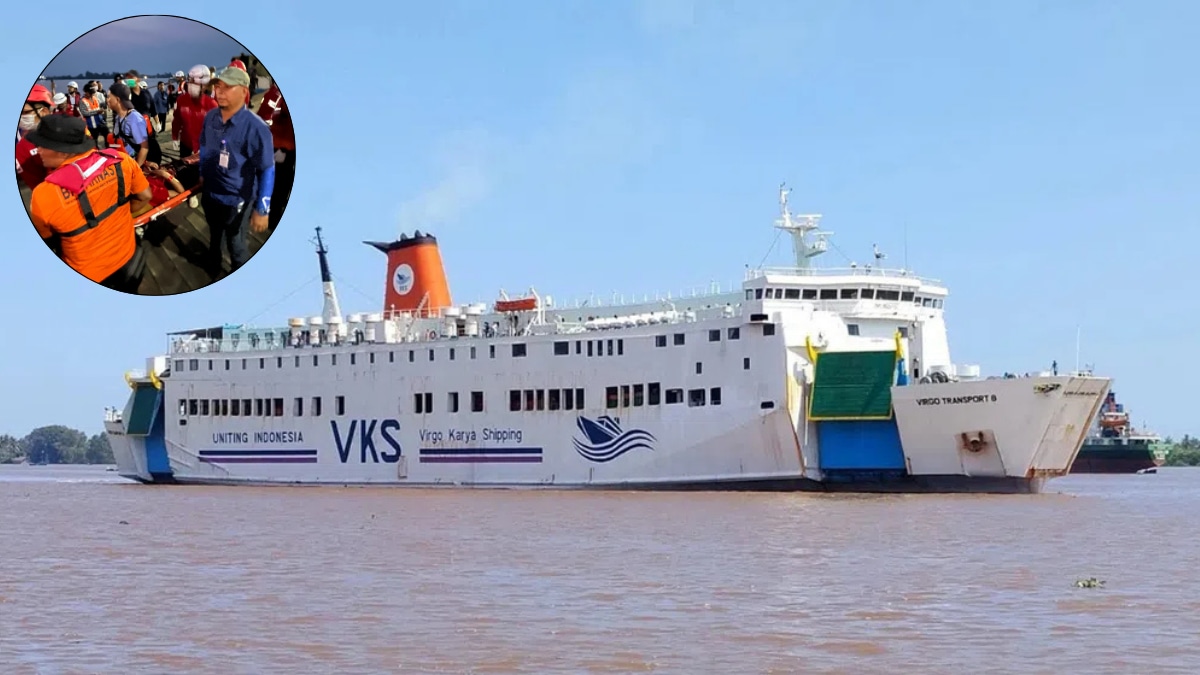
Maritime accidents within island archipelagos are rarely isolated anomalies caused solely by sudden meteorological shifts. Instead, they represent the terminal failure of a multi-tiered risk matrix where vessel age, dynamic cargo loads, environmental stressors, and regulatory oversight collide. The sinking of the roll-on/roll-off passenger vessel Virgo Transport 8 in the Java Sea on September 13, 2026, operating between Surabaya in East Java and Banjarmasin in South Kalimantan, provides an empirical blueprint for analyzing how latent vulnerabilities transform into catastrophic losses of life. Carrying 243 occupants alongside 89 commercial vehicles, the vessel encountered severe sea states characterized by high waves and strong currents before transmitting its final distress signal regarding a severe list.
To evaluate this disaster beyond surface-level reporting, analysts must deconstruct the event through three distinct operational vectors: hull integrity and lifecycle aging, the mechanics of dynamic cargo shifting under free-surface and rolling conditions, and the institutional frictions governing emergency response and regulatory compliance.
Asset Depreciation and Hull Lifecycle Economics
The primary vulnerability begins at the acquisition and operational stage of secondary tonnage. Built originally in Japan in 1987 as the Ferry Kurushima at the Shin Kurushima Onishi shipyard, the vessel logged nearly four decades of service before its acquisition by PT Virgo Karya Shipping in 2025. Operating a 119-meter, 4,277-gross-tonnage vessel near or beyond its initial structural design life introduces severe maintenance cost functions.
Steel fatigue in marine environments is governed by cyclic loading from wave action, salt-water corrosion, and structural stress concentrations around vehicle deck ramps and watertight bulkheads. As a ro-pax vessel ages, the thickness of hull plating degrades exponentially unless subjected to rigorous ultrasonic testing and steel renewal programs. When secondary market ships are transferred from temperate northern waters to tropical equatorial seas, they enter operating environments with different wave frequency spectra and high thermal cycling amplitudes.
The economic model driving these transfers relies on maximizing utilization rates while minimizing dry-dock downtime. When maintenance schedules are compressed or deferred to maintain route profitability, the structural safety margin diminishes. The captain's final transmission indicating a progressive list suggests that the vessel's transverse metacentric height had been compromised, allowing water ingress or cargo shift to induce an unrecoverable angle of heel.
The Cargo-Passenger Interaction Matrix
Ro-pax vessels carry a compounded risk profile because they integrate two fundamentally opposing load dynamics: human cargo requiring stability, evacuation paths, and buoyancy, and heavy vehicular cargo possessing high center-of-gravity profiles and dynamic mass inertia.
During the voyage across the Java Sea, the Virgo Transport 8 accommodated 89 vehicles alongside its passenger complement. Commercial transport vehicles introduce significant mass distribution risks. If lashings and tie-down protocols fail under the influence of rolling motions induced by wind-driven waves, vehicular cargo shifts laterally. A lateral shift of heavy trucks or container transport creates an immediate external list moment, exacerbating the ship's heel angle.
Compounding this is the free-surface effect on vehicle decks or unballasted tanks. When liquids or loose cargo shift across a wide deck, the center of gravity moves in the direction of the heel, drastically reducing the vessel's righting lever curve. In adverse weather, once the angle of heel exceeds the design threshold, the dynamic restoring moment drops to zero, resulting in rapid capsizing. Eyewitness and official accounts confirm that the vessel did not sink instantaneously upon losing propulsion; rather, it capsized and remained partially afloat before settling on the seabed at a depth of roughly 29 meters. This temporal gap between listing, capsizing, and final submersion highlights a critical window where evacuation protocols and structural reserve buoyancy dictate survival outcomes.
Hydrodynamic Stressors and Meteorological Thresholds
The Java Sea is characterized by shallow bathymetry and complex hydrodynamic regimes influenced by monsoonal shifts. Wave heights reaching 2.5 meters or greater, coupled with strong subsurface currents, impose extreme bending moments on vessels navigating cross-seas.
When a ship travels transverse or oblique to steep, short-period waves typical of tropical squalls, wave action induces synchronous rolling. If the natural rolling period of the vessel matches the encounter frequency of the waves, amplification occurs. For an aging hull with altered weight distribution, this resonance can rapidly overwhelm stability margins.
Furthermore, shallow water hydrodynamics alter pressure fields beneath a ship's hull, increasing squat and reducing under-keel clearance. While the vessel was operating in deep enough waters during its transit across the basin, windage forces acting upon the high freeboard and superstructure of a ro-pax design created substantial leeway and heeling moments. The convergence of wind shear, wave energy, and structural list created an irreconcilable hydrodynamic state where the captain's capacity to maintain heading was neutralized.
Regulatory Compliance and Corporate Liability
Maritime safety governance within archipelagic nations depends on the strict enforcement of load-line conventions, passenger manifests, and seaworthiness certifications. Following the sinking, Indonesian authorities detained three individuals associated with the operating company on allegations of negligence and complicity, underscoring the legal mechanisms triggered when operational parameters breach safety thresholds.
The economics of ferry operation often create perverse incentives to maximize passenger and cargo density up to, or exceeding, statutory limits. Accurate manifest reconciliation is frequently undermined by informal loading practices at regional ports. When verification protocols lack digital transparency, passenger headcounts and cargo tonnage metrics diverge from actual physical loads on board.
Regulatory agencies face resource constraints when inspecting hundreds of dispersed ports across thousands of islands. Oversight shifts from preventative auditing to reactive penalization after a disaster occurs. The detention of corporate officers signals a transition toward fixing personal and corporate liability on management decisions regarding maintenance prioritization, crew training, and adherence to weather safety advisories.
Search, Rescue, and Recovery Friction
The post-accident phase introduces its own distinct operational challenges, managed primarily by Basarnas, the Indonesian national search and rescue agency, alongside naval and aviation assets. In the immediate aftermath, search operations spanned thousands of square nautical miles, mobilizing nearly a thousand personnel, multiple vessels, and aircraft.
However, recovery operations in submerged wrecks involve acute physiological and logistical barriers. With the hull resting at a depth of approximately 29 meters and drifting hundreds of meters from its initial capsizing site, dive teams encountered severe environmental hindrances, including murky water visibility, strong sub-surface currents, and structural hazards within corridors and decks.
A particularly complex hazard during underwater recovery is the presence of sealed compartments retaining air pockets. Opening submerged, enclosed spaces can trigger rapid pressure differentials and unexpected water surges, endangering divers. Furthermore, currents exceeding safe working limits restricted continuous underwater access, forcing rescue teams to balance the urgent demands of families waiting at port docks with the safety limits of deep-diving operations. This friction between public urgency and technical recovery constraints illustrates why casualty accounting and body retrieval in maritime disasters extend across weeks rather than days.
Operational Redesign for Archipelagic Transit
Preventing future maritime disasters of this scale requires systemic interventions across ship design, port management, and regulatory enforcement. Relying on aging secondary tonnage imported from international markets without stringent lifecycle recertification guarantees structural failure under severe weather conditions. Fleet renewal programs must mandate automated stability monitoring systems that provide real-time data on hull stress, cargo shift, and metacentric height directly to the bridge crew and shore-based safety management systems.
Port authority operations must decouple cargo clearance from manual, paper-based manifests by implementing mandatory digital weight-verification gates and biometric passenger tracking prior to departure. Meteorological integration must transition from advisory broadcasts to mandatory departure restrictions enforced through automated port clearance holds when wave heights and wind speeds exceed defined operational envelopes for specific vessel classes. Aligning corporate governance with strict penal liability ensures that maintenance expenditure is treated as a fixed operational prerequisite rather than a variable cost subject to margin optimization.


