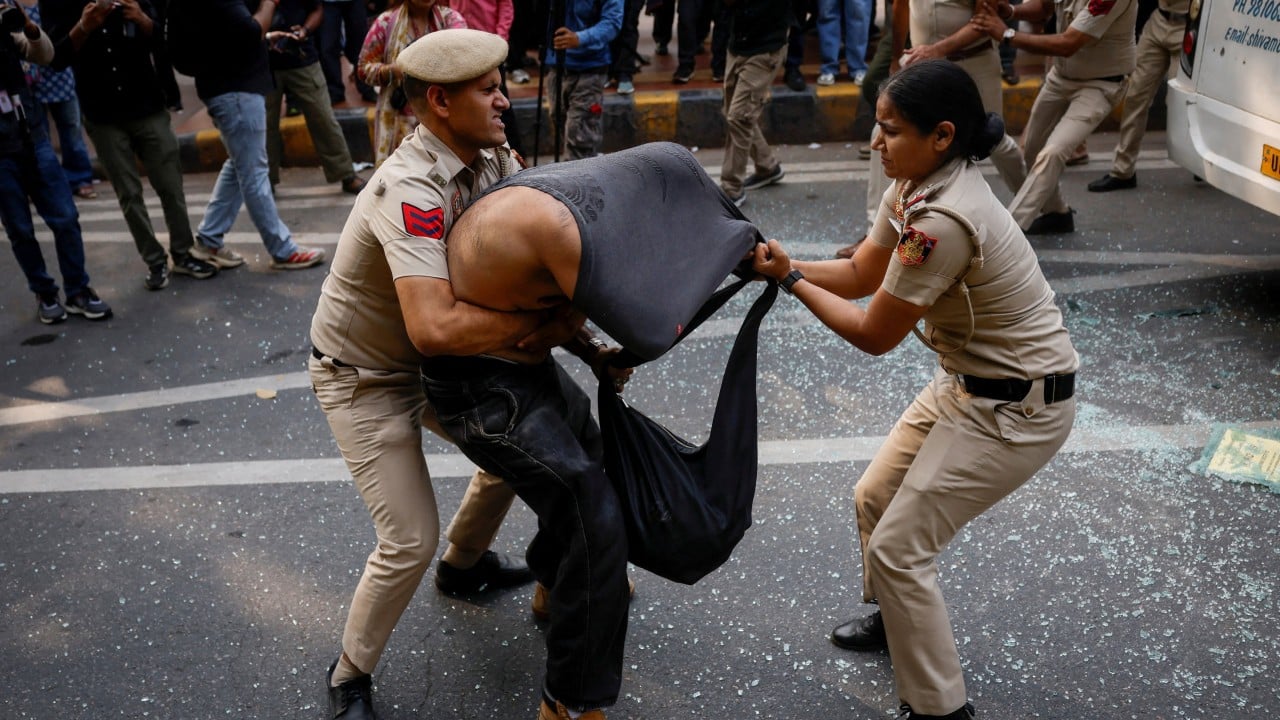
Political stability in contemporary democratic states rests on a delicate equilibrium between institutional compliance and state-administered friction. When state apparatuses attempt to manage mass political dissent through criminal detention, they often trigger a predictable systemic failure. The legal release of high-profile figures from the Cockroach Janta Party in India, following intense state crackdowns on electoral roll revisions, exposes the limits of coercive containment. To understand this dynamic, we must examine the mechanics of decentralized protest movements, the cost functions of state suppression, and the structural vulnerabilities inherent in modern electoral administration.
The Mechanics of Decentralized Political Resistance
Traditional political opposition relies on hierarchical leadership structures, distinct bureaucratic chains of command, and fixed headquarters. These attributes make conventional opposition parties legible to the state and vulnerable to targeted decapitation strategies, asset freezes, and legal coercion.
The Cockroach Janta Party and its associated networks invert this operational model through structural decentralization:
- Absence of a Central Node: Without a singular permanent headquarters or an irreplaceable top-tier leadership tier, state detentions fail to paralyze the network. Arresting tactical coordinators merely validates the movement's decentralized design.
- Asymmetric Satire as Armor: Adopting a derogatory term deployed by political and judicial elites transforms a liability into a brand asset. The nomenclature strips the state of its linguistic monopoly and lowers the barrier to entry for marginalized demographics.
- Distributed Legal Defense: Rather than relying on centralized legal representation, the movement utilizes a decentralized network of volunteer lawyers stationed across municipal courts. This disperses the administrative burden of state-led judicial harassment.
This organizational fluidity creates an acute strategic problem for ruling authorities. When an entity possesses no physical infrastructure to seize, conventional deterrence mechanisms lose their efficacy.
The State Cost Function in Electoral Management
The friction between the Indian state and the youth-led movement is fundamentally anchored in administrative actions taken by the Election Commission of India (ECI), specifically the Special Intensive Revision (SIR) of electoral rolls. State interventions of this magnitude generate quantifiable political costs and operational friction.
When administrative purges remove millions of entries from voter registries under the rationale of eliminating duplicates, migration, or ineligible registrations, two distinct pressures emerge:
- The Verification Bottleneck: Conducting a nationwide audit of nearly one billion voters requires an immense administrative footprint. The systemic omission of millions of urban voters, marginalized communities, and students creates immediate institutional exposure.
- The Legitimacy Deficit: When electoral bodies face credible accusations of partisan bias or systemic disenfranchisement, public trust degrades. The marginal cost of protesting drops significantly when citizens perceive that their foundational political agency has been administratively revoked.
The state’s reliance on criminal charges, such as peace bonds and preventive detentions under municipal laws, represents an attempt to shift the arena of conflict from the electoral domain to the penal system. However, this strategy suffers from diminishing returns.
The Attrition Trap of Preventive Detention
Judicial harassment and short-term detentions are designed to impose high personal costs on activists, forcing them to expend finite resources on legal defense rather than mobilization. Yet, in a networked political environment, this tactic produces counter-productive feedback loops.
State Action: Preventive Detention / Legal Summons
  │
  ▼
Short-term Incarceration of Key Figures
  │
  ▼
Amplified Media Visibility & Legal Solidarity Networks Activated
  │
  ▼
State Concession: Judicial Release / Conditional Bail
  │
  ▼
Escalated Institutional Demands & Widened Coalition Base
Each cycle of detention and subsequent release acts as an organizational stress test. When courts order the release of detained figures—as occurred with the liberation of prominent movement leaders—the state absorbs a double penalty: it signals institutional division or legal constraint while validating the resilience of the opposition.
Strategic Forecast
The confrontation surrounding electoral roll integrity and institutional accountability has moved past the threshold where containment can be achieved via administrative attrition.
As the movement scales beyond localized student grievances into cross-state coalitions, the state faces a stark operational constraint: it cannot indefinitely criminalize decentralized dissent without permanently degrading its own democratic credentials. Resolving this structural impasse requires institutional transparency and independent verification of voter registries, rather than reliance on penal deterrence. Absent structural reform of the ECI's revision protocols, the friction between administrative mandates and citizen-led verification will remain the defining vulnerability of the political landscape.