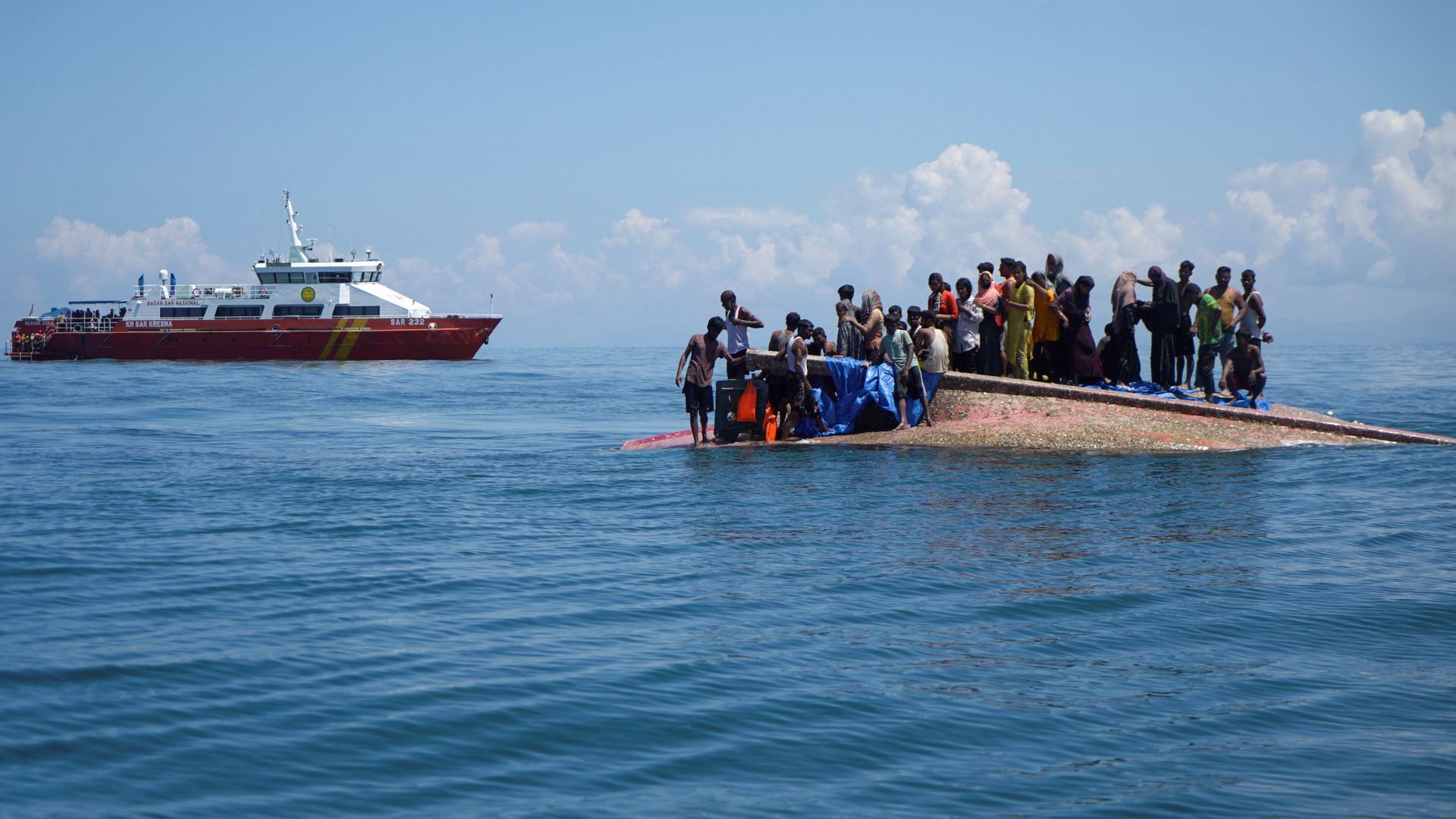
Every time a crowded wooden trawler splits open and spills hundreds of human beings into the churning gray waters of the Bay of Bengal, the international media triggers a pre-programmed script.
The headlines lament a "tragedy." The United Nations issues a sternly worded press release demanding regional governments open their borders. Non-governmental organizations launch urgent fundraising appeals. Activists blame the lack of search-and-rescue ships.
This entire narrative is a comfortable lie.
It is designed to soothe the conscience of Western observers while completely ignoring the cold, transactional reality of human smuggling in Southeast Asia.
These maritime disasters are not unpredictable natural tragedies. They are highly calculated, market-driven events. By treating them as spontaneous humanitarian crises rather than structured corporate operations, the international community actively subsidizes the very cartels that send these boats to sea.
If you want to stop the drownings, you have to stop crying about them and start dismantling the balance sheets of the people organizing them.
The Economics of the Unseaworthy Vessel
Let us dismantle the first myth: the idea that smugglers are trying to get their passengers safely to the shore of destination.
They are not.
In a standard commercial shipping operation, the transport provider has a financial interest in the vessel arriving intact. If a cargo ship sinks, the company loses its asset, its reputation, and its future revenue.
In the human smuggling trade across the Andaman Sea and the Bay of Bengal, the business model is inverted. The boat is a single-use, depreciated asset. It is a write-off the moment it leaves the shallow waters of Cox’s Bazar or the coast of Rakhine State.
I have spent years analyzing illicit supply chains in Southeast Asia. The math behind these voyages is brutal and simple.
- The Vessel: Smugglers purchase discarded, rotting wooden fishing trawlers that are near the end of their operational lives. These boats are bought for scrap value—often less than $10,000.
- The Cargo: Smugglers cram between 500 and 800 people onto a vessel designed to hold 50. At an average rate of $2,000 to $4,000 per passenger, a single voyage generates between $1 million and $3.2 million in raw revenue.
- The Margin: Even after paying off corrupt local maritime police, purchasing cheap fuel, and hiring a desperate captain who is often given a one-way ticket, the net profit margin on a single run exceeds 85%.
Once the boat clears territorial waters, the smuggler has already made their money. The physical survival of the vessel is irrelevant to their bottom line. In fact, a sinking boat can sometimes be more profitable than a successful landing.
How Search and Rescue Acts as an Externalized Safety Net
This is where the contrarian reality gets uncomfortable.
When international organizations demand that regional navies—specifically those of Bangladesh, India, Thailand, and Malaysia—patrol the seas to "rescue" distressed vessels, they are unwittingly acting as the logistics department for human traffickers.
In economic terms, this is a classic moral hazard.
If a smuggler knows that international maritime law obligates passing merchant vessels and nearby naval ships to rescue passengers in distress, they have zero incentive to provide a seaworthy boat. They do not need to spend money on life jackets, functional GPS systems, extra fuel, or structural reinforcements.
Instead, they can intentionally overload a rotting hull, send it into international shipping lanes, and instruct the captain to disable the engine or puncture the hull the moment a larger ship appears on the horizon.
The rescue becomes part of the journey's blueprint. The cartel externalizes the most expensive and risky part of the voyage—the final landing and processing—onto international navies and humanitarian organizations.
We saw this dynamic play out clearly in the Mediterranean, and the exact same mechanics govern the Bay of Bengal. When search-and-rescue assets increase, smugglers do not celebrate safer passages for their clients; they buy even cheaper, more dangerous boats to maximize their profit margins.
The Myth of the Spontaneous Refugee Flight
The public is led to believe that these voyages are spontaneous acts of desperation. We are told that a family, fleeing persecution in Myanmar or the misery of the camps in Bangladesh, suddenly decides to run down to the beach and jump on a boat.
This is a complete fantasy.
You do not board a transnational maritime transport vessel without a highly organized recruitment network guiding your every step. The journey is facilitated by an intricate, multi-tiered corporate structure that spans several countries.
The Recruitment Tier
Local brokers operate openly within the refugee camps of Cox’s Bazar. They target young men and women, promising them guaranteed jobs in the informal economies of Malaysia or Thailand. They offer "travel now, pay later" schemes, which are nothing more than debt-bondage traps.
The Financial Tier
The money does not move in suitcases. It flows through informal banking networks like the Hawala system. This shadow financial network is virtually untraceable by local authorities. Funds are deposited in Kuala Lumpur or Bangkok, held in escrow, and released to the cartels only when the broker receives confirmation that the passenger has boarded the ship or reached a specific transit point.
The Political Tier
A boat carrying 700 people cannot depart from a heavily policed coastline without systemic political complicity. Corrupt elements within local law enforcement and border guards are paid off at standardized rates per head.
To call these events "unforeseen humanitarian disasters" is to insult the intelligence of anyone who understands regional geopolitics. They are highly organized, state-tolerated commercial ventures.
Why Regional Summits and Treaties are Useless Theater
Whenever a boat capsizes, the immediate reaction from global think-tanks is to call for a regional summit. They point to the Bali Process or demand that Southeast Asian nations sign the 1951 Refugee Convention.
This is useless theater. It is a bureaucratic distraction that achieves nothing.
The nations bordering the Bay of Bengal and the Andaman Sea do not care about international treaties. They operate on hard realpolitik.
Malaysia, the primary destination for most of these voyages, has a massive appetite for undocumented, cheap labor in its construction, agriculture, and manufacturing sectors. At the same time, the Malaysian public is politically hostile to large-scale refugee integration.
The Malaysian government's policy is therefore one of calculated ambivalence: they turn back boats when the media spotlight is bright, look the other way when the labor market needs bodies, and refuse to sign any convention that would give these migrants legal rights.
Thailand acts as the transit corridor. The Thai state has historically struggled with deeply entrenched trafficking networks running through its southern provinces. For decades, complicit officials have treated the transit of migrants as a lucrative side-business.
Signing a piece of paper in Geneva will not change the cash flow of a border guard in Satun or Ranong.
Dismantling the Premise: The Wrong Questions
The media asks: How can we make these sea crossings safer?
This is the wrong question. Making the crossing safer only lowers the barrier to entry for the cartels, encouraging them to scale up their operations and put more lives at risk.
The real question we must ask is: How do we make the smuggling business model completely unprofitable?
To do this, we have to implement policies that are deeply unpopular with the humanitarian establishment.
1. Enforce Immediate, Unconditional Returns
The only way to break the financial incentive of the smuggling route is to guarantee that anyone who boards an illegal vessel is immediately returned to their point of origin once rescued.
If a refugee pays $3,000 to a smuggler to reach Malaysia, and they find themselves back in Bangladesh or Myanmar forty-eight hours later, the market collapses. The customer realizes the product does not work. The demand dries up overnight.
Humanitarian organizations argue that this violates the principle of non-refoulement. It is a valid legal concern. But we must weigh the legal purism of non-refoulement against the physical reality of thousands of people drowning in the ocean because we refuse to disrupt the smugglers' promise of successful relocation.
2. Follow the Hawala Money, Not the Boats
We spend millions of dollars tracking wooden boats with satellites and maritime patrol aircraft. This is an expensive waste of time.
We should be tracking the money.
The financial nodes of these trafficking networks do not exist in the jungles of Rakhine State or the mud of Cox’s Bazar. The major accounts are settled in the financial hubs of Bangkok, Singapore, and Kuala Lumpur.
Instead of deploying naval vessels to play lifeguard, regional intelligence agencies should be freezing the assets of the business syndicates that run these operations. If you seize the bank accounts of the top-tier brokers in Malaysia, the boats stop moving.
3. Implement Strict Employer Sanctions in Destination States
The cartels exist because there is a market for cheap, unprotected labor in Malaysia and Thailand.
If you want to stop the boats, you must punish the businesses that employ undocumented migrants. This means heavy fines and jail time for plantation owners, construction bosses, and factory managers who use smuggled labor.
When the destination countries stop offering off-the-books employment, the economic incentive to take the boat disappears.
The current approach to the Bay of Bengal crisis is a cycle of performative outrage and systemic failure. We watch the boats sink, we blame local governments, we demand more rescue vessels, and we wait for the next tragedy to repeat the process.
The cartels are winning because they understand the economics of the situation, while the international community is blinded by its own sentimentality.
Until we treat human smuggling as a rational, highly profitable corporate enterprise that must be economically bankrupted, the bottom of the Bay of Bengal will continue to fill with the bodies of those who paid to cross it.