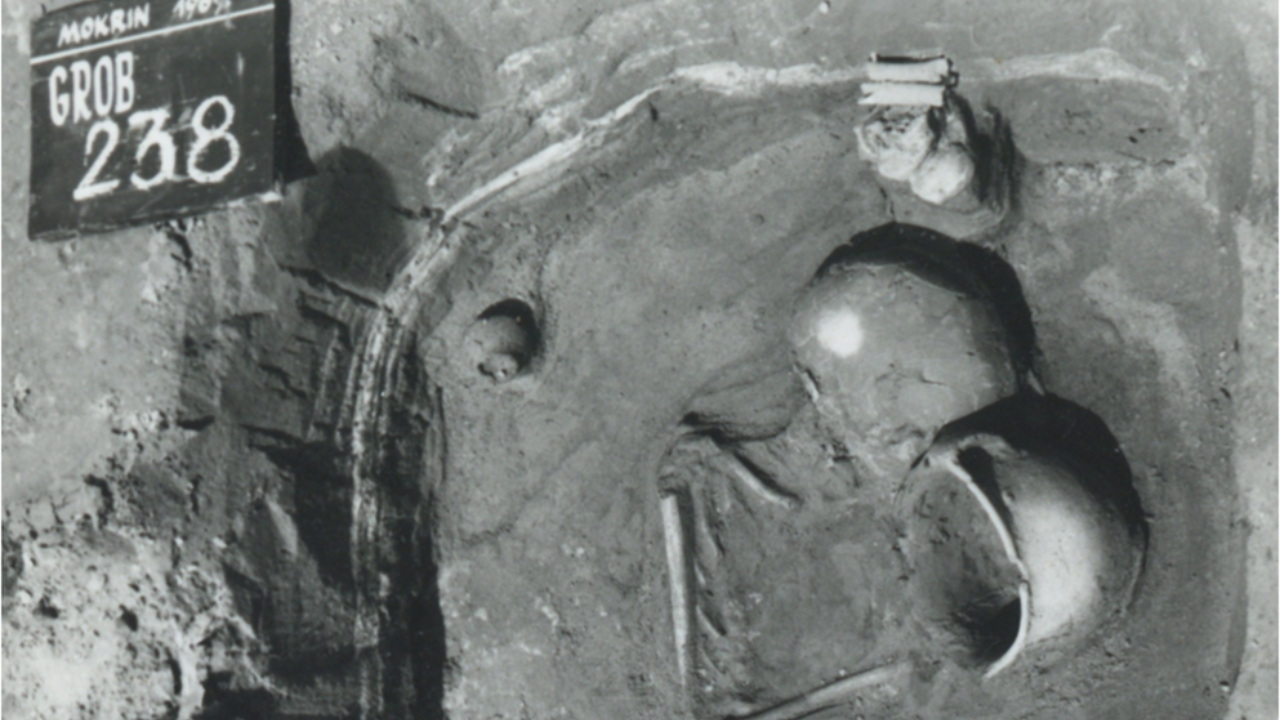
Prehistoric funerary archaeology has historically suffered from an interpretive distortion: adult graves are analyzed as reflections of complex social structures, while infant and juvenile burials are frequently dismissed as demographic anomalies or treated with undifferentiated uniformity. This analytical bias obscures how early societies categorized individuals before biological maturity. Recent bioarchaeological data extracted from 77 non-adult remains across the Maros culture cemeteries of Mokrin and Ostojićevo in northern Serbia, dating between 2100 and 1700 BC, dismantle this oversight. By pairing peptide-based sex identification from dental enamel with high-resolution spatial mapping of body orientation and lateral positioning, researchers have mapped a strict, binary framework of social identity that governed human populations from infancy.
The Maros culture provides an optimal dataset for quantitative mortuary analysis because adult burial rules within this Carpathian Basin network were exceptionally standardized. Adult males were consistently interred on their left sides
Bioarchaeology of Bronze Age Serbia Sex-Linked Mortuary Practices and Social Stratification
news, science
Mortuary archaeology relies on the premise that burial practices are structured reflections of social organization, power dynamics, and kinship systems within a given population. When analyzing a necropolis from the Bronze Age, the primary analytical challenge is separating biological reality from cultural performativity. Recent bioarchaeological research examining 77 skeletal remains from Bronze Age sites in Serbia offers a high-resolution window into how ancient communities materialized gendered social roles through spatial patterning, grave goods, and physical placement. Deconstructing this dataset reveals a rigid architecture of sex-linked burial customs, illuminating the mechanisms by which status, labor division, and inheritance were negotiated 4,000 years ago.
The archaeological record of the Pannonian Plain and the Central Balkans during the Early and Middle Bronze Age is characterized by transition. Shifting subsistence strategies, the consolidation of metallurgical networks, and the emergence of hierarchical social structures placed new demands on communities. Funerary rituals served as the primary technology for resolving social disruptions caused by death. By committing bodies to the earth in specific orientations, with distinct material culture, and within structured spatial zones, these communities codified social contracts that outlived the individuals.
The Structural Anatomy of Gendered Interment
The distribution of grave goods across the Serbian cohort demonstrates a binary coding system that mapped biological sex onto socio-economic identity. In mortuary analysis, the presence of specific artifact classes is frequently interpreted through the lens of gender performance rather than biological sex alone, yet the empirical correlation in this dataset reveals distinct divergence vectors.
The first vector centers on martial and metalworking equipment. Weaponry, when present in this cohort, associates almost exclusively with adult male skeletons. This is not merely a reflection of physical conflict; it represents the institutionalization of status through coercive capacity or the symbolic ownership of defense and trade routes. The metallurgical networks of the Bronze Age required specialized trade partnerships and security. The male-linked grave goods—axes, daggers, and metal ornaments associated with belt fittings—functioned as tokens of socio-political authority within a regional exchange economy.
The second vector governs female-linked assemblages, which concentrate heavily on personal adornment, textile production tools, and specific ceramic typologies. Ornaments manufactured from bronze wire, beads of amber or paste, and pins used for garment fastening indicate that female identity in these communities was heavily communicated through external display value. The presence of spindle whorls and loom weights in female graves points toward an economic model where textile production was a core structural pillar of household wealth generation.
The divergence in these material assemblages highlights a functional division of social capital. Male status was indexed through outward-facing indicators of mobility, defense, and exchange network maintenance. Female status, conversely, was articulated through the management of domestic production units and the visual display of lineage wealth through body ornamentation.
Spatial Segregation and the Mechanics of Kinship
Beyond the inventory of grave goods, the spatial distribution of the 77 individuals reveals systemic patterns of community organization. Cemeteries are not random collections of pits; they are spatial maps of living social networks. In the studied Serbian population, spatial clustering correlates strongly with biological distance and demographic categories.
Subadult burials within the assemblage exhibit distinct placement rules. Children under the age of five are frequently integrated near adult females, reinforcing the maternal-infant nexus as a primary structural unit of the household. However, adolescents begin to show divergence based on sex-linked positioning and orientation within the grave cut. This transition period marks the social onboarding process, where individuals were formally initiated into the gendered economic roles they would occupy as adults.
The spatial orientation of the bodies—the cardinal direction of the head and the lateral flexion—further enforces these divisions. Statistical clustering of burial orientations suggests that community cosmology mapped bodily posture onto the afterlife in ways that mirrored earthly stratification. Deviations from standard burial posture, observed in a minority of the skeletons, point toward anomalous social status, foreign origin, or death under circumstances that disrupted normative community integration.
The Economic Cost Function of Mortuary Ritual
Constructing a formal burial represents an energy expenditure by the living community. The allocation of scarce resources—such as refined metal artifacts, exotic amber, and labor-intensive pottery—to a deceased individual is a direct function of that individual's net lifetime utility or the political imperative of the surviving kin group.
In this Bronze Age population, the resource investment varied systematically by sex and age. Adult cohorts commanded higher resource expenditures than subadults, with the exception of specific infants whose burials included disproportionately rich grave goods, indicating ascribed status derived from hereditary lineage rather than achieved merit. This distinction between achieved and ascribed status is a critical marker of social stratification. When neonates receive high-value bronze artifacts, the society has moved beyond egalitarian structures into institutionalized inequality, where bloodline dictates baseline economic security.
The asymmetry in grave wealth between adult males and females also provides insight into wealth transmission models. If male graves concentrate high-value durable assets like metal weapons and tools, while female graves focus on personal adornment, the economic structure likely favored patrilocal residence patterns where immovable assets and trade privileges were curated along male lines. The adornments in female graves may represent a form of portable wealth or dowry systems designed to secure alliances between disparate settlements across the Balkan river valleys.
Systematic Limitations and Methodological Constraints
To maintain empirical rigor, several analytical constraints inherent to archaeological data must be acknowledged.
First, differential preservation heavily skews osteological analysis. Bone degradation in acidic soils limits the accuracy of sex estimation, particularly in subadult remains where sexual dimorphism in skeletal morphology is insufficiently developed for reliable visual diagnosis. While ancient DNA (aDNA) and peptide analysis of tooth enamel (amelogenin) increasingly bridge this gap, osteological conclusions remain probabilistic.
Second, the archaeological visibility of mortuary practices is incomplete. Flat-grave inhumations preserve skeletal material and accompanying grave goods, but perishable materials—textiles, organic containers, wooden structures, and food offerings—are almost entirely lost to the archaeological record. Consequently, the material culture recovered represents a fraction of the actual economic investment made during the funerary rite.
Third, sample size parameters limit macro-level demographic generalization. A cohort of 77 individuals provides high-resolution data for specific micro-regions or settlement clusters in Serbia, but it cannot be treated as a monolithic demographic signature for the entire European Bronze Age. Regional variations in resource availability, ecological pressures, and proximity to major trade corridors created diverse adaptive strategies across the continent.
Strategic Allocation of Archaeological Capital
The excavation and analysis of the Serbian Bronze Age cohort shift the analytical focus from descriptive cataloging to structural behavioral modeling. By mapping the covariance of biological sex, spatial orientation, and artifact typology, researchers isolate the operational rules of prehistoric societies.
The persistence of these sex-linked burial customs across generations indicates that mortuary rituals were not arbitrary religious expressions, but functional instruments of social stability. They reinforced divisions of labor, legitimized hereditary hierarchies, and regulated the flow of wealth within and between communities during a period of escalating economic complexity.
Future investigations must prioritize high-throughput biomolecular screening, isotopic analysis for migration tracking, and multi-proxy residue analysis on associated ceramics to reconstruct the complete operational environment of these populations. The objective is to transition from observing correlation in the grave to measuring the precise socio-economic variables that shaped life and death in the Bronze Age.