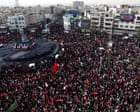
The state-mandated choreography of public grief in Tehran masks a fractured nation and a vicious behind-the-scenes scramble for absolute power. While Iranian state television broadcasts sweeping aerial footage of millions packing the streets for the funeral procession of Supreme Leader Ali Khamenei, the reality on the ground tells a vastly different story. This massive gathering is not a spontaneous eruption of national sorrow. It is a highly engineered political theater designed to project stability while the Islamic Revolutionary Guard Corps and elite clerical factions wage a quiet, ruthless war to determine who will inherit the regime's vast economic empire and nuclear ambitions.
The Mechanics of State Orchestrated Mourning
The regime excels at logistics. For decades, the Islamic Republic has refined the art of mobilizing mass crowds on demand, utilizing a deeply entrenched network of state patronage and coercion to fill the streets of the capital.
Civil servants, municipal workers, and school children are routinely ordered to attend these events under implicit threat of job loss or academic expulsion. Free transportation via chartered buses flows into Tehran from rural provinces where economic desperation makes a free meal and a day's stipend a powerful incentive. The government shuts down public transit networks, forcing commuters into designated procession routes to artificially swell the density of the crowds for international cameras.
This is the facade. Western media outlets frequently take these images at face value, reporting on the sheer volume of bodies without analyzing the machinery required to place them there. During the 2020 funeral of military commander Qasem Soleimani, similar tactics produced massive crowds, yet less than two years later, those same streets erupted in widespread anti-regime protests. The regime understands that visibility equals legitimacy in the eyes of the outside world, making these funeral spectacles a core component of its survival strategy.
The Silent Majority Watching from the Shadows
Away from the camera lenses, a quiet resentment fills the residential neighborhoods of Tehran, Isfahan, and Shiraz. Millions of Iranians are choosing to stay home, watching the state-sponsored theater with a mix of exhaustion and anger.
The economic reality facing ordinary citizens is grim, characterized by runaway inflation, a collapsed currency, and systemic corruption that drains the nation's wealth into foreign military adventures. For the younger generation, which has known nothing but economic isolation and social repression, the death of the Supreme Leader brings no grief. Instead, it brings a tense anticipation of what might follow, mixed with the memory of friends and family members killed or imprisoned during recent civil uprisings.
The divide is generational and deep. Security forces have been deployed heavily in known dissident neighborhoods, cutting off internet access and setting up checkpoints to prevent any spontaneous celebrations or anti-government demonstrations from gaining traction while the official mourning period proceeds.
The Rise of the Military Junta
The real struggle is happening far from the funeral route. The Islamic Revolutionary Guard Corps, or IRGC, is moving rapidly to consolidate its grip on the state apparatus, effectively transforming Iran from a theocracy into a military dictatorship.
The Guard is no longer just a military wing. Over the past three decades, it has evolved into a massive economic conglomerate that controls major industries, including telecommunications, oil extraction, civil construction, and cross-border smuggling networks.
+-------------------------------------------------------+
|              IRGC ECONOMIC GRIP                       |
+-------------------------------------------------------+
|  - Telecommunications & Media Control                 |
|  - Oil Extraction & Smuggling Networks                |
|  - Major Civil Construction & Infrastructure          |
|  - Financial Institutions & Bonyads (Foundations)     |
+-------------------------------------------------------+
The clerical establishment in Qom is losing ground. The elderly ayatollahs who once held supreme political authority are increasingly dependent on the IRGC for physical survival and financial liquidity. The Guard does not want a strong, independent religious scholar to ascend to the position of Supreme Leader. They require a weak, pliable figurehead who will rubber-stamp their domestic economic monopolies and aggressive regional foreign policy without questioning their authority.
The Succession Farce Inside the Assembly of Experts
The formal mechanism for choosing the next leader is a charade. The Assembly of Experts, a body of eighty-eight elderly clerics, is constitutionally tasked with selecting Khamenei successor, but their deliberations are entirely dictated by security intelligence agencies.
The Case of Mojtaba Khamenei
The late dictator's second son has spent years building a quiet power base within the regime's intelligence apparatus and the Basij paramilitary forces. He represents continuity for the core loyalists. However, elevating a son to replace his father creates a massive ideological problem for a regime founded on the explicit rejection of hereditary monarchy.
The Purge of the Moderates
Any cleric possessing independent popularity or moderate leanings has already been systematically barred from running for the Assembly of Experts over the last several election cycles. The candidate pool consists entirely of hardline loyalists, meaning the selection process will not involve a debate over the country's direction, but rather a transactional negotiation over which faction gets to control specific state ministries and multi-billion-dollar religious foundations.
Regional Shockwaves and the Proxy Network
The transition of power in Tehran sends immediate tremors across the Middle East. Iran’s network of proxy militias, stretching from Lebanon to Yemen, relies on the direct authority and financial backing of the office of the Supreme Leader.
- Hezbollah in Lebanon: Dependent on ideological alignment with Tehran to justify its domestic weapons stockpile.
- The Houthi Movement in Yemen: Relies on the IRGC for advanced missile technology and maritime intelligence.
- Iraqi Shiite Militias: Prone to internal fracturing without a strong arbitrating voice from the Iranian leadership.
To prevent any perception of weakness during this transition, the IRGC is likely to order these proxy groups to increase their operational tempo, launching fresh drone or missile strikes against regional adversaries to project an image of uninterrupted strength and resolve.
The Nuclear Escalation Strategy
A vulnerable regime is a dangerous regime. Facing internal illegitimacy and economic decay, the hardline factions taking control in Tehran are highly incentivized to accelerate their nuclear weapons program as the ultimate insurance policy against regime change.
The diplomatic tracks with Western nations are dead. The incoming leadership will view any compromise on enrichment levels as a sign of weakness that could invite domestic rebellion or foreign military intervention. By pushing enrichment levels closer to weapons-grade status, the new leadership aims to force the international community to accept Iran as a permanent nuclear threshold state, securing their domestic survival regardless of how deeply the population detests the government. The crowds in the streets will soon disperse, leaving behind a heavily armed military regime determined to preserve its wealth through domestic terror and international brinkmanship.