
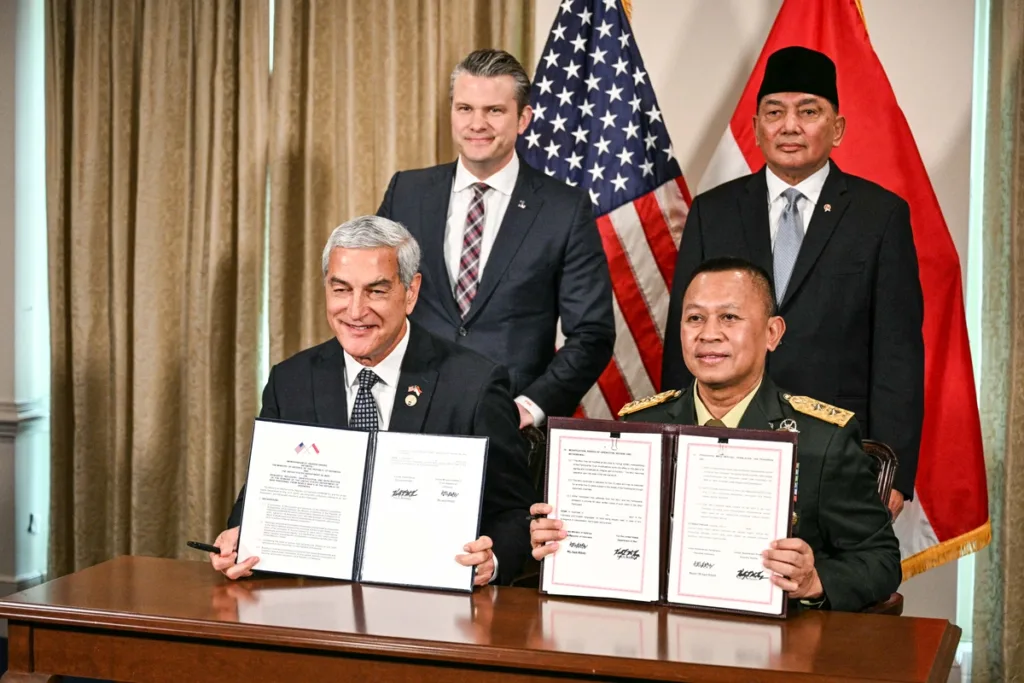
Geopolitics is currently obsessed with a choke point that might not even matter in a real shooting war. The "Malacca Dilemma"—the idea that China is uniquely vulnerable to a naval blockade in the narrow straits between Sumatra and the Malay Peninsula—has become the lazy intellectual anchor for every Southeast Asian defense analyst. When the US and Indonesia signed their recent "historic" defense cooperation agreement, the consensus was immediate: Washington just tightened the noose, and Jakarta finally picked a side.
That narrative is wrong. It ignores the reality of modern missile envelopes, the physics of energy transit, and the actual sovereign interests of an Indonesia that has no intention of being anyone’s unsinkable aircraft carrier.
The Geography Trap
The Malacca Strait is 580 miles long. At its narrowest point near Singapore, it is only 1.5 nautical miles wide. On paper, it is a bottleneck. In reality, blockading it is a logistical nightmare that would cripple the global economy long before it forced Beijing to its knees.
The lazy consensus suggests that by upgrading ties with Indonesia, the US gains a "plug" for the hole. This assumes Indonesia would permit its territorial waters to become a kinetic combat zone. It won't. Jakarta’s "Bebas dan Aktif" (independent and active) foreign policy isn't just a slogan; it’s a survival mechanism. They saw how the US treated allies in the 20th century. They aren't interested in being the front line for a Western containment strategy that offers them plenty of risk and very little "hard" protection.
If you think a few joint exercises and a bilateral defense agreement turn the Indonesian archipelago into a US naval base, you haven't been paying attention to the Indonesian House of Representatives. They are fiercely protective of their neutrality. This pact is about Jakarta getting cheaper hardware and better training, not about them handing the keys of the Sunda or Lombok straits to the Seventh Fleet.
The Missile Envelope Reality Check
We need to talk about the $A2/AD$ (Anti-Access/Area Denial) bubble. Most analysts speak about the Malacca Strait as if we are still in 1944, where you park a cruiser in the middle of a channel and wait.
In a modern conflict, the "Malacca Dilemma" is solved not by ships, but by land-based precision strikes. China’s DF-21D and DF-26 "carrier killer" missiles have ranges that comfortably cover the South China Sea and extend into the Indian Ocean. If the US tries to close the Malacca Strait, China doesn't need to send a fleet to break the blockade. They just need to make the surrounding waters untenable for any surface vessel.
The US-Indonesia pact focuses on maritime security and "domain awareness." That’s a fancy way of saying "better radar." But radar doesn't stop a hypersonic glide vehicle. By the time the US "sharpens" the dilemma, the dilemma has already shifted 1,000 miles south.
The Energy Diversification Fallacy
The argument always comes back to oil. "China gets 80% of its oil through Malacca!"
This statistic is outdated and lacks context. China has spent the last decade building a continental energy strategy that bypasses the sea entirely.
- The Power of Siberia 2 pipeline: Bringing massive amounts of Russian gas directly overland.
- The Gwadar-Kashgar corridor: Part of the CPEC, aiming to move oil from the Arabian Sea through Pakistan.
- The Myanmar Pipelines: Direct transit from the Bay of Bengal to Yunnan province.
Is it enough to replace the sea lanes entirely? No. But it's enough to keep the lights on and the tanks moving during a high-intensity conflict. A blockade is a slow-motion weapon. It takes months to work. In the age of cyber warfare and satellite-guided munitions, a war in the Pacific will be decided in weeks, not years. The Malacca Dilemma is a 19th-century solution to a 21st-century problem.
Indonesia is Playing Both Sides (And Winning)
Stop looking at this pact as a win for Washington. It is a masterclass in Indonesian hedging.
Jakarta just watched the US struggle to maintain its own industrial base while China floods Southeast Asia with high-speed rail, 5G infrastructure, and digital payment systems. Indonesia's defense minister—and now president—Prabowo Subianto is a pragmatist. He knows that if he buys F-15EX jets from the US, he keeps the Americans happy and his generals equipped. Simultaneously, he keeps the door wide open for Chinese investment in nickel processing and "Downstreaming."
The US thinks it is buying an ally. Indonesia knows it is just diversifying its portfolio.
The High Cost of a Blockade
Let's run a thought experiment. Imagine the US actually succeeds in closing the Malacca Strait to Chinese-bound tankers.
Global insurance rates for shipping would instantly quintuple. Every vessel headed for Japan, South Korea, and Taiwan—all major US allies—would have to reroute through the deeper, longer Lombok or Makassar straits. This adds thousands of miles and millions of dollars in fuel costs per journey. You don't just "choke" China; you starve the global supply chain.
The political fallout for Washington would be catastrophic. The "Malacca Dilemma" isn't just China's problem; it’s a global economic suicide pill. Indonesia knows this. They have no interest in seeing their waters turned into a parking lot for stalled cargo ships or a graveyard for tankers.
The Tech Gap the Pact Doesn't Fix
The pact talks about "cooperation in cyberspace." This is the most hollow part of the agreement. While the US and Indonesia are busy practicing amphibious landings, the real war is being fought in the digital architecture of Jakarta.
China’s "Digital Silk Road" has already won the battle for the backbone of Indonesian tech. From Huawei gear in the telecom towers to the TikTok algorithms shaping the opinions of 200 million Indonesians, the influence is structural. A defense pact that ignores the fact that the host nation’s entire digital nervous system is built on "adversary" tech is a tactical delusion.
You can't defend a strait if your communications network has a back door you didn't build.
Stop Misunderstanding the Goal
The goal of the US-Indonesia pact isn't to "win" the Malacca Strait. It’s a desperate attempt at signaling. It’s theater designed to show Beijing that the "First Island Chain" strategy hasn't completely collapsed.
But signals aren't shells. And "awareness" isn't the same as control.
The Malacca Dilemma is a ghost. It’s a relic of a time before long-range sensors and overland pipelines. By focusing on this narrow strip of water, the US is telegraphing exactly where it is stuck in the past. Indonesia isn't sharpening a knife for the US; it's collecting a paycheck and keeping its options open.
If the US wants to actually influence the region, it needs to stop obsessing over naval bottlenecks and start competing on infrastructure, trade, and technology. You don't win the hearts and minds of Southeast Asia by asking them to help you start a blockade. You win by being a better partner than the guy across the street. Right now, the US is offering a shield, but China is offering a future.
The dilemma isn't China's. It's ours.


:strip_icc()/pic2513216.jpg)