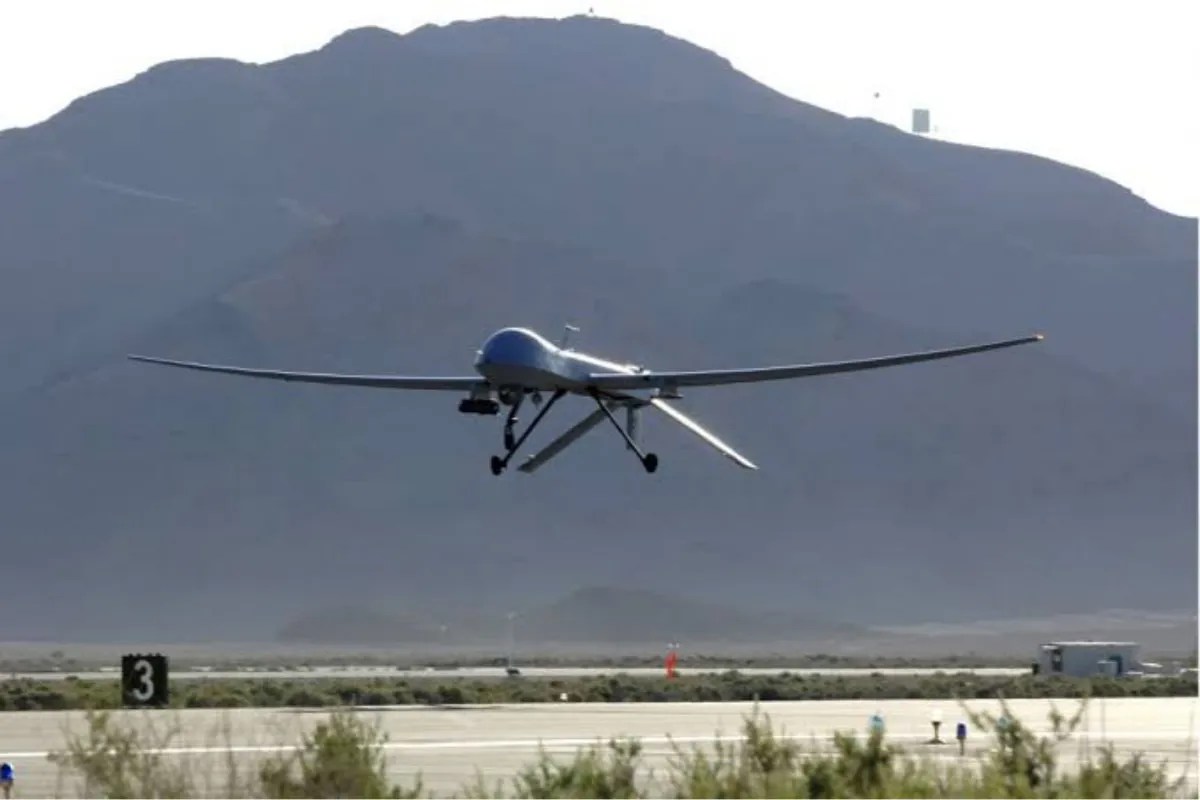
Tensions in the Persian Gulf just crossed another dangerous threshold. When military officials in Tehran announced that air defense units had successfully downed a United States MQ-1 drone near Qeshm Island, mainstream analysts treated it as just another routine skirmish. They're missing the forest for the trees. This isn't business as usual in the Middle East. It's a calculated escalation that exposes deep vulnerabilities in modern aerial reconnaissance and signals a total breakdown of maritime de-escalation channels in the Strait of Hormuz. If you think this is just local posturing, you aren't paying attention to how fragile global energy corridors have become.
Behind the Headlines of the Strait of Hormuz Crisis
Let's look at what actually happened on the ground and in the air. The Islamic Revolutionary Guard Corps didn't just fire a random surface-to-air missile; they deployed a newly developed domestic air defense grid to intercept the MQ-1 surveillance platform. That detail matters immensely. Tehran is showcasing indigenous defense manufacturing under heavy international sanctions, proving that its electronic warfare and radar tracking capabilities have evolved past basic legacy systems.
Most commentators love to talk about grand geopolitical strategies, but they completely ignore the operational friction happening at the tactical level. Operating high-value reconnaissance assets near a hostile coastline is a massive gamble. When you fly predictable patterns within range of modernized tactical air defenses, you're inviting disaster. The US military command structure in the region faces a brutal reality check. Traditional dominance in the skies over the Gulf is no longer absolute. Iranian forces have spent years studying flight profiles, radar cross-sections, and electronic signatures. They've built an environment where legacy drones struggle to operate with impunity.
To understand why this specific incident stings Washington, you have to look at the broader timeline of the region. Diplomatic talks stalled out months ago over disagreements on securing free navigation through the strait. Once the memorandum of understanding collapsed, military commanders on both sides took the leash off. Tehran views every foreign reconnaissance flight as an imminent prelude to a strike, while Washington views freedom of navigation as a non-negotiable principle of international law. That fundamental clash of interpretations guarantees that every single drone flight becomes a high-stakes poker game.
Decoding the MQ-1 Drone Technology and Vulnerabilities
People often confuse the MQ-1 Predator with invincible sci-fi machinery. It's not. It's a reliable, medium-altitude, long-endurance workhorse, but it wasn't designed to survive in a contested, high-threat airspace packed with localized anti-air batteries. It lacks stealth coatings, high-speed evasion maneuvers, and advanced electronic countermeasure suites found on fifth-generation fighter platforms.
When the IRGC Aerospace Force tracked and destroyed the aircraft over Qeshm Island, they exploited precisely these architectural limits. Let's be honest about drone warfare: builders designed these platforms for counter-insurgency campaigns against stateless actors who lacked radar networks, not for high-intensity standoffs with a nation-state possessing integrated air defense command networks.
Military contractors will tell you that software updates and sensor upgrades keep older airframes relevant. That's true up to a point. Physics and geometry always win in the end. A large, propeller-driven or turboprop airframe with a distinct thermal and radar signature stands out starkly against modern digital receivers. Iran's investment in localized radar detection networks means that sitting ducks in the sky don't stay in the air for long. If Washington keeps relying on airframes built for a completely different era of warfare, the casualty count for uncrewed assets will keep climbing.
The Split Command Structure Inside Iran
Here is a nuance that most foreign policy pundits completely mess up. They talk about "Iran" as a single, monolithic actor. It isn't. You have a deeply entrenched institutional rivalry between the regular military, known as the Artesh, and the Islamic Revolutionary Guard Corps.
This split matters because both branches operate separate chains of command, run distinct naval forces, and occasionally compete for prestige and operational credit. For instance, when the regular Army Navy claimed a separate MQ-1 intercept off the Sirik coast, foreign intelligence agencies scrambled to figure out if it was a duplicate report or a entirely separate engagement. Treating these branches as a unified team leads to terrible analytical conclusions.
The IRGC operates with ideological fervor and direct political influence, while the regular military follows a more traditional branch hierarchy. When both organizations start claiming successful intercepts of US hardware within days of each other, it signals internal competition to prove readiness. Hardliners use these operational victories to lock down domestic political support and signal strength to regional rivals. If you're trying to forecast Tehran's next diplomatic move, you have to factor in this institutional rivalry. A moderate voice trying to revive stalled talks gets drowned out instantly the moment military commanders rack up a high-profile tactical win.
Economic Shockwaves and Maritime Fallout
You can't separate what happens in the air from what happens on the water in this narrow choke point. The Strait of Hormuz handles a massive chunk of the world's petroleum transit. When air defenses start lighting up the sky, commercial shipping feels the shockwave immediately.
Recent reports from the region highlight oil tankers striking naval mines and catching fire after straying into restricted maritime zones with their tracking transponders disabled. Maritime trade organizations issue warnings, insurance premiums skyrocket overnight, and cargo carriers start rerouting entirely. That hits global supply chains where it hurts. Energy markets are notoriously jumpy. Every time a drone drops out of the sky or a tanker hits an obstacle, fuel prices react instantly.
Don't buy the comforting narrative that shipping companies can easily absorb these risks. Shipping crude oil through a war zone with deactivated transponders is an act of sheer desperation. Owners are gambling their vessels to beat blockages, and many are losing that gamble. The joint declaration by regional authorities that parts of the strait are restricted zones creates an impossible environment for international trade. If energy importers think they can maintain normal trade flows while military forces treat the waterway as a live-fire zone, they're living in a fantasy world.
Navigating the Realities of Modern Regional Conflict
So where does this leave us? We're stuck in a permanent state of high-stakes friction where minor tactical incidents can snowball into catastrophic military confrontation within minutes.
If you're tracking international
Why the US Military Keeps Losing Drones Near the Strait of Hormuz
news
Millions of dollars in advanced aviation tech can vanish in seconds over a narrow strip of water. When reports surface of the US military losing reconnaissance assets like the MQ-1 near the Strait of Hormuz, mainstream analysts act surprised. You shouldn't be. Modern air dominance faces a brutal reality check in contested regional airspace. Iran's air defense network isn't sitting passively. It's actively probing, tracking, and neutralizing unmanned aerial vehicles that fly too close to sensitive borders.
Operating expensive military hardware in high-tension zones creates predictable vulnerabilities. When planners rely on platforms built for counter-insurgency environments rather than peer-to-peer electronic warfare, disaster follows. Let's look at why these losses keep happening and what they reveal about modern defense strategies.
The Reality of Asymmetric Warfare in the Gulf
Geography dictates strategy. The Strait of Hormuz spans roughly 21 miles at its narrowest point, forcing commercial tankers and military patrols into tight shipping lanes. Iran commands the northern coastline of this crucial maritime chokepoint. That means every patrol flight happens right under the watchful gaze of indigenous radar systems and surface-to-air missile batteries.
You can't just fly multi-million dollar surveillance aircraft along hostile borders without expecting a kinetic response. For decades, Western military planners operated under the assumption of absolute air supremacy. That era ended quietly years ago. Regional powers have spent massive resources upgrading their air defense architectures, acquiring sophisticated radar arrays, and mastering electronic jamming. When a drone enters airspace that a sovereign nation considers its own sovereign territory or immediate security perimeter, engagement thresholds drop to zero.
Why High-End Drones Are Sitting Ducks
Medium-altitude long-endurance platforms weren't built for high-threat environments. They prioritize fuel efficiency, long loiter times, and large payload capacities over radar evasion. Their wingspans are massive. Their radar cross-sections are significant. Their cruising speeds are slow.
Against low-tech militias, an MQ-1 or similar drone operates with impunity. Against a nation-state with integrated air defense networks, they become expensive targets. They don't have the stealth coatings of a fifth-generation fighter. They don't carry internal weapon bays designed to suppress hostile radar before it locks on. When an adversary deploys advanced surface-to-air missile systems backed by active radar guidance, slow-moving propeller or turboprop drones struggle to evade incoming fire.
Military budgets absorb these losses, but the strategic embarrassment lingers. Each downed platform hands a propaganda victory to regional adversaries while depleting specialized fleet inventories that take years to replace.
The Strategic Importance of the Strait of Hormuz
Why keep flying vulnerable assets into a literal hornets' nest? Intelligence collection drives military operations. Knowing what Iranian naval forces, fast-attack craft, and missile batteries are doing requires persistent eyes in the sky. Satellites offer incredible imagery, but they follow predictable orbits. They can't linger over a specific cove or track a fast-moving convoy in real-time the way a drone can.
Commanders demand eyes on targets. Risk calculations get weighed against operational necessity. Washington often assumes that adversaries won't cross the line and shoot down an unmanned asset because of escalation fears. That assumption ignores local calculus. For Tehran, shooting down a surveillance drone demonstrates capability, deters future incursions, and signals domestic strength without triggering a full-scale conventional war. It's a calculated escalation that consistently catches foreign planners off guard.
How Electronic Warfare Changes the Equation
Physical missiles tell only half the story. Electronic warfare dominates modern airspace skirmishes. Long before a missile leaves its launcher, invisible electromagnetic battles rage across radio frequencies.
Drones depend entirely on satellite links and ground control stations to receive commands and transmit telemetry data. When an adversary deploys powerful frequency jammers, those control links fracture. GPS spoofing takes things a step further, feeding false navigational coordinates into the aircraft's onboard computer. A drone can easily become disoriented, drifting off course into restricted airspace or losing connection entirely, making it an easy target for kinetic interception.
Military contractors talk endlessly about software upgrades, but electronic countermeasures evolve faster than hardware patches can be deployed to the field. If you're flying legacy drone platforms in the Persian Gulf, you're fighting a digital war with outdated tools.
What Defense Contractors and Militaries Fail to Adapt
Institutional inertia kills progress. Defense procurement cycles take years, locking militaries into purchasing platforms designed for yesterday's conflicts. When adversaries rapidly innovate with cheap, locally produced air defense systems and electronic attack suites, massive defense contractors keep pushing oversized, expensive aircraft that require pristine operational conditions to survive.
Training pipelines also suffer. Pilots sitting in comfortable air-conditioned trailers thousands of miles away from the theater develop a false sense of security. They view flights over volatile zones as routine surveillance missions rather than active combat operations. That disconnect leads to lax routing choices and predictable flight patterns.
Militaries must pivot toward expendable, autonomous swarms rather than relying on a handful of exquisite, high-value drones. If a platform costs tens of millions of dollars, losing two of them in a single day hurts your budget and your operational readiness. If a platform costs a fraction of that and operates as part of an autonomous network, a single loss means nothing.
Moving Beyond Conventional Air Dominance
The skies over the Middle East demand a complete rethink of unmanned aerial operations. Clinging to the belief that air superiority is a permanent state rather than a temporary advantage guarantees more headlines about downed aircraft and embarrassed defense officials.
Protecting assets requires speed, stealth, and distributed architectures. Until procurement strategies match the harsh realities of modern electronic and kinetic warfare, patrols near Hormuz will remain a high-stakes gamble where the house usually wins.