Silence.
That is the first thing you notice when you stand beneath a retired spacecraft that has traveled one hundred and twenty-three million miles, survived the blistering plasma of twenty-five atmospheric reentries, and now sits bolted to concrete in the middle of South Los Angeles.
For more than a decade, if you walked into the Samuel Oschin Pavilion at the California Science Center, you saw Space Shuttle Endeavour lying flat on her belly. She looked like a magnificent, scorched leviathan resting on a beach—massive, undeniable, yet fundamentally grounded. You could walk right under her wings, inspect the black thermal tiles that look like charcoal briquettes, and admire the engineering. You could read the placards. You could memorize the trivia.
And yet, something was missing.
When a rocket lies horizontal, your brain files it away as a museum piece. An artifact. A dinosaur skeleton cleaned up for Sunday afternoon crowds. You forget that the entire point of the machine was to defy the crushing pull of the Earth, to balance millions of pounds of volatile liquid propellant on a controlled explosion, and to punch a hole straight through the sky.
To understand what Endeavour actually is, you have to see her the way the astronauts saw her at three in the morning on a humid Florida coast, illuminated by xenon floodlights, venting white clouds of freezing oxygen into the dark. You have to see her vertical.
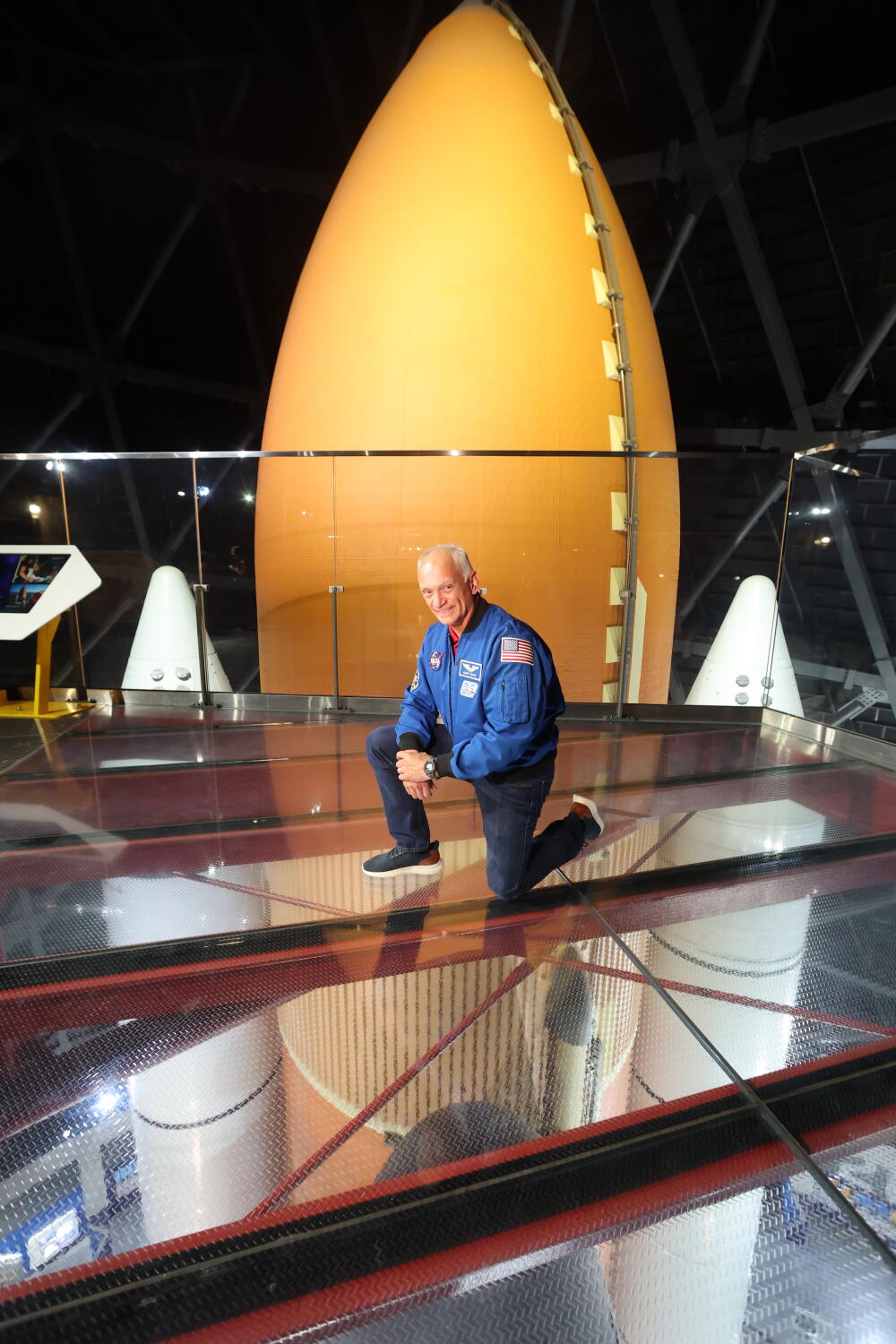
Now, as engineers and riggers complete the monumental task of hoisting Endeavour upright—mating her to genuine solid rocket boosters and a massive external fuel tank inside the new Samuel Oschin Air and Space Center—the ship is waking up. Not to fly again, of course. Her main engines will never roar over the Atlantic again. Instead, she is assuming her true posture so that a generation that never watched a shuttle launch can finally feel the sheer, terrifying audacity of human spaceflight in their bones.
Born From the Ashes of Tragedy
To stand at the base of this twenty-story stack is to confront a difficult truth. Endeavour should never have existed.
In the mid-1980s, NASA had no plans to build a fifth operational orbiter. The fleet—Columbia, Challenger, Discovery, and Atlantis—was considered complete. Then came January 28, 1986. Seventy-three seconds after liftoff, the Space Shuttle Challenger disintegrated over the Atlantic Ocean, taking the lives of seven crew members and shattering the illusion that space travel had become routine.
Imagine being an aerospace worker in Palmdale, California, in the months following that disaster. Grief hung over the assembly lines like fog. Yet out of that sorrow came a mandate from Congress to build a replacement—not from scratch, because budget realities were unforgiving, but from structural spare parts originally manufactured for Discovery and Atlantis.
She was a child of thrift and heartbreak. Even her name was chosen differently. Rather than letting bureaucrats pick a title behind closed doors, NASA turned to the nation's classrooms. Over sixty thousand students submitted essays, and the winning choice came from elementary and middle schoolers who proposed naming the ship after HMS Endeavour, the eighteenth-century vessel commanded by British explorer Captain James Cook. Like Cook’s ship, which charted the South Pacific and carried astronomers to observe the transit of Venus, this new orbiter would carry a British-style spelling—with that crucial, stubborn u—into uncharted territory.
When she rolled out of the Palmdale plant in April 1991, she was the youngest of the fleet, designated OV-105. She was lighter than Columbia, packed with upgraded avionics, improved braking systems, and a brand-new drag chute—a forty-foot nylon parachute designed to unfurl from her tail upon touchdown, cutting her landing roll by up to two thousand feet. She was built to be safer, sharper, and more resilient than anything that came before her.
The Invisible Stakes of the First Flight
Numbers on a museum plaque rarely convey terror. Consider a hypothetical rookie mission specialist—let’s call him Marcus—strapping into Endeavour’s mid-deck for her maiden voyage, STS-49, in May 1992.
Marcus isn't thinking about historical milestones. He is lying on his back in an orange pressure suit, listening to the pumps whine beneath him, acutely aware that he is sitting on top of nearly four million pounds of explosive fuel. When the three RS-25 main engines ignite, the entire stack twangs forward by several feet before snapping back—a violent shudder that feels like a giant hand shaking a tin can.
Six seconds later, the twin solid rocket boosters light. There is no turning them off. Once those boosters ignite, you are going to space, or you are not coming home.
On that first mission, Endeavour wasn't just taking a victory lap. Her crew was tasked with rescuing Intelsat VI, a stranded communications satellite spinning uselessly in orbit. The mission went sideways almost immediately. Two astronauts tried to capture the four-ton satellite using a specialized capture bar, and it wouldn't latch. They tried again. Nothing. With fuel running low and the mission teetering on the edge of a very public failure, NASA made an unprecedented call.
Three astronauts—Pierre Thuot, Richard Hieb, and Thomas Akers—went outside together. To this day, it remains the only three-person spacewalk in human history. Floating above the curve of the Earth, moving in slow, deliberate synchronization, the three men grabbed the massive satellite with their gloved hands, steadied it by sheer human muscle, and wrestled it into the payload bay so a new booster motor could be attached.
That was Endeavour’s debut. Not a sterile test flight, but an improvised, high-wire rescue mission that proved what humans could accomplish when machinery failed.
Fixing the Blind Eye of Humanity
If Endeavour’s first flight proved her grit, her fifth mission saved modern astronomy.
In 1990, NASA had launched the Hubble Space Telescope with breathless fanfare, only to discover a humiliating catastrophe. The telescope’s primary mirror had been ground too flat by roughly one-fiftieth the width of a human hair. Images came back blurry. Late-night comedians mocked the agency. The flagship of space science was effectively nearsighted.
In December 1993, Endeavour launched on STS-61 to perform orbital eye surgery.
Think of the Hubble repair mission like trying to perform microsurgery on a moving train while wearing thick oven mitts, in pitch darkness every forty-five minutes, with no emergency room within two hundred miles. Over five grueling spacewalks, Endeavour’s crew installed corrective optics—essentially a set of precision contact lenses—and replaced aging solar arrays and gyroscopes.
When the first crystal-clear images beamed down from Hubble weeks later, revealing distant galaxies in breathtaking sharpness, the entire trajectory of astrophysics shifted. Every awe-inspiring photograph of the Pillars of Creation, every deep-field image peering back toward the dawn of time, exists because Endeavour carried the surgeons and the tools to fix Hubble’s vision.
The Architecture of a Global Home
As the 1990s gave way to the new millennium, Endeavour’s role evolved from lone rescuer to heavy-lift construction crane.
In December 1998, she carried the Unity node into orbit, mating it with the Russian-built Zarya module. Those two pressurized cans, bolted together by astronauts floating in the vacuum, became the cornerstone of the International Space Station. Over twelve separate missions, Endeavour hauled trusses, solar wings, logistics modules, and the Japanese Kibo laboratory into low Earth orbit.
She also carried people who broke barriers quietly, without grandstanding. On STS-47 in 1992, Mae Jemison stepped onto Endeavour’s flight deck and became the first African American woman in space. Years later, on Endeavour’s penultimate flight, astronaut Mark Kelly commanded the ship while his wife, Congresswoman Gabrielle Giffords, recovered from a horrific assassination attempt back on Earth—a reminder that even when humans reach for the stars, our hearts remain tethered to fragile, mortal lives below.
By the time Endeavour touched down for the final time on June 1, 2011, concluding STS-134, she had circled the Earth 4,671 times. She had spent 299 days in space—nearly ten months of continuous flight at 17,500 miles per hour.
The Slowest Journey of All
Then came the strange, surreal epilogue.
A spacecraft engineered to circle the globe every ninety minutes had to be moved twelve miles through the streets of Los Angeles at a pace slower than a toddler's walk.
In October 2012, after riding piggyback atop a modified Boeing 747 across the country—performing low-altitude flyovers past the Golden Gate Bridge and the Hollywood Sign—Endeavour was mounted onto wheeled transporters at Los Angeles International Airport. What followed was a three-day urban ballet called Mission 26.
Anyone who stood along Manchester Boulevard or Crenshaw that weekend remembers the absurdity and the magic of it. Power lines were temporarily lifted. Traffic lights were unbolted. Hundreds of trees were removed—and later replaced four-to-one by the museum—just to give her seventy-eight-foot wingspan room to breathe. At times, her wingtips cleared apartment balconies and telephone poles by mere inches.
People didn't stay inside. Hundreds of thousands of Angelenos lined the sidewalks in lawn chairs, holding babies on their shoulders, cheering as a seventy-five-ton winged spaceship crept past donut shops, strip malls, and palm trees at two miles an hour. For one weekend, the cosmos came down to street level.
Why Vertical Changes the Psychology of Awe
Which brings us back to the present moment, and the massive engineering feat unfolding in Exposition Park.
To lift Endeavour upright, crews had to execute a process called "Go for Stack"—a sequence that hasn't been performed anywhere on Earth since the final shuttle launch in 2011. First came the aft skirts, anchored into a massive seismic isolation pad designed to let the entire twenty-story structure ride out a major California earthquake without snapping. Next came the solid rocket motors, stacked segment by segment. Then the orange external tank—ET-94, the last remaining flight-qualified external tank in existence—was hoisted into place by a massive crane.
Finally, in the dead of night to avoid thermal expansion and wind gusts, Endeavour herself was lifted nose-up, swung gently over the concrete walls of the unfinished building, and mated to the tank.
Why go through this staggering expense and complexity when the shuttle was already on display?
Because perspective alters truth.
When you walk into a room and see a machine standing two hundred feet tall, looming above you like a skyscraper ready to ignite, your nervous system reacts differently. Your neck cranes backward. Your stomach drops slightly. You suddenly grasp the sheer violence required to escape Earth’s gravity well. That towering orange tank isn't a neat cylinder anymore; it is a five-hundred-thousand-gallon thermos of super-cold liquid hydrogen and liquid oxygen, waiting to be consumed in eight and a half minutes. Those twin white boosters aren't decorative pillars; they are solid-fuel rockets that burned six tons of propellant every single second.
And perched on the side of that controlled bomb is the orbiter—a fragile, winged glider wrapped in twenty-four thousand individual silica tiles, each one custom-shaped to prevent the aluminum frame underneath from melting into slag at three thousand degrees Fahrenheit.
Standing at the base of the upright stack, you realize that spaceflight was never sleek or effortless. It was bulky, loud, dangerous, and improvised by thousands of machinists, seamstresses who stitched thermal blankets by hand, software engineers who wrote code with zero margin for error, and astronauts willing to sit on top of it all.
A Monument to What We Dare to Build
We live in an era of sleek, reusable rockets that land themselves on ocean barges with algorithmic grace. Modern spaceflight looks clean on a livestream. It is easy to take for granted.
Endeavour offers no such illusion. Look closely at her fuselage when she stands above you, and you will still see the scorch marks of reentry, the faint discoloration along her leading edges, the subtle patchwork of tiles replaced between flights. She is scarred because she worked.
A generation of kids will soon walk through the doors of the Samuel Oschin Air and Space Center, look up two hundred feet into the rafters, and see a real spaceship poised on the edge of departure. They won't just read a list of trivia about how many miles she flew or how many satellites she deployed. They will feel the physical weight of human ambition pressing down on the floor beneath their shoes, and in the quiet hum of the exhibit hall, they might just hear the faintest echo of the countdown.