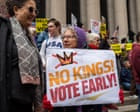
Ninety minutes sounds brief on paper. In the middle of roughly 3,000 nationwide rallies and early-voting pushes ahead of the November 2026 midterms, ninety minutes felt like an eternity to organizers trying to steer crowds and recruit volunteers.
On Saturday, October 17, 2026, Meta took the official Instagram account of the No Kings Coalition offline right as demonstrations unfolded across cities from New York and Washington, D.C., to Los Angeles and Seattle. Even after the account's public visibility came back, coalition administrators said they remained locked out of full backend access for hours, unable to post updates or coordinate directly with their network in real time.
Outrage followed fast. Activists warned of political censorship, the League of Women Voters called the timing deeply troubling during active civic organizing, and a coalition of state attorneys general led by California Attorney General Rob Bonta—alongside officials from states including Connecticut, New York, Massachusetts, and Washington—pressed Meta for answers.
Here's the uncomfortable truth behind the No Kings Instagram suspension: whether you buy Meta's technical excuse or suspect deeper political bias, the incident exposes how fragile public organizing becomes when a single private company controls the town square.
What Actually Happened During the No Kings Instagram Suspension
Timing is everything in organizing, and October 17 was a high-stakes mobilization day. A year after large No Kings protests spread across 2,500 cities in 2025, organizers were using rallies to drive early voting and sign up volunteers ahead of the November 3 midterms.
When the account went dark, rumors spread immediately. When a high-profile protest movement loses its primary visual channel mid-event, people don't automatically assume a routine server hiccup. They wonder who flipped the switch.
Meta's response came in stages and didn't clear up every doubt. Initially, statements pointed toward high-frequency actions like posting, sharing, or commenting triggering automated defenses. Coalition members pushed back, noting they'd only posted a handful of times in the prior 24 hours while livestreaming to thousands.
A day later, Meta spokesperson Andy Stone offered a more specific explanation on X. According to Stone, Meta's security systems detected a sharp spike—roughly four times normal volume in short bursts—in "reading" behavior tied to a Claude tool examining profiles, posts, and hashtags. That sequential machine-paced reading looked like automated bot traffic, prompting an automated suspension. Stone said an automated re-review about an hour later reversed the removal, though restoring full admin access took longer.
Honest assessment? Meta's shift from posting activity to reading traffic is plausible on a technical level, yet plenty of questions remain unanswered. Meta hasn't publicly identified which Claude tool was involved, who operated it, or whether it had any connection to the coalition's staff or volunteers. Anthropic hasn't publicly confirmed the tool either.
Why Bot Defenses and AI Agents Keep Colliding
Anyone who has managed high-traffic accounts or built web tools knows the tension behind this story. Platform anti-abuse systems are built on a simple heuristic: humans click around irregularly, while scrapers and bots fire rapid, sequential requests in tight bursts.
AI agents break that binary. An assistant or research agent tasked with summarizing hashtags, checking post performance, or monitoring mentions can easily pull pages four times faster than a person scrolling on a phone. To an automated defense looking at request shape and speed rather than intent, an AI helper looks indistinguishable from an aggressive scraper.
There's also a glaring asymmetry in how automated enforcement works. Machines can flag and pull an account down in seconds. Fixing the ripple effects—especially regaining full administrative control when a page is tied to live events—takes noticeably longer. Even when an automated re-review catches the mistake within an hour, the operational damage during a live protest or voter drive already happened.
That doesn't prove malice by itself. Automated false positives happen every day on large social networks. Still, when an automated system can knock a major civic account offline right in the middle of a national day of action, relying purely on "oops, our algorithm got confused" wears thin pretty fast.
Why Skepticism Over Political Bias Won't Go Away
Even if Meta's engineering team is telling the exact truth about the traffic spike, you can't separate this episode from the broader political climate around Meta.
Critics, lawmakers like Sen. Chris Murphy, and state attorneys general have scrutinized Meta's relationship with the Trump administration, its policy shifts around moderation and DEI protections, and its massive commercial and regulatory stakes in Washington—from AI infrastructure to government contracts. When a company has deep political and business entanglements while wielding unilateral power over public speech channels, every outage gets viewed through a political lens.
At the same time, fairness cuts both ways. Jumping straight from a 90-minute suspension to a grand conspiracy isn't backed by hard evidence here, and we shouldn't pretend otherwise. A fourfold burst of sequential reading traffic is a concrete technical claim, even if Meta hasn't released independent logs or named the tool behind it.
What makes the situation so volatile is that both possibilities point to the same structural flaw. Whether the shutdown came from an overzealous bot filter tripped by an AI agent or from something darker, everyday citizens and grassroots groups have almost zero leverage when their primary megaphone goes quiet.
Practical Steps Organizers and Creators Can Take Right Now
If you run a protest group, advocacy campaign, community page, or creator brand, treating a single social platform as your sole lifeline is a rookie mistake. I've seen teams scramble during live launches and events because one automated lock froze their main handle. You can't control Meta's spam filters, but you can reduce how much they hurt you.
- Build off-platform channels you actually own. Keep an email list, SMS alerts, or a simple standalone website where supporters can check rally times, polling info, and updates even if a social account gets suspended.
- Audit who and what touches your account. Know which third-party apps, scheduling tools, or AI assistants have access to read or interact with your profiles, and avoid running high-speed automated browsing on accounts tied to live events.
- Maintain multiple backup admins. Don't leave account recovery or posting permissions in the hands of a single person who might be offline or locked out when trouble hits.
- Pre-stage emergency comms. Draft backup announcements ahead of major events and keep secondary handles active so your audience knows where to look if your main page disappears.
Algorithms will keep misreading AI traffic, and political fights over big tech will keep escalating. Owning your direct line to your people is the one defense that doesn't depend on a platform's good mood.