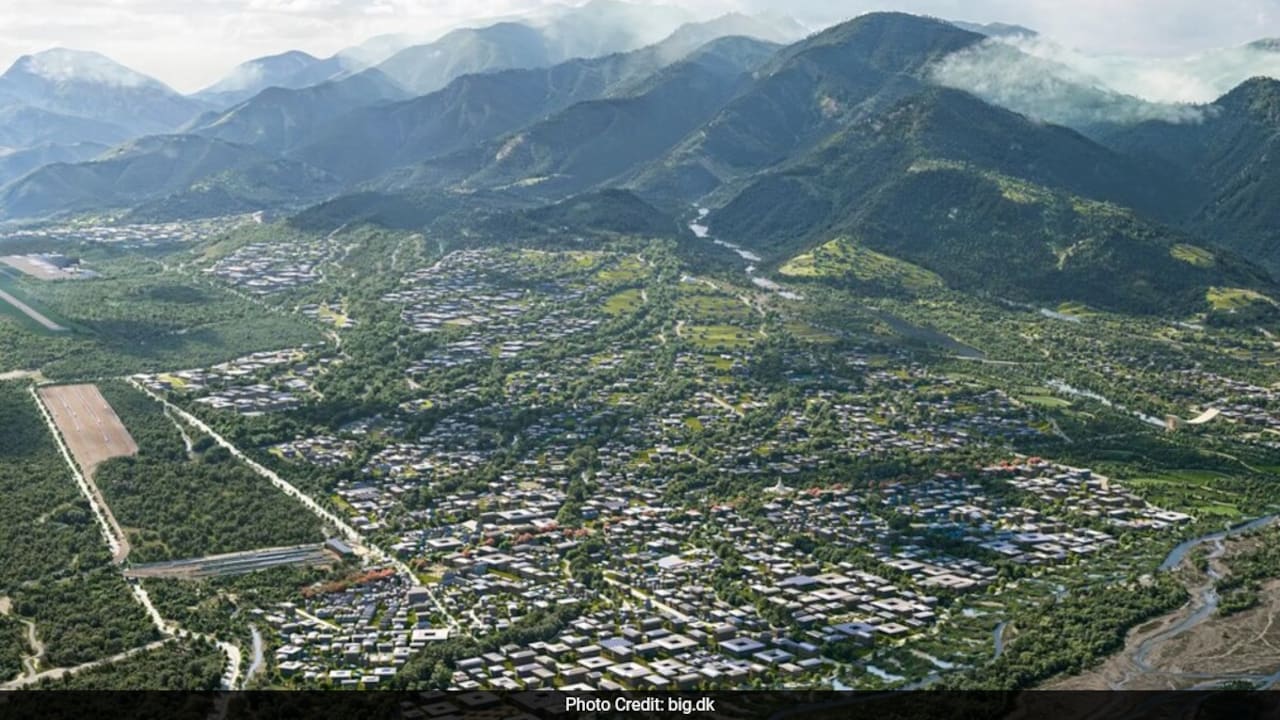
Money has always been a restless creature. For centuries, it fled to wherever the walls were highest and the vaults deepest. It built glass cathedrals in Zurich, carved quiet sanctuaries out of Swiss alpine valleys, and nested inside the shimmering skyscrapers of Singapore and New York. Capital sought safety in sterile efficiency. It sought secrecy. It sought speed.
And then, somewhere in the folds of the eastern Himalayas, a king looked at the global financial machine and decided to build something entirely different.
Imagine sitting in a room where the air smells faintly of pine resin and wood smoke, miles above sea level, while a sovereign nation proposes a radical paradox. Bhutan does not want your money just to make more money. Bhutan wants your money to mean something.
That is the quiet earthquake behind the recent announcement out of Gelephu Mindfulness City. The kingdom has officially unfurled its policy framework for family offices and investment funds. To the casual observer tracking global wealth management, this might sound like standard administrative boilerplate. Another special economic zone. Another set of tax incentives designed to lure mobile capital away from the Cayman Islands or Delaware.
It is nothing of the sort.
Consider Elena. She is a hypothetical director for a multi-generational family office managing capital accumulated over three decades of industrial manufacturing. Elena spends her weeks navigating a dizzying maze of compliance spreadsheets, geopolitical friction, and the quiet existential dread that her clients' wealth is contributing to a world burning itself out. Her clients do not just want a three percent return this quarter. They want to know that fifty years from now, their descendants will inhabit a planet with breathable air, stable institutions, and communities that possess a soul.
Until recently, places like Zurich or London offered the protection, but not the purpose.
Enter Gelephu.
Deep in the southern foothills of Bhutan, where subtropical forests meet the plains of India, the kingdom is carving out a mindfulness city. This is not a metaphor. It is an administrative, legal, and economic entity governed by an independent civil law system designed specifically to attract international arbitration, green technology investments, venture capital, and now, private wealth and family offices.
The new policy framework is remarkably precise about what it permits, and ruthlessly clear about what it rejects. Family offices establishing a presence in Gelephu are invited to manage private wealth, engage in philanthropic deployment, and channel venture capital into sustainable enterprises. But the rules of entry carry a distinct philosophical weight. Investments must align with ecological sustainability, mindfulness principles, and long-term socio-economic well-being.
This is where the skepticism usually begins.
Critics look at Bhutan—a nation historically famous for measuring its success through Gross National Happiness rather than Gross Domestic Product—and ask how a mountain kingdom can hope to compete with the entrenched financial infrastructure of London or Singapore. They point to the lack of deep-water ports, the mountainous terrain, the nascent state of the local capital markets. They wonder if this is an idealistic daydream destined to crash against the cold realities of international finance.
They miss the point entirely.
Capital is terrified right now. It is terrified of climate collapse, social fracturing, regulatory whiplash, and the sheer emptiness of infinite compounding interest in a finite world. Wealth holders are increasingly waking up to a stark realization. Their money is only as safe as the society surrounding it. If the ecosystem collapses, if social cohesion dissolves, a billion dollars in a Swiss bank account becomes entirely worthless.
Bhutan offers an alternative hypothesis. What if capital sought sanctuary not in isolation from society, but in deep alignment with a society that has spent generations protecting its environment, its culture, and its spiritual heritage?
The newly minted regulations for family offices in Gelephu are structured to provide modern governance standards while preserving the moral clarity of the nation. Trusts, holding entities, and investment funds operating within the special administrative region benefit from streamlined licensing procedures, tax efficiencies tailored for long-term stewardship, and access to a growing ecosystem of renewable energy, organic agriculture, and green infrastructure projects.
Money flows where it is treated best. Historically, that meant lowest taxes and least regulation. Today, it increasingly means lowest existential risk.
To understand why this matters, look at how family offices have evolved over the past decade. The younger generation of wealth inheritors—millennials and Generation Z—are driving a massive Great Wealth Transfer. They do not want to park their family fortunes in fossil fuel conglomerates and weapon manufacturers just to squeeze out an extra percentage point of yield. They demand impact. They demand transparency. They demand a narrative they can look at in the mirror without flinching.
Gelephu hands them that narrative on a silver platter.
Imagine a family office board meeting overlooking the misty ridges of the Himalayas instead of a fluorescent-lit conference room in midtown Manhattan. The portfolio managers are reviewing an allocation not into speculative real estate derivatives, but into a green grid initiative powering Bhutanese hydroelectricity and cross-border clean energy corridors into South Asia. The capital is working. It is generating returns. But it is also anchoring a regional transition toward a carbon-negative future.
That is what makes the Gelephu announcement a watershed moment. It bridges the gap between cold quantitative finance and warm human aspiration.
Of course, building a financial hub from scratch is an uphill battle. Logistics are complicated. Talent acquisition takes time. Developing an independent legal system that global institutional investors trust implicitly requires years of meticulous execution, diplomatic negotiation, and regulatory consistency. Bhutanese officials are candid about these hurdles. They are not promising an overnight miracle. They are building an institution meant to endure for centuries.
And that is precisely what family offices are designed for.
Short-term traders live by the second. Venture capitalists live by the decade. Family offices live by the century. They think in terms of dynasties, legacies, and multi-generational survival. Their entire raison d'être is continuity.
By positioning Gelephu as a global hub for long-term capital, Bhutan is tapping into the deepest psychological need of modern wealth: the desire for permanence with a clear conscience.
The policy details themselves are comprehensive. They cover asset protection vehicles, private trust companies, investment fund structuring, and immigration pathways for key personnel. Yet, beneath the legal terminology lies an invitation to participate in an unprecedented socioeconomic experiment. The kingdom is offering a sovereign sandbox where business innovation does not come at the expense of ecological health or human dignity.
Consider the alternative. As traditional financial centers grapple with rising sea levels, housing crises, political polarization, and regulatory uncertainty, the traditional havens are losing their sheen. Safety is migrating. It is moving toward places that have retained their equilibrium.
Bhutan has maintained its equilibrium through intentionality. For decades, the country restricted mass tourism, guarded its forests with constitutional mandates, and prioritized the holistic well-being of its citizens over hyper-industrialization. Critics once called it backward. Today, that restraint looks like supreme foresight.
When a nation has spent fifty years proving that it means what it says about sustainability, its entry into the financial services sector carries an inherent credibility that money simply cannot buy. You cannot greenwash a sovereign kingdom that has constitutionally required sixty percent of its land to remain under forest cover. You cannot fake mindfulness when the entire national ethos is built on the premise that development must be equitable and kind.
This brings us back to the family offices and investment funds now looking toward Gelephu.
They are arriving not because they are charitable foundations giving away their fortunes, but because they recognize a superior risk-adjusted thesis. In a volatile world, alignment with a stable, principled, and forward-thinking sovereign state is the ultimate hedge.
The policy is written. The legal boundaries are drawn. The mountain air is crisp, and the digital infrastructure is being laid across the river valleys.
Wealth has always looked for a home where it can grow safely. Now, it has found a home where it can grow wisely.
As the sun sets over the peaks of the Himalayas, casting long, purple shadows across the fertile plains of Gelephu, the old financial capitals of the world continue their frantic churn of screens and tickers. But far away, in the quiet heart of the mountains, a different kind of future is being quietly, meticulously funded.