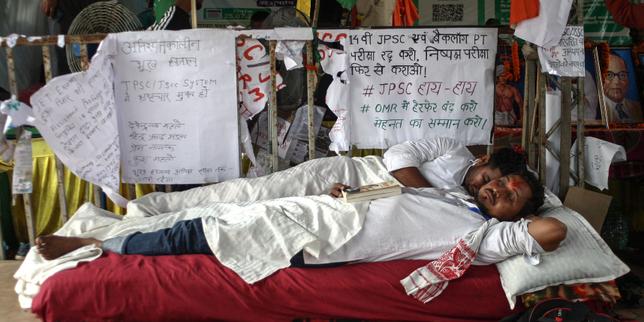
If you think exam paper leaks and institutional corruption are just minor administrative hiccups, look at Ranchi today. Thousands of young job aspirants aren't just angry; they're putting their bodies on the line because the system is systematically breaking their futures.
The recent fierce march toward the Jharkhand legislative assembly wasn't born in a vacuum. When desperate students face off against barricades, water cannons, and tear gas just to demand fair public service recruitment tests, it tells you everything about the simmering rage across the country regarding systemic paper leaks.
The Reality Behind the Ranchi Clashes
Let's look at the facts. The protests in Jharkhand didn't start yesterday. They grew over weeks of mounting frustration with recruitment bodies like the Jharkhand Public Service Commission (JPSC) and the Jharkhand Staff Selection Commission (JSSC). Students allege widespread question paper leaks and deep-seated irregularities.
The state government claimed it met the vast majority of demands, but the protesters aren't buying it. Scrapping only three out of thirteen contested exams doesn't fix a broken trust pipeline. When people spend years studying in cramped rooms, surviving on sparse means, and betting their entire adult lives on a fair shot at a civil service job, partial measures feel like an insult.
The situation escalated violently when thousands broke through barricades near the Jagannathpur Temple on their way to the assembly complex. Police deployed baton charges, water cannons, and tear gas. Graphic accounts from injured protesters highlight a tragic disconnect between state machinery and the youth it's supposed to serve. Even student leaders like Devendra Nath Mahto, enduring a prolonged hunger strike, joined the front lines straight from an ambulance on a stretcher.
Why a Local Protest Resonates Nationally
This isn't isolated to Jharkhand. Across India, the youth unemployment crisis collides daily with compromised examination processes. Earlier cycles of student agitation in New Delhi proved that systemic test fraud triggers national shockwaves.
When exams are rigged, it destroys meritocracy. It sends a toxic message to millions of hardworking young citizens: capability doesn't matter, connections or cash do. That realization drives students to march, fast, and risk criminal charges or physical injury. They are demanding independent oversight—such as a Central Bureau of Investigation (CBI) probe—because local investigative bodies often lack public credibility. Recent arrests of former commission officials only validate why trust in state-level probes remains remarkably low.
Where Accountability Falls Short
Governments love to rely on quick PR fixes, police containment, and defensive talking points. Arresting a former commission chairperson or offering piecemeal cancellations is no longer enough to calm an entire generation of educated youth who see their prime years slipping away to bureaucratic negligence.
If political leaders want stability, they need to overhaul recruitment architecture from top to bottom. Transparency, rigorous data security for question papers, and swift, unbiased judicial oversight are non-negotiable if public faith is going to be restored. Until the state stops treating student activism as a law-and-order nuisance and starts treating it as an urgent emergency, the streets will keep erupting.
:max_bytes(150000):strip_icc()/ar-American-Cheese-taste-test-horizon-4x3-54cc339550cd44b9a818c17bdfd5428d.jpg)