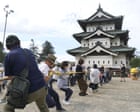
The internet lost its collective mind over a headline claiming Japan enlisted 1,800 people to drag a 360-tonne castle keep using ropes and rollers. Social media feeds flooded with romanticized nonsense about ancient engineering wisdom, communal harmony, and the enduring power of traditional human muscle. People ate it up. It fit the neat, comfortable narrative of quirky Japan honoring its heritage with sheer grit.
It is also an absolute masterclass in economic inefficiency.
Let us dismantle the lazy consensus right out of the gate. Pulling a 360-tonne wooden and stone structure across a courtyard using hemp ropes and logs is not an inspiring triumph of historical preservation. It is a brilliant PR stunt masking a logistical failure of modern project management. If any commercial enterprise handled heavy asset relocation the way heritage committees handle historic keeps, the board of directors would be marched out in handcuffs.
I have spent two decades managing complex, high-risk industrial relocations where a single miscalculation costs millions. I have seen heritage boards blow massive budgets on medieval LARPing exercises because they are terrified of offending local traditionalists.
Here is the truth nobody in the heritage tourism circuit wants to admit: tradition is a terrible reason to ignore basic physics and mechanical advantage.
The Myth of Ancient Authenticity
Let us look at the mechanics. The project in question typically refers to historic structural relocations in Japan—such as the famous moving of temple or castle structures using hikiya techniques. Enthusiasts love to talk about how the samurai did it.
The samurai did it because they did not have hydraulic dollies, self-propelled modular transporters, or pneumatic cranes with high-tonnage ratings. They used human muscle because human muscle was cheap, expendable, and abundant.
Today, gathering 1,800 people to haul ropes for a tourist photo-op is not an authentic recreation of history. It is a carefully orchestrated spectacle designed to generate viral engagement. Real historical hikiya masters used complex systems of wooden levers, fulcrums, and capstans operated by small, highly skilled crews—not a mob of thousands of amateurs pulling blindly on command.
When you throw 1,800 untrained bodies onto a haul line, you introduce a catastrophic variable into the load distribution. Friction coefficients change wildly. Tension spikes unevenly across the rigging. You are trading precise engineering control for theatrical chaos.
The Real Cost of Nostalgia
Let us talk numbers, because the romantic narrative conveniently ignores the balance sheet.
Mobilizing 1,800 people requires coordination, insurance, safety briefings, staging areas, catering, and public relations teams. The administrative overhead alone could fund a proper hydraulic lift system that would relocate the structure in a fraction of the time with zero structural stress from uneven human tugging.
Wood is anisotropic. It has different mechanical properties along different axes. When you subject a centuries-old timber frame—already desiccated, brittle, and structurally vulnerable—to the jagged, shock-loaded pull of human crowds rather than the smooth, continuous creep of hydraulic rams, you risk internal shear fractures.
You are risking the destruction of a irreplaceable cultural asset just so politicians can put on happi coats and pull ropes for the morning news broadcast. That is not conservation. That is vandalism with a good press agent.
The Contrarian Playbook for Heritage Logistics
If you actually care about preserving history instead of performing it for tourists, you throw out the medieval playbook and adopt modern heavy-lift technology.
- Isolate and Stabilize: Before moving an ounce of weight, internal steel exoskeleton bracing should be engineered to lock the timber joints into a rigid box.
- Eliminate Shock Loads: Replace human muscle with computer-synchronized hydraulic push-pull systems. Hydraulics do not get tired, slip, or yank unpredictably when a camera flash goes off.
- Optimize the Footprint: Modern multi-axle self-propelled modular transporters distribute weight evenly across high-density polyurethane tires, protecting subterranean infrastructure that ancient rollers would crush.
Admitting that modern technology outperforms ancient brute force does not diminish the achievement of the original builders. In fact, true respect for historical master carpenters means recognizing that they used the most advanced tools available to them in their era. If a sixteenth-century master builder had access to a 500-tonne hydraulic crane, he would have dropped his chisel, kissed the engineer, and bought a round of saké.
Stop confusing pageantry with preservation.
The next time you see a viral video of thousands of people straining against a hemp rope to move a heritage building, do not applaud the community spirit. Look at the structural stress fractures forming in the silent timber, count the wasted man-hours, and realize you are watching a very expensive, very risky medieval costume party.