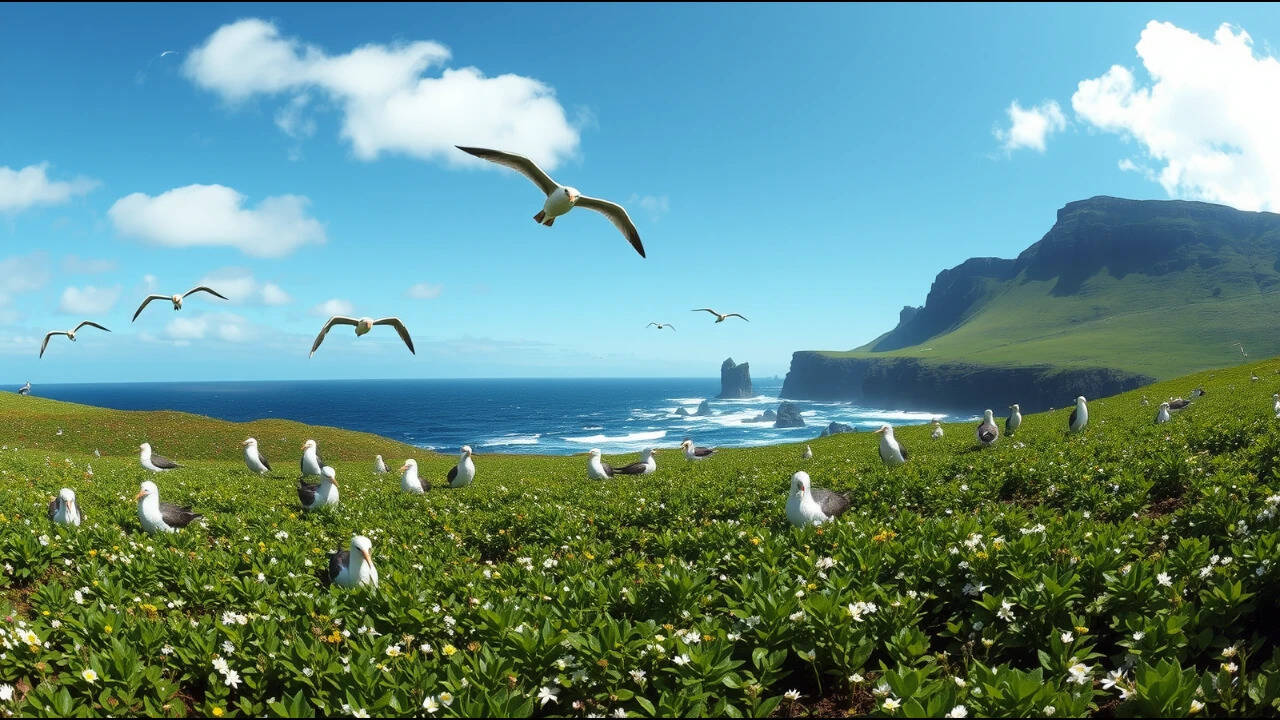
Wind does not merely blow on Macquarie Island. It strips. It batters black basalt cliffs, freezes tears in the corners of eyes, and carries the salt-heavy breath of the Southern Ocean across a jagged spine of rock sitting entirely alone between New Zealand and Antarctica.
Nothing human belongs here. Yet, for two centuries, we left our fingerprints behind in the form of teeth and claws.
Picture a stark, treeless plateau rising out of a gray-green swell. In the early nineteenth century, sealers stepped ashore and brought stowaways. They did not mean to. Wooden hulls carried mice, rats, and rabbits. These creatures did not just arrive; they unpacked. Without natural predators, their populations exploded into a quiet, creeping plague that chewed an ancient ecosystem down to its bones.
Quiet. That is the word people forget. Ecological collapse rarely arrives with an explosion. It arrives with silence.
Consider what happens when a million rabbits treat a fragile sub-Antarctic sanctuary like an all-you-the-can-eat buffet. They stripped the tussock grasses bare. They undermined steep slopes with thousands of burrow systems. Rain came. Without roots to hold the earth, entire hillsides slid into the sea, burying penguin colonies beneath tons of liquefied mud.
Above ground, the rodents feasted. Mice and rats targeted not only seeds and vegetation but also the soft, defenseless bodies of burrowing petrels and storm petrels. Chicks disappeared in the dark. Eggs vanished. A sanctuary designated as a UNESCO World Heritage site was slowly turning into an empty husk.
For generations, conservationists watched in horror. The math was brutal. You cannot simply drop poison and walk away. On an island swept by fierce gales, dropping bait from the air is a high-stakes gamble. If you miss a single pregnant female mouse, the mathematical engine of reproduction resets the clock. The horror story begins anew.
The turning point required audacity.
In 2011, after years of planning and millions of dollars, Australian authorities launched the largest island eradication project attempted in human history. Helicopters equipped with GPS guidance systems crisscrossed the vertical cliffs and wind-scoured plateaus, dropping specialized bait. It was a surgical strike executed on a continental scale.
Then came the cleanup crew. Specially trained conservation dogs—loyal, tireless working breeds—were brought to the rocky shores. Their job was to sniff out the ghosts. Handlers walked hundreds of miles through freezing sleet, trusting the wet nose of a dog to find a single, hidden rodent scent in acres of tussock grass.
Silence hung heavy over the operation. Everyone knew the risks. Non-target species like Macquarie Island parakeets had already been driven to extinction by earlier human carelessness. Every step required agonizing precision.
Months bled into years.
Slowly, almost miraculously, the green returned.
Without rabbits grazing the slopes down to bedrock, the emerald tussock grasses surged back upward. Hillsides healed. The subterranean tunnels collapsed and filled with rich, dark soil rather than windblown dust. The burrowing petrels, unmolested in the dark of night, returned to their ancestral nesting grounds by the hundreds of thousands.
Today, walking across Macquarie Island feels like stepping backward through time, past the footprint of human error, and into an era before we learned how to break the world by accident.
The wind still howls across the black basalt. The Southern Ocean still crashes against the cliffs. But the grass holds the earth now. And in the dark beneath the roots, the island is finally breathing on its own.


