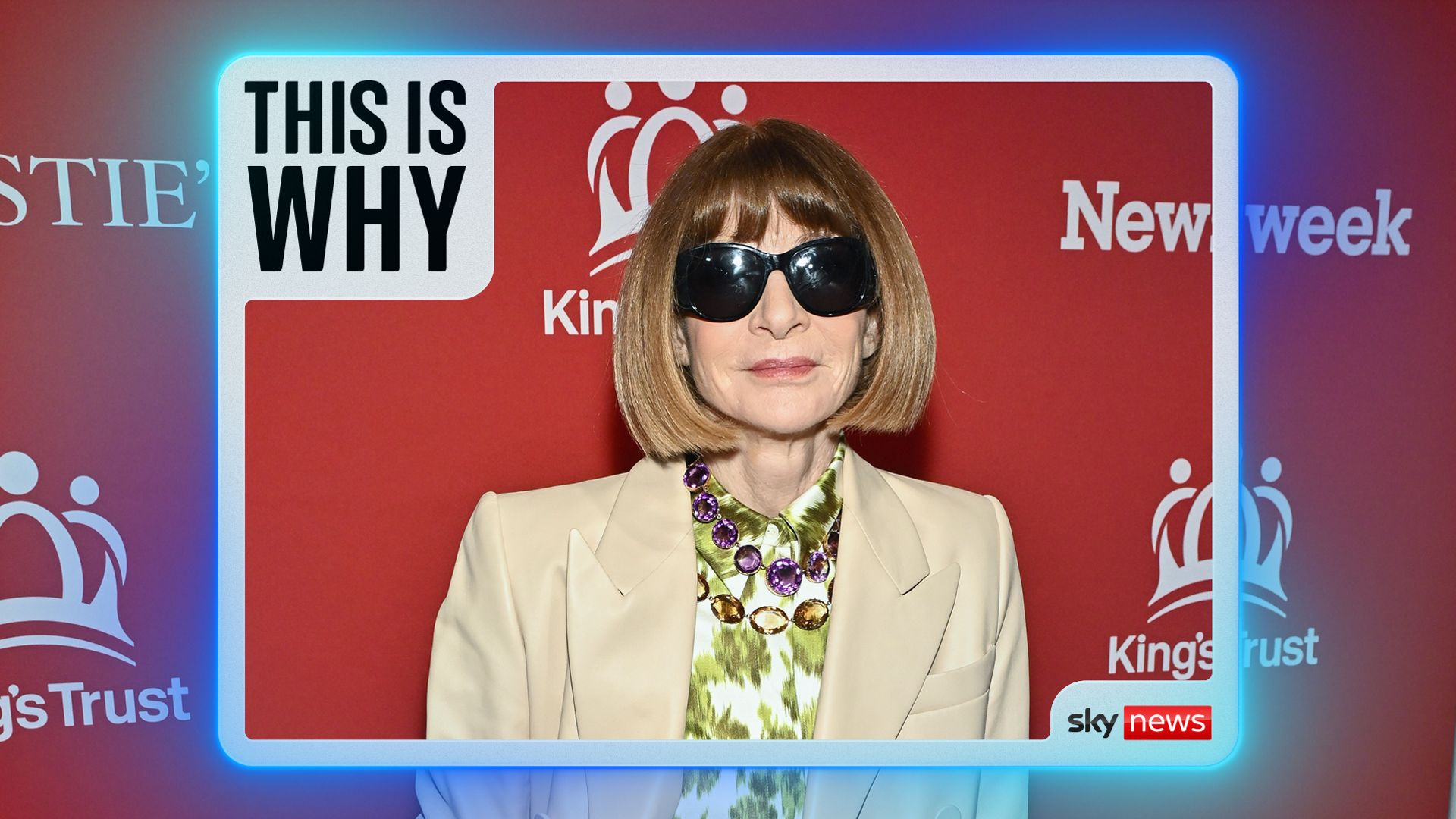
Anna Wintour does not just run a magazine; she manages a global trade settlement system. For over three decades, her seat at the head of American Vogue has served as the ultimate clearinghouse for the fashion industry’s immense capital risks. While critics often mistake her longevity for mere celebrity or personal style, her power is actually rooted in a cold, mathematical utility. She provides the "Yes" or "No" that prevents billion-dollar conglomerates from hemorrhaging money on the wrong trends. In an industry built on the ephemeral, Wintour is the only fixed point of stability.
To understand why she remains the most powerful figure in fashion, one must look past the sunglasses and the bob. The industry is a chaotic web of textile manufacturers, retail buyers, luxury groups like LVMH and Kering, and independent designers. Without a central arbiter to signal which aesthetics are commercially viable, the system would collapse under the weight of its own indecision. Wintour is that arbiter. She acts as a human insurance policy for the luxury market.
The Gatekeeper of the Retail Supply Chain
Power in fashion is usually measured by who gets the front row seat. That is a superficial metric. Real power is measured by who influences the buy. Long before a collection hits a runway, Wintour’s influence is felt in the boardrooms of department stores and the offices of venture capitalists.
When a young designer receives the CFDA/Vogue Fashion Fund, it is not just a trophy for the shelf. It is a credit rating upgrade. This endorsement tells fabric mills that the designer is good for the bill. It tells Neiman Marcus that the clothes will actually sell. By handpicking which talents receive the Vogue imprimatur, Wintour effectively de-risks the investment for every other player in the supply chain.
This role as a kingmaker is not based on whimsy. It is based on a terrifyingly accurate track record of predicting consumer behavior. If Wintour decides that a specific shade of cerulean is the color of the season, the entire machinery of global production shifts to accommodate that choice. This is not magic. It is a self-fulfilling prophecy fueled by the sheer volume of her platform’s reach.
The Met Gala as a Political Weapon
The Met Gala is frequently described as the "party of the year." That description is an insult to its actual function. Under Wintour’s direction, the event has been transformed from a localized charity dinner into a high-stakes geopolitical summit for the attention economy. It is where the "hard power" of old-money institutions meets the "soft power" of digital celebrity.
Wintour controls the guest list with an iron grip, and that control is her greatest piece of leverage. By deciding who is "in" and who is "out," she maintains a monopoly on cultural relevance. Silicon Valley CEOs, Hollywood stars, and European royalty all compete for her approval because they know that being seen at the Met Gala provides a level of prestige that money cannot buy.
The Monetization of Prestige
The gala generates tens of millions of dollars for the Costume Institute, but its true value lies in the branding. It cements Vogue as the central sun around which all other cultural entities must orbit. When a tech mogul sits next to a pop star at a table curated by Wintour, a transaction has occurred. The mogul gets "cool" and the pop star gets "establishment" credibility. Wintour takes a commission on that exchange in the form of increased influence.
The Survival of the Print Monolith
In an era where digital media has gutted traditional publishing, Vogue remains a physical object of desire. Many have predicted Wintour’s downfall as Instagram and TikTok took over the fashion conversation. They were wrong. They failed to realize that in a world of infinite, cheap digital noise, a curated, expensive physical product becomes more valuable, not less.
The "death of print" narrative ignores the psychological need for a hierarchy. If everyone is an influencer, then nobody is an authority. Wintour’s refusal to chase every passing digital fad has preserved the brand’s aura of exclusivity. While other magazines shuttered or pivoted to desperate "clickbait" strategies, she maintained a standard of photography and journalism that felt permanent.
The Condé Nast Consolidation
Wintour’s power was further solidified when she was named Global Editorial Director of Condé Nast. This move was a recognition that the company could no longer afford to let its international editions operate as independent fiefdoms. By centralizing control, Wintour turned Vogue into a unified global superpower.
This consolidation allowed her to negotiate from a position of absolute strength with global luxury brands. If a brand wants to launch a new perfume, they don't just buy an ad in American Vogue; they coordinate a multi-platform, multi-national campaign through Wintour’s office. She has become the de facto Chief Marketing Officer for the entire luxury sector.
The Counter Argument Performance vs Reality
It is common to hear that Wintour is out of touch or that her era has passed. Critics point to the rise of street-style and the democratization of fashion as evidence that a central gatekeeper is no longer necessary. This argument misses the point of how capital works.
Democratization creates volume, but it does not create value. In fact, the more crowded the marketplace becomes, the more the elite consumer craves a filter. Wintour is the ultimate filter. Even those who claim to ignore her are often wearing clothes that were influenced by her decisions three years prior. Her "taste" is coded into the algorithms of the fast-fashion giants who rip off the designers she initially championed.
The Succession Vacuum
One of the clearest indicators of Wintour’s dominance is the lack of a visible successor. There is no "next Anna." This is not an accident. She has built a system that is so reliant on her personal relationships and her specific brand of institutional knowledge that it is nearly impossible to imagine the machine running without her.
Her power is not just about her title; it is about a forty-year rolodex that includes every major player in politics, art, and commerce. You cannot hand that off in a transition memo. You cannot teach the "Vogue" eye in a seminar.
The Institutionalization of an Individual
Wintour has achieved something rare in the history of business: she has become an institution. She is the living embodiment of the industry she represents. When people talk about "Fashion" with a capital F, they are usually talking about the world she built.
Her influence is not a relic of the past; it is the infrastructure of the present. As long as there is a need to distinguish between the expensive and the valuable, there will be a seat for a figure like Wintour. She did not just survive the changes in the industry; she dictated the terms of its surrender.
The industry follows her not because of affection, but because of a collective recognition that without her, the party ends. The investors go home. The lights go out. She is the one keeping the engine running, one precisely timed "Yes" at a time.
If you want to understand the future of the luxury market, stop looking at the trends. Look at the woman in the dark glasses. She has already decided what you will be wearing two years from now, and the banks have already cleared the checks.


