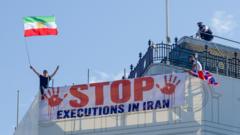
When a government starts hanging people just weeks after arresting them, the message isn't justice. It’s pure terror.
United Nations human rights chief Volker Türk recently dropped a chilling update on global bodies, pointing directly at a sharp spike in executions inside Iran. Since March 19, at least 56 people have been executed on national security charges. Twenty-seven of those individuals were tied directly to street protests that kicked off earlier in the year. For an alternative look, consider: this related article.
If you think this is just standard judicial procedure, you're missing the bigger picture. It’s a deliberate strategy to crush dissent. And over 100 more people currently sit on death row facing the exact same fate.
Inside the Courtrooms Where Due Process Dies
You cannot talk about Iran's capital punishment wave without looking at how these trials actually work. They are fast, secret, and rigged. Further reporting regarding this has been published by The Guardian.
Türk highlighted a jaw-dropping case where 12 defendants were sentenced to death after a single, closed-door hearing lasting a mere three hours. Imagine facing the gallows, and your entire defense gets wrapped up faster than a movie matinee.
Torture drives these convictions. Confessions extracted under physical abuse and severe ill-treatment routinely form the bedrock of Revolutionary Court rulings. Defendants rarely get independent legal representation. Families often find out about an execution only after it happens, or they scramble outside prison gates in the dead of night trying to stop the hangings.
Take the tragic case of 20-year-old Arvin Kheirkhah. Authorities executed him at Shahroud prison after a conviction for waging war against God, a catch-all charge used to silence political opposition. His family stood vigil outside the walls, begging for mercy. It didn't matter. The state carried it out anyway.
Why the Surge is Happening Now
Why the sudden escalation? Independent watchdogs like Iran Human Rights point to a grim reality. Authorities are weaponizing capital punishment under the cover of broader geopolitical conflicts and regional tensions.
When external pressures mount, authoritarian regimes tighten the internal screw. Dissent becomes treason. Voicing frustration over economic collapse or basic freedoms gets conflated with national security threats.
Drug-related executions are also surging right alongside political ones. Thousands of low-level offenders and marginalized citizens get swept into a judicial meat grinder that operates completely out of public view.
Political prisoners inside notorious facilities like Evin Prison see the writing on the wall. Veteran reformist politician Mostafa Tajzadeh recently smuggled out an open letter calling the executions "playing with fire". He warned that killing young protesters will only widen the chasm between the state and its citizens, pushing a fractured society closer to absolute collapse.
The Global Response and the Road Ahead
Condemnation from Geneva is loud, but action remains painfully slow. Türk has urged Iranian authorities to halt all executions immediately and move toward abolishing the death penalty altogether. He calls capital punishment completely incompatible with basic human dignity.
Yet, international diplomacy often falls short. Human rights groups have slammed major diplomatic frameworks, such as the Islamabad Memorandum of Understanding, for completely omitting human rights protections. When global powers prioritize geopolitical deals over human lives, regimes notice. They take silence as a green light.
The clock is ticking for the more than 100 prisoners currently awaiting execution on security-related charges. Without massive international pressure, public outcry, and concrete diplomatic consequences, the gallows in Isfahan, Shahroud, and Tehran will stay busy.
Pay attention to what happens next. Share these stories, keep the pressure on local representatives, and don't let these individuals become invisible statistics.


