Seven dollars and fifty cents. That is the price of the cotton crewneck sitting at the bottom of your laundry basket right now, and it is also the exact daily cost of keeping a family of four from starving in the industrial sprawl just north of Dhaka.
Numbers lie when they are printed in black ink on a financial report. They look clean. They look rational. You read a headline about dozens of garment factories shutting their doors as tear gas drifts across the asphalt of Gazipur and Ashulia, and your brain naturally files the event away as an abstract supply chain disruption, another distant tremor in an unstable corner of the global economy. You might picture angry crowds, shuttered steel gates, and police batons clattering against plastic riot shields. What you probably do not picture is the quiet, suffocating arithmetic of a single Tuesday evening inside a ten-by-ten concrete room with a corrugated tin roof that turns into an oven every afternoon. Building on this idea, you can find more in: Inside the Federal Power Struggle Over Kalshi and State Gambling Laws.
To understand why tens of thousands of people stepped into the path of rubber bullets and water cannons, you have to stop looking at macroeconomic indicators and start looking at a pot of lentils.
Consider a hypothetical worker—let us call her Rina, though her reality belongs to roughly four million people across Bangladesh. Rina is twenty-six years old. She works as a senior sewing machine operator, which means her fingers move faster than the human eye can comfortably track, guiding heavy denim or delicate knitwear beneath a reciprocating needle four hundred times a minute for ten to twelve hours a day. Until the streets erupted, her base monthly wage hovered around 8,000 taka—roughly seventy-three US dollars, a figure that had remained frozen since 2018 while the world around her caught fire with inflation. Analysts at Bloomberg have provided expertise on this trend.
For years, Rina survived on the margins of that margin. She skipped breakfast. She shared a single communal latrine and a trickle of grey tap water with fourteen other families. She sent a few hundred taka back to her aging parents in a river-eroded village in the north. Then came the quiet creep of global prices. Rice doubled. Cooking oil became a luxury item measured out in cautious teaspoons. Eggs, the cheapest protein available to the working poor, vanished from her tin plate altogether. When your wages stay locked in 2018 while your rent and groceries sprint into the middle of the current decade, starvation does not arrive like a sudden storm. It arrives like a slow leak in a sealed room, gradually stealing the oxygen until you realize you are suffocating while wide awake.
Silence. That was the first thing workers noticed when the machines stopped humming across the industrial belts of Mirpur, Savar, and Narayanganj.
For decades, the rhythmic clatter of industrial Juki sewing machines has been the heartbeat of modern Bangladesh. When that noise suddenly dies across dozens of major manufacturing hubs, the silence is terrifying because it means the bargain has broken. A garment factory in full swing is a sensory assault—the sharp, metallic tang of machine oil, the blizzard of microscopic cotton lint suspended in shafts of fluorescent light, the relentless, vibrating roar of thousands of motors running in unison. Working inside that environment requires a kind of trance. You surrender your body to the assembly line so that a shopper in London, New York, or Berlin can buy a multipack of socks without thinking twice about where the cotton was spun or whose back ached to stitch the seams.
When Rina and thousands of her coworkers walked out of those factory gates and onto the Dhaka-Mymensingh highway, they were not launching an ideological revolution. They were staging an intervention against math that no longer worked.
The Architecture of a Broken Promise
To grasp why the clashes between garment workers and police turned so violent so quickly, you have to look at how the global apparel industry actually functions beneath its glossy sustainability pledges. Think of the modern fashion supply chain not as a partnership, but as a funnel of pressure. At the wide top sit multinational retail giants, perpetually locked in a race to offer lower prices, faster turnaround times, and endless seasonal variety. At the narrow spout at the bottom sit the factory owners in Dhaka and Chittagong, and directly beneath them, absorbing the full, crushing weight of every negotiated discount, stand the workers.
I have walked through these industrial zones during seasons of both boom and unrest, and the physical geography tells you everything you need to know about who holds the leverage. The factories themselves are often gleaming, multi-story fortresses of glass and reinforced concrete, built to pass strict international safety audits after the catastrophic collapse of Rana Plaza in 2013 forced the world to pay attention. Inside, the fire exits are clear, the sprinkler systems are pressurized, and the compliance certificates hang neatly framed in the lobby.
Step fifty yards outside the main gate, however, and the first-world compliance evaporates into dust and open drainage ditches.
The workers who spend their days inside state-of-the-art facilities go home to slums where electricity flickers out unpredictably and landlord evictions are a constant threat. This is the central paradox of the ready-made garment sector, an industry that accounts for more than eighty percent of Bangladesh’s total export earnings and transforms the country into the world’s second-largest apparel exporter after China. The buildings were modernized, the machines were upgraded, and the export volumes shattered records year after year. Yet the human beings operating those machines were expected to absorb the shockwaves of a pandemic, a global shipping crisis, and historic food inflation on salaries that barely covered a single room and a sack of rice.
When unions demanded a new minimum wage of 23,000 taka a month—roughly two hundred and eight dollars—they were not asking for luxury. They were presenting a basic grocery bill. Independent labor researchers had already calculated that a living wage in Dhaka’s industrial suburbs required even more than that simply to afford basic nutrition, modest housing, and minimal healthcare.
Instead, the government-appointed wage board offered 12,500 taka. Roughly one hundred and thirteen dollars.
On paper, politicians and factory associations touted the figure as a fifty-six percent increase. To anyone watching from a distance, a fifty-six percent raise sounds generous, perhaps even radical. Inside a tin-roofed shack in Ashulia, however, percentages do not pay the grocer. After accounting for the inflation that had already devoured their purchasing power over the preceding five years, the new wage left families right back where they started: choosing between buying medicine for a feverish child or paying the overdue electric bill.
Betrayal. That is what turned simmering frustration into street fires.
When the Siren Sounds
Protests in the garment belt follow a tragically familiar choreography, yet every eruption carries its own distinct brand of desperation. It begins with whispers along the sewing lines. Word spreads from floor to floor that the wage board has rejected the union proposal, that the owners are refusing to budge, that the months of waiting have yielded a number designed to look good in a press release while changing nothing in the kitchen.
A few workers stand up from their stools. Within minutes, an entire floor of eight hundred operators walks toward the stairwells. They pour out into the street, chanting slogans that echo off the concrete walls of neighboring compounds, urging workers in adjacent factories to lay down their scissors and join them. Factory managers, terrified of property damage and missed shipping deadlines, slam shut the heavy iron gates and lock the doors, suspending operations indefinitely. Within forty-eight hours, dozens of plants—some employing tens of thousands of people each and supplying the biggest names on Western high streets—go completely dark.
Then come the sirens.
The state response to labor unrest in Bangladesh has rarely been delicate, because the state views the garment sector not merely as an industry, but as the sole load-bearing pillar of the national economy. If the factories stop, the foreign currency reserves dry up. If the foreign currency dries up, the country cannot import fuel, fertilizer, or grain. From the perspective of the authorities, clearing the highways is an existential necessity. From the perspective of the workers standing in the road, blocking the highway is the only microphone they have left.
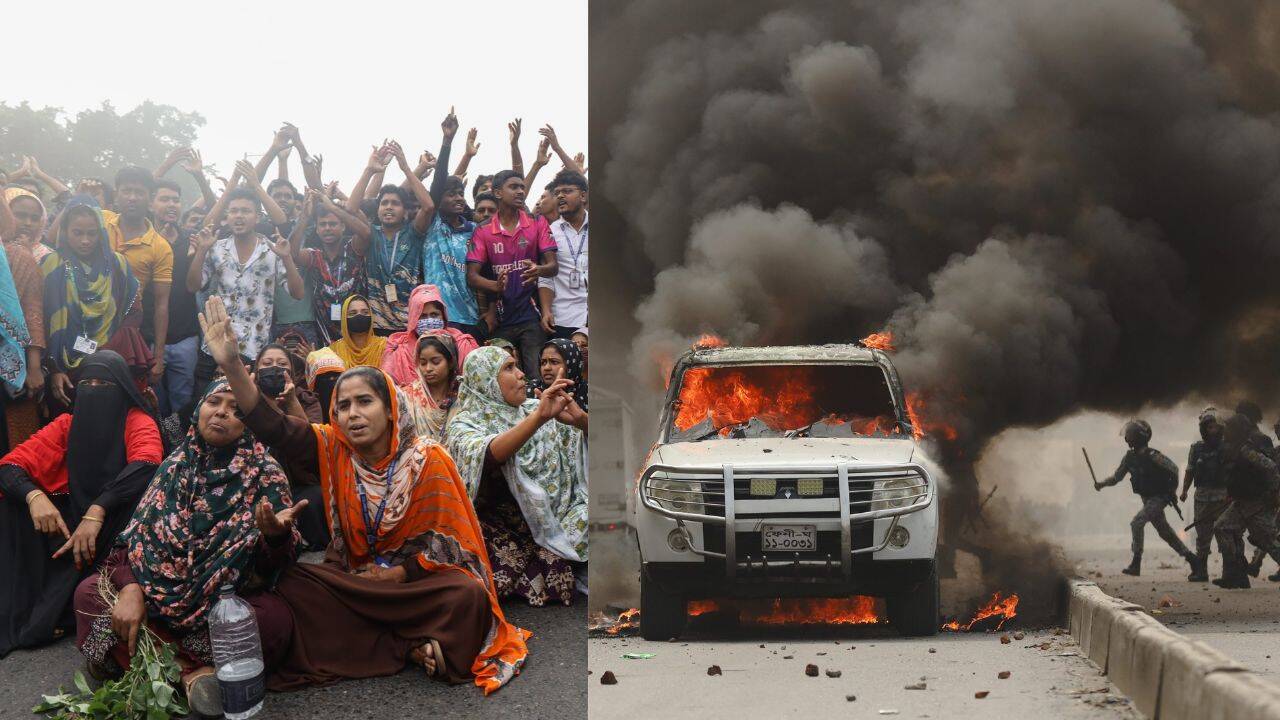
When riot police deploy tear gas and sound grenades into dense crowds of exhausted, underfed workers, chaos consumes the narrow streets. Bricks fly. Buses burn. Workers scatter into the labyrinthine alleys of their neighborhoods, coughing and wiping stinging eyes with the hems of their scarves, while armoured vehicles rumble past the shuttered storefronts. People die in these clashes—workers shot during chaotic dispersals, others crushed in panics or caught in fires—and each death hardens the resolve on both sides.
I remember speaking years ago with an older pattern maker in Savar who had survived three major wage uprisings over two decades. He held up his right hand, showing me the calloused ridge along his thumb where years of gripping heavy tailoring shears had permanently reshaped his bone and skin. "Every time we ask for bread," he told me quietly, "they tell us we are destroying the country. How can you destroy a country by asking to stay alive inside it?"
That question hangs over every single factory closure. It exposes the sheer fragility of a global economic model built on keeping labor artificially cheap in one hemisphere so that consumption can remain effortlessly convenient in another.
The Myth of the Razor-Thin Margin
Whenever wage protests paralyze Dhaka, a predictable chorus of excuses rises from the boardrooms of both local manufacturers and international fashion brands. Factory owners argue, often with genuine panic, that they cannot pay higher wages because global buyers refuse to pay higher prices for the clothes. They point out that raw material costs have surged, energy prices at home have spiked, and their profit margins have been squeezed to fractions of a penny per garment.
They are telling half the truth.
The brutal reality of apparel sourcing is that Western brands wield near-total pricing power. If a supplier in Bangladesh raises its prices by fifteen cents per shirt to fund a living wage, the brand’s purchasing department can simply threaten to move the order to Vietnam, Cambodia, Ethiopia, or Myanmar. Suppliers are forced to bid against one another in a relentless downward spiral, absorbing rising labor and utility costs themselves just to keep their machines running.
Yet the other half of the truth is equally uncomfortable. For decades, Bangladesh’s political establishment and factory-owning elite have been deeply intertwined. Many prominent parliamentarians own garment factories themselves. The industry enjoys lavish tax holidays, subsidized loans, and immense institutional protection, while independent labor organizing has historically been met with intimidation, blacklisting, and bureaucratic roadblocks. Workers who try to form genuine unions frequently find themselves fired on fabricated charges, their names circulated among neighboring factories so they can never find work again.
And where are the global brands while tear gas fills the streets outside the factories stitching their winter collections?
Mostly, they issue carefully worded statements expressing "concern" over the violence and urging "constructive dialogue" between stakeholders. They remind the public that they do not own the factories—they merely place orders with them. It is a masterpiece of corporate insulation. By outsourcing the physical production of clothing to independent contractors thousands of miles away, retail giants capture the lion's share of the retail markup while outsourcing every ounce of moral and legal liability.
Consider the actual math of a twenty-five-dollar pair of jeans sold in a suburban shopping mall. The labor cost paid to the workers who cut, sewed, washed, distressed, and packaged that garment in Bangladesh typically accounts for less than three percent of the final retail price—often less than seventy-five cents. Doubling the wages of every single worker in that factory would add perhaps fifty or sixty cents to the production cost of those jeans. A brand could absorb that cost entirely without a shareholder ever noticing a dip in quarterly dividends, or pass it along as a rounding error that no shopper on earth would ever register at the checkout counter.
Yet the industry operates as though paying a seamstress enough to buy eggs and milk would trigger the immediate collapse of global commerce.
What Happens When the Doors Stay Locked
When dozens of factories shut down indefinitely under the weight of strikes and lockouts, the pain does not stop at the edge of the tarmac. It ripples outward through an entire ecosystem of survival.
Outside every major garment hub sits an informal economy entirely dependent on the monthly payday of factory workers. There are the women who wake up at four in the morning to fry flatbreads and brew sweet milk tea at roadside stalls for the morning shift. There are the rickshaw pullers who ferry exhausted workers down flooded alleys after overtime shifts end at nine at night. There are the corner grocers who sell rice, lentils, and soap on credit throughout the month, keeping thick, grease-stained ledgers of every family’s debt until the tenth of the following month, when wages finally drop.
When the factories lock their gates, that entire ecosystem freezes instantly.
Landlords begin hovering near the entrances of tin-roofed compounds, demanding rent that workers no longer have. Grocers cut off credit because their own wholesale suppliers are demanding cash. Workers who fled to their home villages to escape the police raids sit on dirt floors watching their savings evaporate, torn between returning to a city where they might be arrested or starved, and staying in villages where there is no work at all.
Meanwhile, inside the shuttered factories, millions of dollars of half-finished merchandise sit draped over silent sewing machines. Autumn jackets, holiday sweaters, spring activewear—all frozen mid-seam. Every day the doors remain closed, shipping deadlines slip further out of reach. Brands begin invoking penalty clauses for late deliveries or quietly shifting emergency production runs to factories in other countries, leaving local suppliers facing financial ruin and workers returning to fewer jobs once the dust finally settles.
It is a cycle of mutual destruction disguised as business as usual. Nobody wins when a garment belt burns. The police go home bruised and hated; the factory owners watch their orders bleed away; the workers bury their dead and return to the sewing lines under the threat of mass terminations, forced to accept a wage package they already know cannot sustain them.
The Thread We Refuse to Follow
It is easy to feel helpless when confronted with a system this vast and entrenched. You might wonder what difference a single consumer, a single article, or a single moment of attention can possibly make against the momentum of a multi-trillion-dollar global supply chain.
The confusion is understandable, because the modern economy is deliberately designed to sever the emotional link between the maker and the buyer. When you pick up a folded sweater in a brightly lit store, there is no trace of the hands that guided it through the needle. There is no scent of the humid factory floor, no echo of the sirens outside the gate, no hint of the arithmetic that forced a young mother in Dhaka to skip her dinner so she could afford bus fare to work the next morning. The tag simply says Made in Bangladesh, reduced to three neutral words that explain everything and reveal nothing.
Yet awareness is precisely where the vulnerability of this system lies. Fast fashion and global apparel brands survive on two things: speed and invisibility. They rely on the assumption that shoppers will never look past the price tag, and that by the time the tear gas clears in Ashulia, the news cycle will have moved on to the next crisis, leaving the factories to reopen quietly under the same broken terms.
Every time those factory gates slam shut, they are exposing a lie we have all been invited to believe—the lie that cheap clothes are actually cheap. Nothing in this world is ever truly discounted; the cost is simply shifted onto someone else’s shoulders. When a t-shirt costs less than a cup of coffee, someone, somewhere, is paying the difference with their health, their safety, and their hunger.
Walk over to your closet tonight. Reach inside, pull out the nearest shirt hanging on a plastic hanger, and flip open the tiny white satin label sewn into the left side seam. Look at the name of the country printed there in faint black ink, then hold the fabric between your thumb and forefinger and feel the tiny, microscopic ridge of thread holding the garment together—thousands of invisible stitches pulled tight by a pair of hands ten thousand miles away, still waiting for the world to decide what their life is worth.