Plants are no longer just passive residents of the soil. For decades, the botanical world operated under a rigid set of rules taught in every primary school classroom. Roots drink water and minerals from the earth, while leaves breathe in carbon dioxide and catch sunlight. This binary system—soil for minerals, air for carbon—formed the bedrock of agricultural science. It turns out that model was incomplete. Recent breakthroughs in atmospheric biology reveal that plants are actively "eating" the dust that settles on their surfaces, bypassing the soil entirely to extract vital nutrients directly through their leaves.
This is not a minor biological quirk. It is a fundamental shift in our understanding of how life sustains itself in harsh environments. By absorbing particulate matter—ranging from Saharan sand to industrial soot—plants are effectively mining the air. This discovery forces a total reassessment of fertilizer strategies, carbon sequestration models, and how we protect crops in an increasingly volatile climate.
The Foliar Shortcut
We have long known that plants can absorb liquids through their stomata, the tiny pores on the underside of leaves. Gardeners use foliar sprays for a quick nutrient boost. However, the idea that solid mineral dust could be a primary food source remained largely ignored by mainstream botany. The mechanism is more sophisticated than simple absorption.
When dust particles land on a leaf, they don't just sit there. Interactions between the leaf’s natural waxes, moisture from dew, and organic acids secreted by the plant create a micro-environment. This chemical cocktail breaks down the solid minerals in the dust. The plant then pulls these dissolved elements—phosphorus, iron, potassium—directly into its vascular system.
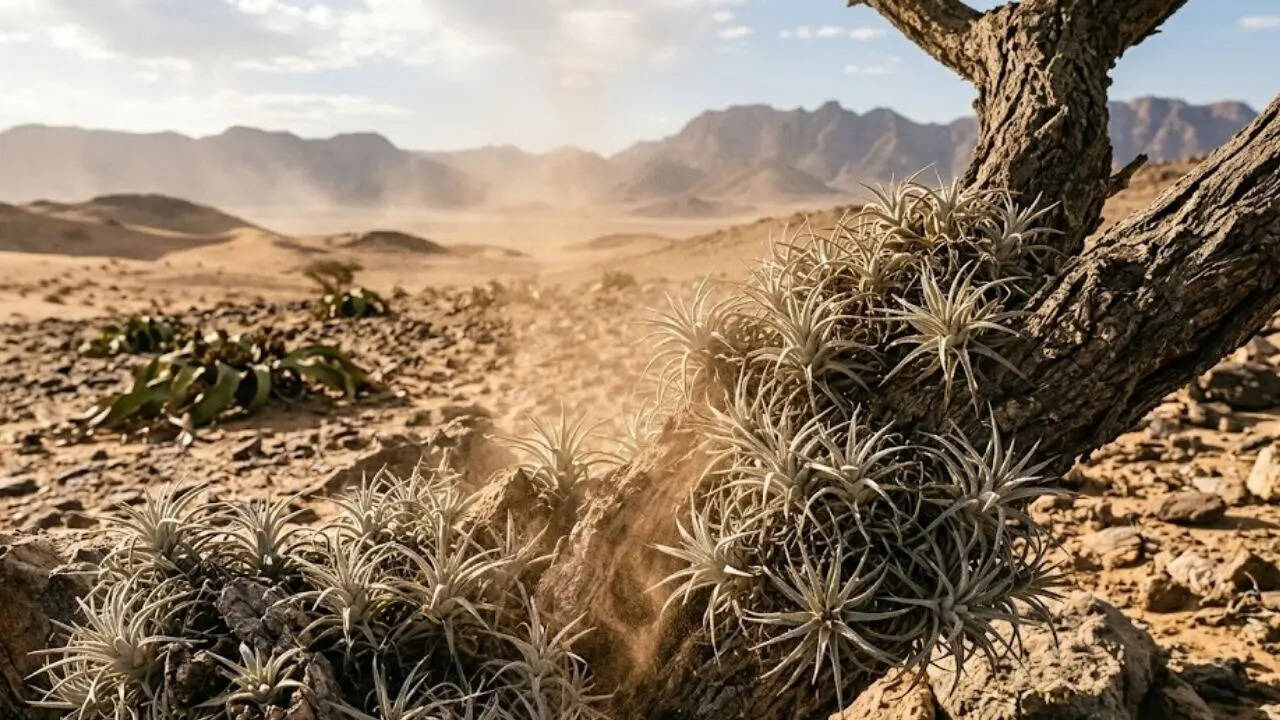
It is a survival strategy born of necessity. In rainforests where the soil is nutrient-poor due to constant leaching, or in arid deserts where roots cannot reach deep enough, the atmosphere provides a floating buffet. High-altitude bromeliads and certain species of moss have mastered this for millennia, but we are now seeing that common agricultural crops like wheat and maize also possess these "dust-eating" capabilities.
Global Nutrient Pipelines
The scale of this atmospheric feeding is staggering. Every year, billions of tons of dust travel across oceans. The Saharan Air Layer carries mineral-rich sediment from Africa across the Atlantic to the Amazon basin. Historically, scientists believed this dust had to settle on the forest floor, decompose, and then enter the root system.
New isotopic tracking shows a much faster route. A significant percentage of the phosphorus fueling the Amazon's growth is captured mid-air by the canopy. The leaves act as a massive filter, scrubbing the sky of minerals.
The Hidden Cost of Clean Air
There is a dark irony in this discovery. As we move to reduce particulate matter in the atmosphere to improve human health, we may be inadvertently starving certain ecosystems. Industrial dust, while harmful to human lungs, often contains nitrogen compounds and trace metals that plants have adapted to utilize.
This creates a tension between environmental goals. We are cleaning the air for our own survival, but in doing so, we might be removing a critical, invisible fertilizer that forests and crops have come to rely on over centuries of industrialization.
Evolution of the Scavenger
The ability to consume dust is an evolutionary masterstroke. Plants that can bypass the soil have a competitive advantage during droughts. When the ground is bone-dry, roots become useless. The soil-to-root interface requires water to move nutrients. Without it, the plant wilts and dies even if the soil is rich in minerals.
Leaves do not have this limitation. Even in a drought, morning dew provides enough moisture to dissolve surface dust. This allows the plant to maintain its internal chemistry when its "primary" food source is locked away in parched earth.
Consider the implications for the future of farming. We are entering an era of unpredictable rainfall and degraded topsoil. If we can identify and breed traits that enhance a plant's ability to capture atmospheric dust, we could develop "drought-proof" crops that thrive on the very particles that currently cause us grief.
The Chemistry of Surface Digestion
To understand how a leaf "eats" a rock, you have to look at the cuticle. The waxy coating on a leaf is often viewed as a barrier to prevent water loss. In reality, it is a dynamic interface.
Plants secrete specific enzymes onto their leaf surfaces. These enzymes are remarkably similar to the ones found in the human digestive tract or in the root tips of trees. They are designed to dissolve stubborn mineral bonds.
- Phosphorus Solubilization: Many dust particles contain phosphorus locked in apatite minerals. Leaves secrete organic acids that lower the pH at the point of contact, melting the mineral.
- Iron Sequestration: Iron is often the limiting factor for plant growth. Atmospheric iron, often from volcanic ash or industrial processes, is more readily available to leaves than the iron locked in heavy clay soils.
- Microbial Symbiosis: We are finding that the "phyllosphere"—the community of bacteria living on leaf surfaces—works in tandem with the plant. These bacteria help break down complex dust particles in exchange for sugars leaked by the leaf.
This is a biological factory operating on the surface of every green thing you see. It is decentralized, efficient, and largely invisible to the naked eye.
Infrastructure of the Sky
The global "dust cycle" is a massive, natural infrastructure project. Dry lake beds in Central Asia, the deserts of the Middle East, and the dry plains of Australia are the "kitchens" where this plant food is prepared.
Wind carries these minerals thousands of miles. When a dust storm hits a region, it is often viewed as a disaster. While it is certainly a hazard for transportation and respiratory health, for the local flora, it is a massive delivery of fresh supplies.
We see this clearly in the oceans as well. Phytoplankton—the "plants" of the sea—rely almost entirely on dust deposits for their iron. When dust levels drop, the oceanic food chain collapses. The terrestrial version of this process is simply more complex because it involves the sophisticated surface anatomy of vascular plants.
Redefining Agriculture
For a century, the "Green Revolution" focused on the soil. We poured billions of tons of synthetic fertilizers into the earth. We assumed that if the roots were fed, the plant was healthy.
This narrow focus has led to massive environmental damage. Excess fertilizer leaches into groundwater, creates dead zones in the ocean, and destroys soil structure. If we acknowledge that plants are designed to take in nutrients through their leaves, we can change the delivery method.
Precision foliar nutrition is the next frontier. Instead of drenching the soil, we could use targeted mists that mimic the natural dust-absorption process. This would require a fraction of the raw materials and eliminate the problem of runoff.
The Carbon Sequestration Myth
This research also throws a wrench into current carbon credit markets. Most models calculate a forest's carbon-storing potential based on soil quality and rainfall. They don't account for the "atmospheric bonus" of mineral dust.
A forest growing downwind of a desert or an industrial hub might be sequestering far more carbon than predicted because it is being "extra fed" from the sky. Conversely, if wind patterns shift due to climate change, those forests could starve and stop absorbing carbon, regardless of how much rain they get. Our climate models are currently flying blind because they ignore the dietary habits of the canopy.
The Industrial Filter
Cities present a unique case study. Urban plants are often covered in a thick layer of "grime"—a mix of rubber particles from tires, soot from exhaust, and construction debris.
We used to think this grime was purely detrimental, clogging the pores of the leaves. While heavy pollution is certainly toxic, low-level urban dust often contains high concentrations of zinc and nitrogen. Analysis of urban trees shows that they are actively incorporating these man-made pollutants into their wood and leaves.
They are quite literally cleaning our mess by eating it. The problem is that this "food" often comes with heavy metals like lead or cadmium. The plant doesn't have a sophisticated filter to distinguish between a "good" mineral and a "bad" metal. It absorbs both. This means that urban fruit trees or community gardens near busy roads might be concentrating toxins not just from the soil, but directly from the air they breathe.
Breaking the Binary
The wall between "earth-based" and "air-based" life is crumbling. We are discovering that the biological world is far more integrated than our silos of study suggest. A geologist studying dust storms in the Gobi Desert is, in fact, studying the food supply for a wheat farmer in China.
This realization demands a new kind of interdisciplinary science. We need atmospheric physicists talking to plant physiologists. We need urban planners looking at trees not just as shade, but as active atmospheric scrubbers that require specific "dust profiles" to stay healthy.
The traditional view of a plant as a straw stuck in the ground is dead. The reality is more like a net, cast wide into the wind, catching the invisible debris of a moving planet.
The Path Forward
To capitalize on this shift, we must move away from the "soil-only" mindset that dominates global policy.
- Map the Nutrient Plumes: We need a global map of atmospheric nutrient flows. We need to know which regions are "nutrient exporters" (deserts) and which are "importers" (forests and croplabs).
- Redesign Crop Surfaces: Genetic research should focus on the "stickiness" and chemical activity of leaf cuticles. Increasing a plant's ability to capture and dissolve dust could reduce our reliance on synthetic fertilizers by 30% or more.
- Monitor Atmospheric Thinning: As we scrub our air of particulates, we must monitor the health of the surrounding wilderness. We may need to supplement the atmosphere with "clean dust" to prevent ecosystem collapse in regions that have become addicted to industrial or desert minerals.
We have spent centuries looking down at the dirt to understand how to grow life. It is time to start looking up. The sky is not just a source of light and water; it is a vital, circulating reservoir of the very building blocks of the biosphere.
The next revolution in biology won't happen in the soil. It is already happening in the wind, settling silently on every leaf in the world. Stop thinking of dust as dirt. It is the hidden currency of global survival, and the plants have been cashing in on it since the beginning of time.