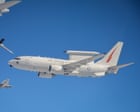
High above the shifting sands of the Middle East, a Wedgetail aircraft hums with a vibration that gets under your skin. Inside the fuselage, the air is recirculated and dry, smelling faintly of ozone and old coffee. Operators sit before glowing consoles, their eyes tracking flickering icons that represent lives, movements, and potential tragedies thousands of feet below.
This is the Australian E-7A Wedgetail, a masterpiece of airborne early warning and control. It is often described as a "flying brain." It can see everything. It knows where the threats are, where the allies are, and where the shadows hide. But lately, there is a ghost in the machine—not a technical glitch, but a moral one.
The operators are facing a choice that doesn't exist in the training manuals. They are seeing the battlefield with crystalline clarity, but they are holding back the lightning.
The Friction of Ethics
For decades, the alliance between Australia and the United States has been treated as a given. A seamless integration. A "plug and play" partnership where data flows like water between taps. But the reality on the ground in the Middle East has shifted the tectonic plates of that relationship.
Vice Admiral David Johnston, the man tasked with overseeing the Australian Defence Force, recently had to explain a delicate internal reality. Australian intelligence gathered by these sophisticated planes is no longer a blank check for American kinetic action.
Imagine a hypothetical operator named Sarah. She sees a target on her screen. It matches the profile of a threat. In the old world, that data would zip across a digital link, and moments later, an American strike would neutralize it. Today, Sarah’s thumb hovers. She has to ask: What is this intel going to be used for?
If the answer is an offensive operation—a strike intended to destroy rather than defend—the flow of information stops. Right there. In mid-air.
This isn't about a lack of trust. It is about the heavy, suffocating weight of international law and the specific mandates under which Australia operates. The Australian government has made it clear that their mission in the region is one of stability and defense. They are the shield, not the sword.
A Digital Sovereignty
The technology makes this possible, but the humans make it difficult. The Wedgetail is a marvel of the modern era, capable of tracking maritime and aerial targets simultaneously across millions of square miles. It is the ultimate tool for situational awareness. Yet, the more you see, the more responsible you are for what happens next.
Military cooperation is usually built on the idea of a "common operating picture." Everyone sees the same map. Everyone acts on the same cues. By choosing to withhold specific intelligence regarding offensive strikes, Australia is essentially redacting the map in real-time.
Consider the complexity of that task. It requires a layer of human judgment that moves faster than the software. Officers must vet every packet of data, ensuring that they aren't inadvertently providing the targeting coordinates for a mission that violates their own nation’s rules of engagement.
It creates a strange, quiet tension in the cockpit. The Americans are partners, friends, and brothers-in-arms. But at 30,000 feet, the Australian crew is a sovereign island. They are navigating a sky filled with American jets, yet they are maintaining a boundary that is as invisible as a radio wave and as solid as a brick wall.
The Cost of the Red Line
The stakes are higher than a mere diplomatic disagreement. In the world of high-stakes intelligence, information is the only currency that matters. When you stop sharing, the price of everything else goes up.
Critics argue that this selective sharing weakens the alliance. They suggest it creates "blind spots" that could put lives at risk. If an American unit expects intelligence that never arrives, the consequences are measured in blood, not just bureaucracy.
But the counter-argument is rooted in a deeper, more uncomfortable truth. If Australia provides the data that leads to a controversial strike—one that results in significant civilian casualties or violates international norms—Australia owns that strike. The blood is on the hands of the person who pointed the finger, not just the one who pulled the trigger.
This is the invisible firebreak. Australia is attempting to build a wall between "defense" and "offense" in an era where those two concepts are increasingly blurred. In a modern counter-insurgency environment, the line between a defensive patrol and an offensive raid is often nothing more than a matter of perspective.
The Weight of the Silence
The silence on the radio is sometimes the loudest thing in the sky.
When an Australian operator denies a data request, they aren't just clicking a "decline" button. They are asserting a national identity. They are saying that being an ally does not mean being an extension.
This policy reflects a growing discomfort with how intelligence is weaponized in a world of drone strikes and long-range precision. We have become too good at killing from a distance. The Wedgetail’s sensors are so sensitive they can detect the heartbeat of a conflict before it even begins. That kind of power demands a leash.
The Australian Defence Force is operating under a microscope. Every flight, every data log, and every intercepted transmission is a potential legal liability. The "defence boss" isn't just managing planes; he is managing the soul of a military that is trying to remain ethical in an unethical theater.
It is a lonely position to be in. You are part of the most powerful military machine in human history, yet you are choosing to be the friction in the gears.
The Ghost in the Console
We often talk about "interoperability" as the gold standard of modern warfare. We want our computers to talk to their computers. We want our missiles to fit on their rails. We want a world where the alliance is a single, breathing organism.
But there is a danger in being too integrated. When two nations become one machine, the smaller nation loses its ability to say "no."
Australia’s stance in the Middle East is a messy, complicated, and brave attempt to maintain the power of "no." It is an admission that even in the heat of a mission, there must be a moment of pause. A moment where a human being looks at the screen and decides that some things are worth not knowing.
The Wedgetail continues its orbit. The engines roar, a constant, low-frequency thrum that vibrates through the floorboards and into the boots of the crew. They see the world in neon lines and pulsing dots. They see the moves the enemy hasn't made yet.
Down on the ground, the dust kicks up behind a convoy. In the air, the American fighters bank, waiting for the word. And inside the "flying brain," an Australian officer watches the icons move, holding a secret that they refuse to share, guarding a line that exists only because they decided it should be there.
The sky is vast, but the room for error is narrowing every day. The most important piece of technology on that aircraft isn't the multi-role electronically scanned array radar. It is the conscience of the person sitting in the dark, deciding where the help ends and the hurt begins.