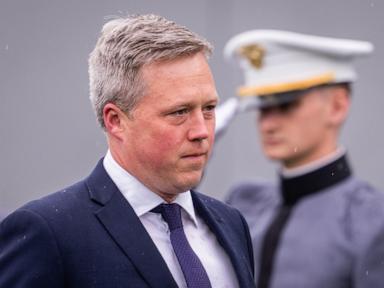
The departure of Army Secretary Dan Driscoll exposes a structural fracture point inside the Department of Defense, where civilian leadership friction directly degrades institutional continuity. When the primary civilian administrator of the nation's largest land force exits following persistent friction with the Secretary of Defense, the disruption extends far beyond interpersonal politics. This administrative breakdown compromises modernization initiatives, destabilizes procurement timelines for low-cost drone countermeasures, and leaves critical command echelons vacant during an active period of global deployment.
Understanding this development requires examining the mechanisms of civilian-military alignment and the cost functions associated with sudden executive turnover. The friction between the Office of the Secretary of Defense and service secretariats typically originates from competing incentives regarding procurement reform, personnel management, and alignment with White House political directives.
The Structural Drivers of Executive Friction
Executive friction within defense leadership rarely stems from simple personality clashes. Instead, it emerges from systemic divergences in how operational risk and institutional transformation are evaluated.
The primary driver involves procurement philosophy. Service secretaries operating under commercial efficiency models often attempt to bypass legacy defense primes to accelerate acquisition. Driscoll leveraged his background in private equity and venture capital to introduce commercial practices, aiming to fast-track affordable interceptors to counter cheap enemy drones. When service-level modernization strategies conflict with the centralized preferences of the Defense Secretary, operational paralysis ensues.
The secondary driver centers on personnel management and command appointments. The institutional architecture of the military relies on predictable pathways for promotions and stability at the general officer level. When senior leaders, such as the Army Chief of Staff, are removed without transparent operational justification, the internal signaling mechanism breaks down. Service secretaries caught between protecting institutional stability and complying with sweeping political purges face an untenable administrative dilemma.
The Cost Function of Leadership Vacancies
The immediate consequence of Driscoll's resignation is a compounding leadership vacuum at the highest levels of the United States Army. The service currently operates without a Senate-confirmed Chief of Staff, following the earlier ouster of General Randy George. The departure of the top civilian leader alongside a vacant top military post creates a dual-leadership deficit.
This vacuum generates quantifiable strategic vulnerabilities:
- Procurement Bottlenecks: Modernization programs designed to transition the Army away from reliance on multimillion-dollar missile systems toward scalable, low-cost drone interceptors require sustained bureaucratic momentum. Leadership turnover halts contract negotiations and stalls vendor engagement.
- Inter-Agency Alignment Failures: Service secretaries frequently act as diplomatic and industrial bridges between the Pentagon, the White House, and external allies. The abrupt exit of these figures disrupts ongoing strategic discussions regarding international defense cooperation and localized force protection.
- Institutional Memory Erosion: Rapid churn among Senate-confirmed positions shifts decision-making authority toward temporary or acting officials who lack the political capital required to force long-term structural reforms through a resistant bureaucracy.
Evaluating the Replacement Mechanism
The institutional replacement process now dictates the trajectory of Army modernization. Under standard administrative procedure, the service undersecretary assumes interim responsibilities, yet the Defense Secretary retains broad discretion to appoint acting leadership or nominate political loyalists without prior service-level pedigree.
When appointments prioritize ideological alignment over operational familiarity, the institutional friction does not resolve; it merely shifts inward. The incoming leadership must either reconcile the demands of the Office of the Secretary of Defense with the pragmatic realities of force readiness or risk repeating the cycle of administrative attrition that defined Driscoll's tenure.
To restore institutional equilibrium, the Department of Defense must decouple service-level modernization oversight from short-term political purges. The strategic imperative moving forward requires establishing insulated acquisition lanes for asymmetric warfare technology, ensuring that civilian-military friction at the top does not compromise the tactical capabilities of units deployed downrange.