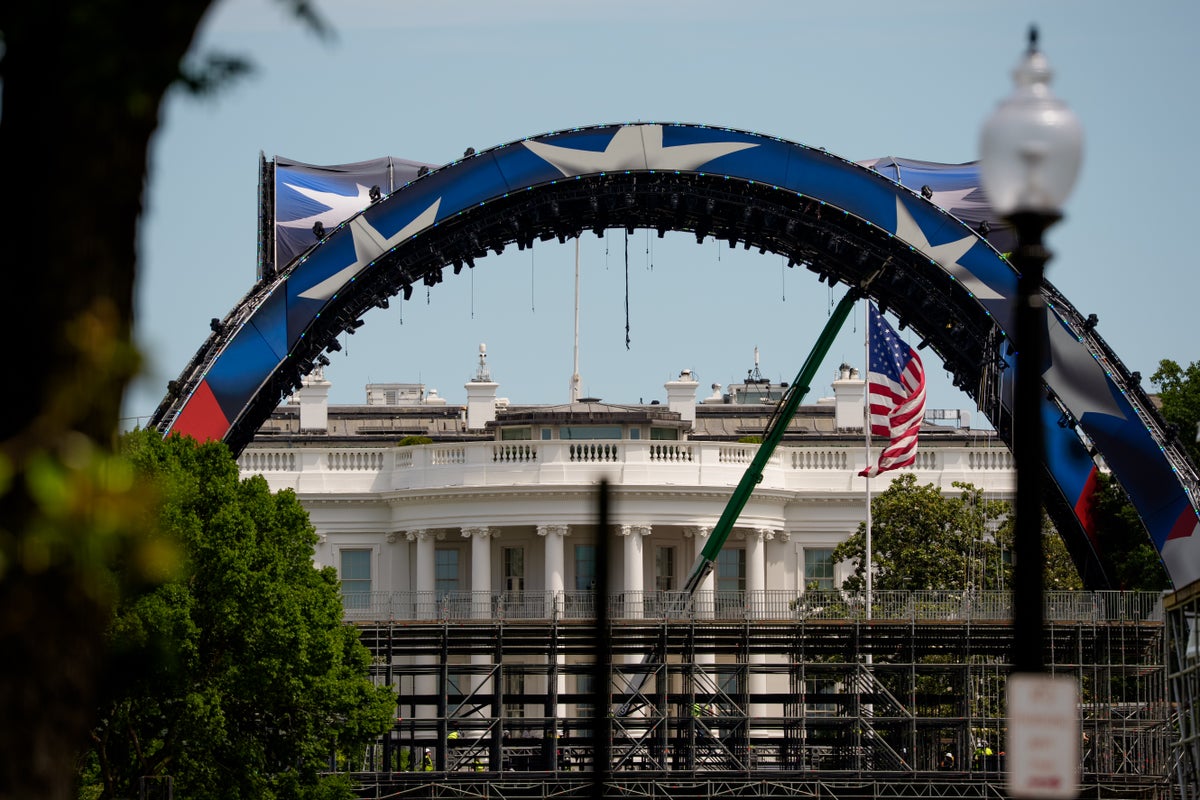
The massive steel structure currently rising above the South Lawn of the White House is more than a temporary birthday present for the current president. It is a sixty-million-dollar collision of combat sports, presidential branding, and unprecedented corporate access that threatens to upend decades of executive protocol. Officially dubbed part of the "Freedom 250" semi-quincentennial celebrations, the upcoming June 14 Ultimate Fighting Championship event has transformed from a quirky executive whim into a complex logistical and political nightmare. When Donald Trump suggested this week that the towering ninety-foot open-air arch known as "The Claw" should remain permanently on the Executive Mansion's grounds, he wasn't just making a casual comparison to the Eiffel Tower. He was signaling a structural shift in how corporate power interacts with the American presidency.
Behind the scenes, the mechanics of putting an octagon-shaped cage fight outside the Oval Office have exposed deep rifts between corporate organizers, federal security agencies, and the entertainment industry. For a more detailed analysis into this area, we recommend: this related article.
The Economics of a Sixty Million Dollar Backyard Brawl
Corporate events on municipal property happen all the time, but the sheer financial scale of UFC Freedom 250 strains the boundaries of normal presidential function. Initial cost estimates for the event sat near twenty-one million dollars, roughly matching what TKO Group Holdings spent to produce UFC 306 inside Las Vegas’s high-tech Sphere. By late spring, corporate documents revealed that the projected budget had ballooned to sixty million dollars.
Taxpayers are reportedly not on the hook for this staggering sum, which is being funded privately through the Freedom 250 organization and corporate partnerships. However, the private financing mechanisms have introduced a distinct set of ethical questions. To get more background on this development, comprehensive analysis is available on The New York Times.
While the general public can view the fight via large screens at nearby Ellipse Park, the actual seating bowl on the South Lawn has shrunk dramatically from the president's initial dream of twenty-five thousand attendees down to roughly forty-three hundred invite-only spots. To offset the soaring production costs of building a massive, weather-exposed stadium on historic turf, the UFC circulated a "partner investment" deck earlier this spring. The price tag for elite access reached a staggering 1.5 million dollars per package.
For that seven-figure sum, corporate buyers aren't just getting ringside seats next to the president on his 80th birthday. They are purchasing unprecedented proximity to the seat of global power. Executive ethics experts have quietly pointed out that while a traditional political fundraiser has clear contribution limits and disclosure mandates, a privately funded corporate sports event held on the White House lawn occupies an uncharted legal gray area.
Logistical Friction and Executive Overreach
The physical construction of The Claw has turned the usually pristine landscape of the nation's capital into an industrial zone. Security officials from the Department of Homeland Security have placed the site under a Level 1 Special Event Assessment Rating, the highest possible domestic security designation usually reserved for Super Bowls or presidential inaugurations.
The disruption has rippled out into the surrounding community in unexpected ways. The Scripps National Spelling Bee, which normally sees families strolling leisurely across the Ellipse toward Constitution Hall, had to navigate a labyrinth of heavy cranes and steel tubing.
But the friction isn't just external. The actual mechanics of holding an elite combat sports event in the elements have terrified the sport's purists. UFC CEO Dana White and commentator Joe Rogan have openly expressed deep reservations about the setup.
"There’s two things I hate," White admitted during a recent media appearance. "I hate stadiums, and I hate even worse than a stadium is fighting outside. There’s just so many different variables you have to deal with... the weather, rain, lightning, bugs, and temperatures."
Rogan went further, arguing that asking world-class athletes like lightweight contenders Ilia Topuria and Justin Gaethje to compete for world titles in an uncontrolled environment is fundamentally flawed. A championship basketball game would never be held on an asphalt playground in the June heat. Yet, the pressure to deliver a historic spectacle for the chief executive has overridden standard athletic protocols.
The Gathering Cultural Backlash
While the White House press shop insists the event will be a historic triumph, the cultural curated lineup behind the weekend has rapidly unraveled. The event was intended to feature a broader cultural festival, but a quiet exodus of musical talent has left the administration scrambling.
Artists including Morris Day and The Time, Young MC, Martina McBride, and Bret Michaels all quietly withdrew from the Freedom 250 project. Representatives for the performers indicated they were originally pitched a non-partisan national celebration, only to realize the event was deeply intertwined with a highly personalized political rally and birthday celebration.
The president's response to the talent vacuum was characteristic. He simply pledged to headline the event's speaking portions himself.
The resulting card is heavily dependent on international stars like Alex Pereira and Ciryl Gane to fill the void, creating an ironic juxtaposition for an event marketed as the ultimate celebration of American independence. Organizers scrambled to frame the diverse lineup as a nod to America’s immigrant heritage after failing to secure a standard "America versus the world" format.
The Legal and Structural Reality of a Permanent Cage
The core of the current controversy lies in the president's assertion that the ninety-foot metal arch could remain a permanent fixture of the Washington landscape. It is a statement that underscores a broader philosophy of governance that views public infrastructure as personal real estate.
It would not be the first time a president altered the grounds. Franklin D. Roosevelt added the indoor swimming pool to help with his physical therapy, and Gerald Ford installed the outdoor pool. But those modifications served the functional living needs of the first family. A massive, multi-million-dollar corporate sports stadium is an entirely different entity.
The administration’s grand architectural ambitions have already hit serious speed bumps in the judiciary. Earlier this spring, a federal judge ordered a temporary halt to a separate, four-hundred-million-dollar White House ballroom project after intense scrutiny over procurement processes and historic preservation laws. The legal precedent suggests that any attempt to turn The Claw into a permanent monument will face immediate, aggressive challenges from historic preservation societies and congressional oversight committees.
The White House cannot simply be re-engineered into a permanent sports entertainment venue by executive decree. The National Capital Planning Commission and the Commission of Fine Arts hold strict statutory authority over modifications to the historic footprint of Lafayette Square and the South Lawn.
The true legacy of the June 14 event won't be decided by who walks away with the interim heavyweight belt under the humid Washington sky. It will be measured by how far the boundaries of presidential decorum and corporate sponsorship can be stretched before the institutional framework of the executive branch snaps entirely.