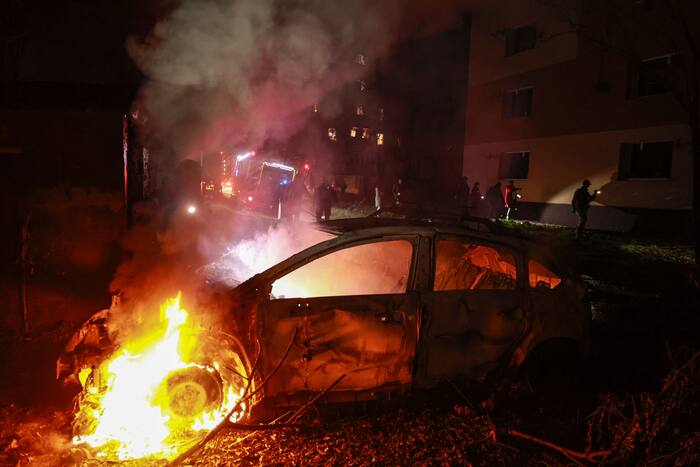
Fires broke out at petroleum facilities around St Petersburg as Ukraine launched a massive drone wave numbering more than one thousand unmanned aircraft across Russian territory. The strikes hit close to Russia’s Baltic export gateway, exposing how deep-strike attrition has turned energy infrastructure into a permanent front line. A thousand drones in a single push is not a one-off raid. It is an industrial stress test aimed at air defenses, refineries, tank farms, and the logistics lines that keep fuel moving.
In energy reporting, a headline about a blaze at an oil site often stops at the flames and the smoke plume. That misses the mechanics. Petroleum complexes are sprawling, volatile systems packed with storage tanks, distillation towers, pump stations, pipelines, rail spurs, and electrical substations. Even a single well-placed hit on a control line, a valve manifold, or a fuel tank can force an operator to shut down adjacent units to prevent a cascading fire.
Over the past several years of covering energy markets and conflict logistics, I have watched attackers and defenders adapt in real time. Cheap long-range drones do not need to obliterate an entire refinery to impose heavy costs. They only need to force shutdowns, stretch air-defense batteries thin, and turn routine operations into an expensive game of cat and mouse.
Why St Petersburg Oil Sites Matter Beyond the Flames
St Petersburg sits at the sharp end of Russia’s northern energy and maritime footprint. The city and its surrounding Leningrad Oblast region connect inland pipelines and rail corridors with Baltic Sea ports and regional fuel distribution networks. When oil facilities near St Petersburg face fires or drone alerts, the shockwaves reach well past the local fire department.
A refinery or fuel depot does not operate in isolation. Crude arrives by pipeline or rail, gets processed or blended, and leaves via tankers, barges, railcars, or regional trucks. Disrupt any link in that chain and bottlenecks appear elsewhere. Even if primary processing units keep running, damaged storage or loading gear can back up supply and force cuts in throughput.
Consider a hypothetical example of a coastal fuel terminal handling export grades and domestic diesel. If a drone strike ignites a storage tank and damages nearby piping, operators face a stark choice. Keep pumping and risk feeding a larger blaze, or throttle back transfers while crews contain the heat and inspect surrounding lines. Either way, time is lost, throughput drops, and repair crews have to work under strict safety and security rules.
Industrial redundancy helps absorb minor hits, yet it rarely makes a site immune to large-scale waves. Spare tanks, bypass lines, and backup pumps can keep some flows moving. Still, when hundreds of drones saturate airspace across multiple regions at once, defenders cannot shield every pipe, transformer, and tank farm with equal density.
The Arithmetic of a Thousand-Drone Wave
Launching more than one thousand drones changes the math of air defense. High-end surface-to-air missiles and interceptor jets are expensive, limited in magazine depth, and vital for protecting high-value military and political targets. Firing a multi-million-dollar interceptor at a propeller-driven drone that costs a fraction of that amount is a losing economic trade if repeated hundreds of times.
Attackers know this math cold. A massed wave combines strike drones with decoys, varied flight paths, low-altitude terrain hugging, and staggered timing. The goal is saturation. Keep radar operators busy, force air-defense units to expend interceptors or reveal their positions, and slip enough aircraft through the gaps to hit energy nodes, power substations, and depots.
Massed drone waves turn air defense from a pure marksmanship contest into an inventory and endurance problem.
Electronic warfare complicates the picture further. Jamming and GPS spoofing can knock some drones off course or bring them down short of their targets. Yet autonomous navigation tools, terrain-following profiles, and sheer volume blunt those defenses. When a thousand aircraft go up, even a modest penetration rate creates dozens of headaches across wide swaths of territory.
Defenders have adapted with mobile gun trucks, shorter-range interceptors, acoustic sensors, and hardened enclosures around critical gear. Those measures help around key hubs. Across hundreds of miles of pipelines, substations, and tank farms, however, total coverage remains a physical impossibility.
What Refineries and Tank Farms Actually Fear
To understand why a fire at an oil site draws immediate market and strategic attention, look at what sits inside the perimeter. Crude oil, naphtha, gasoline, jet fuel, and diesel behave differently when heated or breached. Some burn fiercely with thick black smoke. Others release flammable vapors that can ignite rapidly if sparks meet the wrong mixture.
Fire suppression at large energy sites relies on foam systems, water DELUGE lines, cooling sprays, and bund walls designed to contain spills. Those systems are engineered for industrial accidents, not repeated aerial impacts. If a strike knocks out water pressure, severs power to pumps, or hits multiple tanks close together, firefighters face an uphill battle that can last days.
Refining Capacity Versus Storage and Export Chokepoints
People often conflate oil extraction, refining, and export terminals. They are distinct stages with different vulnerabilities.
| Infrastructure Type | Primary Function | Main Strike Vulnerability | Operational Consequence of Damage |
|---|---|---|---|
| Refineries | Converts crude into gasoline, diesel, and fuel oil | Distillation columns, heat exchangers, tankage, power feeds | Unit shutdowns, lower refined fuel output, longer repair lead times |
| Tank Farms and Depots | Stores crude or refined products for distribution or export | Above-ground storage tanks, manifolds, loading racks | Lost storage buffer, delayed shipments, regional supply strain |
| Pump Stations and Pipelines | Moves crude or product across long distances | Pumping units, control systems, block valves | Pressure drops, rerouting, slower throughput along corridors |
| Port Terminals | Loads vessels for maritime export | Berths, transfer lines, storage tanks, power gear | Vessel delays, demurrage costs, tighter export schedules |
Refineries often grab the spotlight because complex processing equipment takes specialized parts and skilled crews to repair. Tank farms and export terminals can be just as consequential in the short term. If storage fills up because ships cannot load or railcars cannot clear product, upstream operations can slow down even if the refinery itself was not heavily damaged.
The Hidden Drag of Repairs and Compliance
Rebuilding charred steel and scorched concrete is only part of the bill. After a strike, operators have to extinguish hot spots, cool adjacent structures, clear unexploded ordnance or debris, inspect welds and pressure vessels, and restore instrumentation. Every step takes time.
Insurance, financing, and shipping add friction. Tanker owners and insurers watch strike zones closely. Even when physical damage is contained to one facility near St Petersburg or elsewhere in the region, heightened risk can push up freight rates, slow turnaround times, and force buyers to adjust schedules.
Why This Matters Far Beyond Russia's Borders
Energy markets are interconnected, even when sanctions, price caps, and sanctions-evasion routes reshape trade flows. When drone waves hit oil infrastructure in Russia, traders, refiners, and policymakers elsewhere pay attention for three main reasons.
First, refined products like diesel and gasoil trade on global balances. Tightness in one region can ripple into import costs and refinery margins elsewhere, especially heading into colder months when heating and transport demand climb.
Second, this conflict has become the world’s largest live laboratory for drone warfare against industrial infrastructure. Defense planners in capitals far from Eastern Europe are taking notes on how cheap long-range drones stress air defenses, how hardened energy sites fare, and how quickly damaged industrial gear can be patched or bypassed.
Third, escalation dynamics stay tense. Strikes on energy sites carry political and economic weight on both sides. Moscow has leaned heavily on energy revenues and fuel logistics to sustain its war effort, while Kyiv has sought to impose tangible costs inside Russia and disrupt supply lines supporting Russian forces. Each major drone wave tests where both sides draw red lines and how resilient their domestic systems remain.
Gray Areas and Limits of the Drone Playbook
It is easy to treat massive drone attacks as a silver bullet. They are not. Drones carry relatively small warheads compared with cruise or ballistic missiles. A small warhead can start a fire in a fuel tank or damage an exposed unit, yet it often struggles to destroy deeply buried or heavily armored structures in a single hit.
Weather also plays a role. Heavy fog, strong winds, icing, and low clouds can affect drone launches, sensors, and flight endurance. Air defenses also improve over time as commanders integrate new radars, decoys, and interceptor drones into their networks.
Nor does a fire at an oil facility automatically paralyze a large economy overnight. Large energy producers have deep pipeline networks, alternative routes, strategic stocks, and state backing that help them absorb shocks that would cripple a smaller system. Measuring the true impact requires looking past dramatic footage of flames to check whether throughput stays down for weeks or recovers within days.
What to Watch Next on the Ground
Anyone tracking strikes on St Petersburg oil sites and thousand-drone waves should watch concrete indicators rather than hype. Look for satellite imagery and verified reports showing whether fires spread to multiple tanks or stay confined to a single unit. Look for signs of power outages or rail disruptions around nearby terminals.
Watch how quickly air-defense alerts shift across regions. A thousand-drone push rarely happens in a vacuum; it often pairs with strikes on power grid nodes, logistics hubs, or military sites to stretch response teams thin.
Most of all, watch duration. A blaze extinguished in hours is an operational disruption and a costly warning. A pattern of repeated strikes that keeps key facilities operating below capacity, forces frequent shutdowns, and strains repair pipelines is a slow grind that compounds over months. Track the repair timelines and shipping flows, because that is where the real toll shows up.


