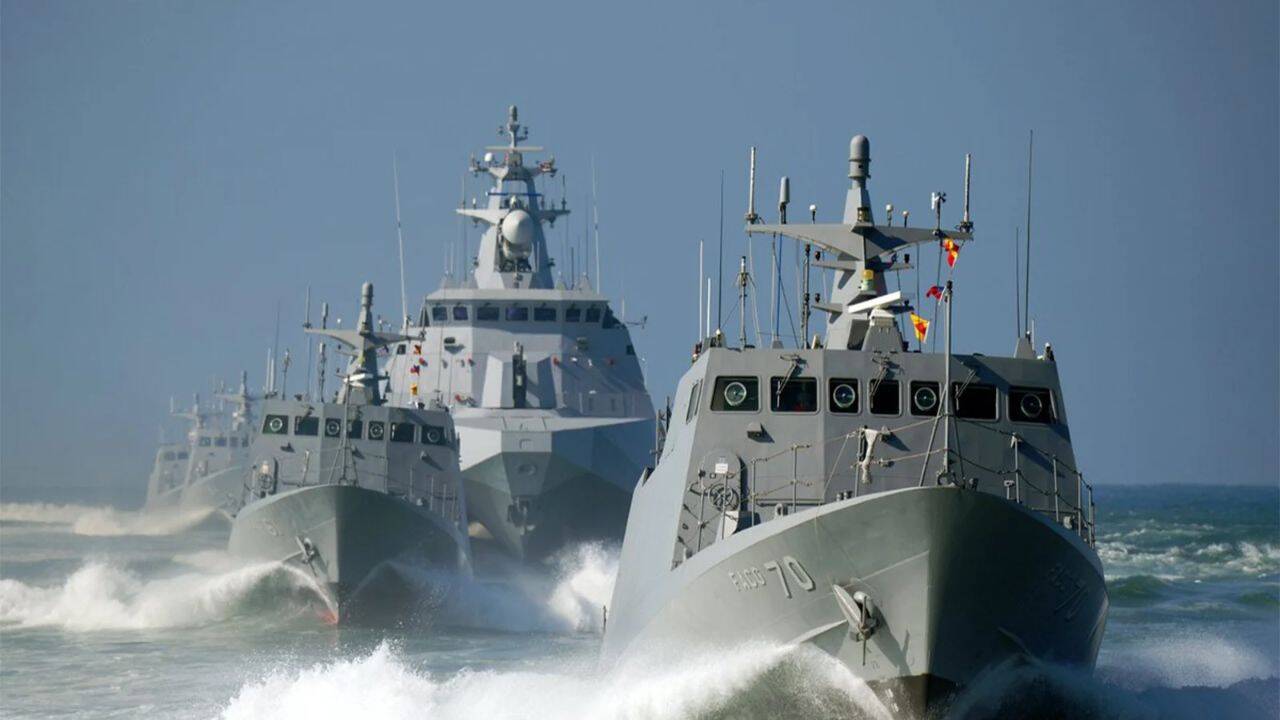
Every morning, Taiwan’s Ministry of National Defense releases a clinical, color-coded graphic showing where Chinese aircraft and naval vessels operated over the previous twenty-four hours. Most newsrooms treat these dispatches like a weather report—a quick tally of fighter jets crossing the median line, a mention of People’s Liberation Army Navy (PLAN) hulls loitering off the coast, and a standard warning about rising maritime pressure. That surface-level reporting misses the actual story. Beijing is not merely flexing muscle or preparing for an imminent amphibious invasion; it is systematically rewriting the operational geography of the Western Pacific, turning an international waterway into a domestic policing zone through sheer, exhausting repetition.
Watch the numbers long enough and the pattern stops looking like a series of isolated provocations. It looks like a rehearsal that never ends.
The Anatomy of Exhaustion
When a wire service reports that dozens of Chinese aircraft and half a dozen naval ships were detected around Taiwan, the public tends to picture a dramatic standoff on the high seas. The reality in the operations centers in Taipei is far more bureaucratic, expensive, and grinding. Every time a J-16 fighter or a Y-8 anti-submarine plane pushes past the median line—the informal, decades-old buffer running down the middle of the Taiwan Strait—Taiwan’s air force has to make a calculated gamble.
Scramble an F-16V to intercept, and you burn through precious airframe hours, jet fuel, and pilot stamina. Hold back and rely solely on ground-based radar and missile batteries, and you cede physical control of the airspace without firing a shot.
Naval deployments follow the exact same logic, only slower. A PLAN destroyer or frigate operating near Taiwan’s contiguous zone—the band of water extending twenty-four nautical miles from the baseline—does not need to open its missile hatches to achieve its objective. Its mere presence forces the Republic of China Navy to shadow it, hull for hull, day after day.
Consider a hypothetical scenario to see how this attrition plays out on a balance sheet. Suppose a smaller defender maintains a fleet of twenty-six major surface combatants, while its larger neighbor commands well over three hundred. If the larger force keeps eight vessels continuously rotating around the island on multi-day shifts, the smaller navy must commit at least eight of its own ships to constant shadowing duty, plus another eight in port for maintenance, refit, and crew rest. Before a single torpedo is loaded, more than half of the defender's surface fleet is effectively tied down by routine peacetime patrols.
This is the core mechanism of gray-zone warfare. It operates below the threshold that would trigger a formal military response from Washington or Tokyo, yet it achieves strategic effects that used to require an actual shooting war. By normalizing the abnormal, Beijing erodes the psychological and material readiness of Taiwan's military while conditioning international observers to tune out the daily alerts.
Why the Median Line Died Without a Funeral
For nearly seventy years, the median line of the Taiwan Strait functioned as an invisible wall. Drawn in the 1950s by the United States military to keep Nationalist and Communist forces from accidentally starting a broader conflict, it had no basis in international maritime law. Neither side formally recognized it on paper, yet both respected it in practice because predictability kept everyone alive.
That consensus evaporated between 2020 and 2022, and it is never coming back.
Beijing’s formal position now is that the median line simply does not exist, and that the Taiwan Strait is not international waters at all, but rather internal waters subject to Chinese jurisdiction. When Chinese aircraft cross that center point today, they are not testing Taiwan's radar response times—they already mapped those years ago. They are establishing a legal and administrative precedent. In international diplomacy, sovereignty is often won by whoever shows up consistently without being expelled.
The Shift to Joint Combat Readiness Patrols
Look closely at the official terminology coming out of the PLA’s Eastern Theater Command. Years ago, excursions near Taiwan were described as routine training exercises or targeted warnings aimed at specific political visits. Now, Beijing routinely characterizes them as joint combat readiness patrols.
The phrasing matters. A patrol implies ownership, routine governance, and law enforcement authority. By pairing air force sorties with naval surface groups—and increasingly, China Coast Guard cutters—Beijing is rehearsing the seamless integration of its armed forces in a congested maritime environment.
During these patrols, aircraft rarely fly simple straight-line tracks anymore. Instead, Taiwanese tracking data frequently reveals complex multi-axis encirclements. Fighter jets push across the northern and central stretches of the median line while drones and reconnaissance planes swing south through the Bashi Channel—the vital strategic bottleneck separating Taiwan from the Philippines—and loop up along Taiwan’s rugged, less-defended eastern coastline.
That eastern flank used to be Taiwan’s sanctuary. Protected by the towering Central Mountain Range, bases like Hualien and Taitung were designed to shelter surviving aircraft and ships in the event of a massive ballistic missile strike from the mainland. By routinely positioning aircraft carriers like the Shandong or Liaoning alongside surface action groups in the Philippine Sea east of Taiwan, the PLAN has demonstrated that the sanctuary is gone. Taiwan can now be tracked, targeted, and boxed in from 360 degrees.
The Coast Guard Trojan Horse
If you want to understand where the real maritime pressure is coming from, stop looking exclusively at gray-hulled warships and start watching the white hulls.
The China Coast Guard (CCG) is the largest maritime law enforcement fleet on earth, operating vessels that displace more than ten thousand tons—heavier than most guided-missile destroyers in Western navies. Crucially, the CCG is no longer a civilian agency. Since 2018, it has fallen directly under the command of the Central Military Commission, the same body that runs the PLA.
Deploying coast guard cutters around Taiwan’s outlying islands—such as Kinmen and Matsu, which sit just miles off the coast of Fujian province—gives Beijing an escalatory dial with dozens of granular settings. If a Taiwanese coast guard vessel confronts a PLAN warship, it is a military incident that risks immediate armed conflict. If a Taiwanese coast guard vessel confronts a China Coast Guard cutter, it looks like a regulatory dispute over fishing rights, smuggling, or maritime safety.
In early 2024, following a fatal incident involving a mainland speedboat near Kinmen, the CCG began conducting regular "law enforcement patrols" inside waters that Taiwan had administered without interruption since 1949. They even boarded a Taiwanese tourist boat for inspection.
Think about the brilliance and the danger of that move. No missiles were fired. No naval blockade was declared. Yet Beijing successfully demonstrated that it can stop, board, and inspect civilian vessels operating under Taiwanese jurisdiction whenever it chooses.
The Quarantine Option
Most military planners in Washington and Taipei have spent decades gaming out two extreme scenarios: a full-scale amphibious invasion across one hundred miles of treacherous water, or a total military blockade enforced by submarines, sea mines, and naval destroyers. Both options carry catastrophic risks for Beijing. An invasion could fail spectacularly on the beaches, while a formal naval blockade is universally recognized under international law as an act of war, virtually guaranteeing economic sanctions and potential military intervention by the United States and its allies.
The relentless detection of Chinese ships and planes around Taiwan points toward a third, far more insidious option—a quarantine.
Unlike a military blockade enforced by the navy, a quarantine is framed as a civilian law enforcement or customs operation led by the coast guard and maritime safety authorities, backed up over the horizon by the PLA. Under this model, Beijing could declare a temporary maritime safety zone around Taiwan's major ports—Kaohsiung, Keelung, Taichung—requiring all incoming commercial cargo ships and liquefied natural gas tankers to submit to mainland customs declarations or diversion to mainland ports for inspection.
Taiwan imports roughly 98 percent of its energy and around 70 percent of its food. Its economy runs on semiconductor exports that leave the island by air and sea every hour. Beijing would not need to sink a single container ship to bring the island's power grid and economy to their knees. It would simply need to drive maritime insurance premiums so high that global shipping lines like Maersk or MSC refuse to sail into Taiwanese ports.
Every time the PLAN and CCG conduct coordinated drills around Taiwan’s port approaches, they are mapping shipping lanes, testing electronic warfare interference against civilian automatic identification systems (AIS), and practicing the exact choreography required to choke off the island's maritime lifelines without ever declaring war.
What the Daily Tallies Conceal
There is a major blind spot in relying on Taiwan's daily defense ministry disclosures to gauge the true temperature in the Strait. Because those reports are designed for public consumption and strategic messaging, they strip out the technical details that actually keep military analysts awake at night.
A tally of "24 aircraft and 7 naval vessels" tells you nothing about emissions, acoustic signatures, or data-link integration.
When a Chinese Y-9 reconnaissance aircraft flies a slow figure-eight pattern off Taiwan’s southwestern coast, its primary weapon is not kinetic. It is harvesting the electromagnetic spectrum. Every time Taiwan’s Patriot missile batteries, Tian Kung air defense radars, or naval vessels switch on their tracking radars to monitor an incoming Chinese jet, that Y-9 records the exact frequency, pulse repetition rate, and signal modulation. Those electronic fingerprints are fed back into mainland databases to program electronic warfare pods and anti-radiation missiles.
Similarly, the public graphics rarely detail what is happening beneath the waves. The southwestern approaches to Taiwan, where the shallow continental shelf drops abruptly into the deep waters of the South China Sea, form one of the most acoustically complex submarine operating environments in the world. PLAN surface ships and anti-submarine helicopters operating in this sector are constantly mapping water temperature layers, salinity gradients, and seabed topography. They are hunting for quiet lanes where Chinese nuclear submarines can slip undetected into the open Pacific, while simultaneously laying down acoustic baselines to spot American or Japanese submarines trying to enter the Strait.
The Structural Trap for Defenders
Critics of Taipei’s defense posture sometimes argue that the Taiwanese military is overreacting to Beijing’s daily pressure—that scrambling fighters and dispatching frigates every time the PLA crosses an imaginary line plays directly into China's hands.
They have a point, up to a limit. Taiwan has gradually adjusted its rules of engagement, relying more heavily on land-based radar, surface-to-air missile crews, and unmanned aerial vehicles to track routine incursions rather than burning out its manned fighter fleet on every single sortie.
Yet a defender cannot simply ignore an approaching warship or bomber fleet, because the operational signature of a routine exercise is identical to the opening phase of a real attack. In modern warfare, strategic surprise rarely comes from hiding an invasion force—satellites see everything now. Surprise comes from conditioning the enemy to believe that a massive buildup is just another drill until the first cruise missiles are already in the air.
This creates an agonizing dilemma for commanders in Taipei, Yokosuka, and Honolulu. If you treat every surge in Chinese air and naval activity as a potential invasion, your forces will be exhausted and your equipment worn down within six months. If you treat every surge as routine theater, you risk being caught flat-footed on the morning Beijing decides to turn a patrol into a seizure.
The Chokepoint Economics Nobody Calculates
Western commentary on Taiwan often gets bogged down in abstract debates over democratic values or the legal nuances of strategic ambiguity. Shipping executives and semiconductor supply chain managers look at a map of the Taiwan Strait and see something much simpler: a narrow, irreplaceable artery of the global economy.
Nearly half of the world's container fleet passes through the Taiwan Strait every year. All of the ultra-high-end logic chips that power global artificial intelligence infrastructure, smartphones, and automotive systems are fabricated on the western side of that island.
When Beijing increases maritime pressure around Taiwan, it is signaling to Tokyo, Seoul, Manila, and Washington that their economic survival runs through waters China increasingly treats as its own backyard. Notice how Chinese naval deployments around Taiwan almost always coincide with broader maneuvers in the East China Sea near the Senkaku Islands and in the South China Sea near Second Thomas Shoal. These are not three separate flashpoints. They are three sectors of a single, unified maritime perimeter—the First Island Chain—that Beijing is systematically trying to push outward.
The daily tally of jets and hulls in the Taiwan Strait is simply the most visible barometer of a quiet, relentless campaign to make the cost of defending the status quo higher than the world is willing to pay.



