Singapore is dismantling its reliance on traditional air conditioning by forcing commercial buildings to adopt centralized district cooling, mandatory energy efficiency standards, and passive architectural designs. Driven by the reality that cooling systems consume roughly a third of the city-state’s total electricity, the government has moved beyond polite incentives to strict regulatory mandates under the Singapore Green Plan 2030. By piping chilled water directly from massive underground plants into entire neighborhoods and redesigning how buildings breathe in tropical humidity, the nation is executing a multi-billion-dollar infrastructure overhaul aimed at slashing carbon emissions before rising global temperatures push its power grid to the breaking point.
To understand the sheer scale of this intervention, you first have to look at the thermodynamics of survival on the equator. Singapore sits one degree north of the equator. Relative humidity routinely hovers above eighty percent, and afternoon temperatures regularly breach thirty-two degrees Celsius. For decades, the standard engineering response to this climate was brute force. Developers wrapped steel frames in floor-to-ceiling glass, turning skyscrapers into vertical greenhouses, and then bolted massive, decentralized chillers onto every roof to pump freezing air inside.
It worked, until it didn't. Today, air conditioning is not just a comfort in Singapore; it is an existential energy sink. As global temperatures climb and the urban heat island effect intensifies—a phenomenon where concrete and asphalt absorb solar radiation during the day and radiate it back at night—the demand for cooling threatens to outpace the city's clean energy transition.
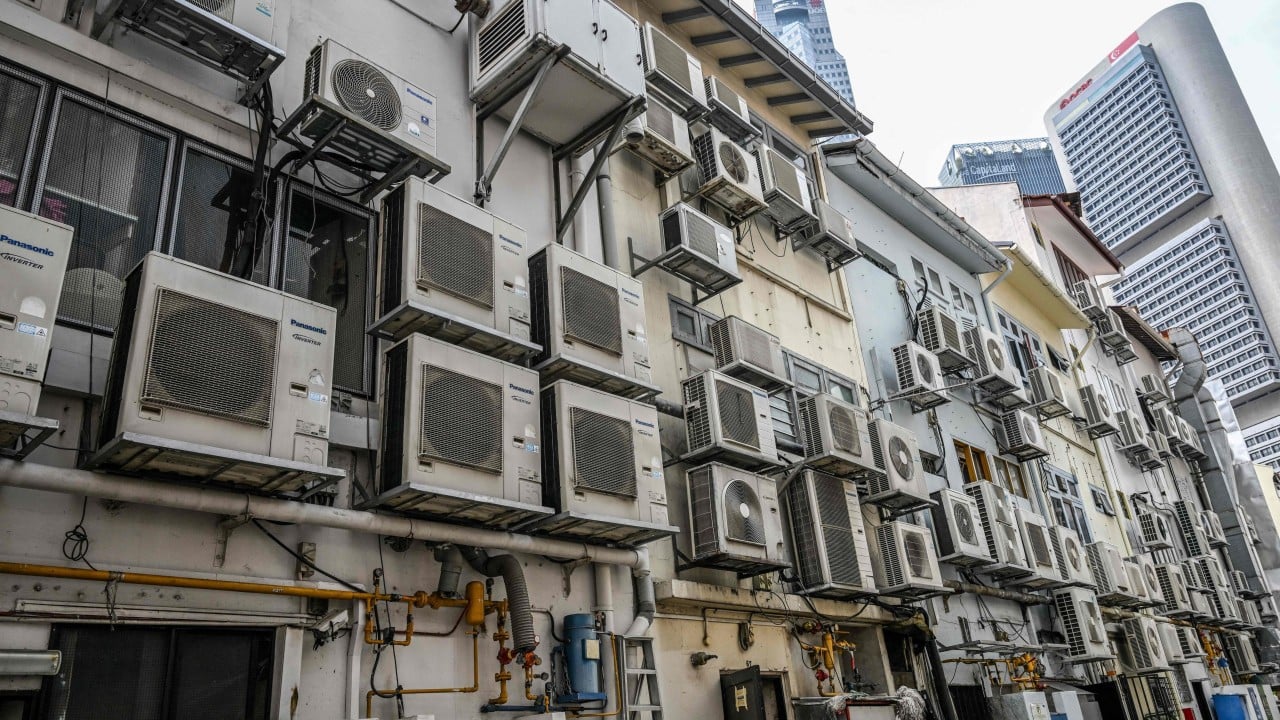
Lee Kuan Yew, Singapore’s founding prime minister, famously declared the air conditioner to be the greatest invention of the twentieth century, crediting it with making tropical productivity possible. Half a century later, his successors are facing the bill for that miracle. The very machines keeping the financial district functional are actively heating up the streets outside, creating a vicious thermodynamic feedback loop. Every traditional split-unit or rooftop chiller extracts heat from inside a building and dumps it directly into the surrounding ambient air, raising street-level temperatures by up to two degrees Celsius in dense commercial zones.
The Underground Chilled Water Grid
The centerpiece of Singapore’s counter-offensive is hidden beneath the pavement of Marina Bay. Operated by SP Group, the Marina Bay District Cooling Network is the world’s largest underground district cooling system, and it represents a fundamental shift in how urban real estate manages thermal loads.
Instead of requiring every office tower, luxury hotel, and shopping mall to build, maintain, and power its own mechanical chiller plant, the network centralizes the heavy lifting. Giant industrial chillers located in underground plants cool water down to roughly four degrees Celsius. That water is then pumped through a closed-loop network of heavily insulated underground pipes directly into connected buildings. Once inside, the building’s internal air-handling units transfer indoor heat into the chilled water. The warmed water—now around thirteen degrees Celsius—is piped back to the central plant to be cooled all over again.
The engineering advantages are massive. Centralized plants operate at economies of scale that individual building systems cannot match. They utilize thermal energy storage tanks, running the power-hungry chillers at night when electricity demand is low and tariff rates are cheaper, storing the freezing water to be circulated during the sweltering afternoon peak.
The spatial dividend is equally lucrative for real estate developers. By eliminating rooftop cooling towers and basement chiller rooms, developers reclaim thousands of square feet of prime commercial real estate. In a land-scarce metropolis where every square meter is fiercely contested, turning mechanical plant rooms into leasable retail space or rooftop gardens alters the financial math of green construction.
Following the success at Marina Bay, the model is being aggressively replicated. In Tengah, Singapore’s first smart and sustainable town, centralized cooling is being rolled out not just for commercial skyscrapers, but for public residential apartments. For a city where over eighty percent of the population lives in public housing managed by the Housing & Development Board (HDB), bringing chilled-water grids into the domestic sphere marks an unprecedented democratization of industrial infrastructure.
Why Traditional AC Fails in the Tropics
To grasp why Singapore is pouring billions into district cooling and alternative technologies, you have to understand the hidden flaw in conventional air conditioning. Standard AC units do two entirely different jobs simultaneously: they lower the temperature of the air (sensible cooling) and they remove moisture from the air (latent cooling).
In a dry desert climate like Dubai or Phoenix, an air conditioner spends almost all its energy simply lowering the temperature. In Singapore, up to fifty percent of the energy consumed by a standard air conditioner goes entirely toward wringing water out of the air.
Conventional systems accomplish this by overcooling the air far below human comfort levels—often down to twelve or thirteen degrees Celsius—just to force the moisture to condense onto cooling coils. Then, because air that cold is freezing and uncomfortable for office workers, the system actually has to reheat the air slightly before blowing it into the room. You are burning energy to freeze the air, and then burning more energy to warm it back up. From an engineering perspective, it is absurdly wasteful.
Enter decoupled cooling and desiccant dehumidification. Rather than relying on brute-force condensation, next-generation systems separate temperature control from humidity control. Chemical desiccants—materials that naturally attract and hold water molecules, much like the tiny silica gel packets found in shoeboxes—strip the moisture out of the incoming tropical air first. Once the air is dry, a secondary cooling loop only needs to drop the temperature to a mild twenty-five or twenty-six degrees Celsius to make the room feel crisp and comfortable.
When human skin is exposed to dry air, sweat evaporates efficiently, triggering the body’s natural cooling mechanism. By controlling humidity independently, buildings can raise their thermostat setpoints by two to three degrees without occupants feeling any warmer. In the world of commercial HVAC, raising the thermostat by a single degree Celsius reduces cooling energy consumption by roughly six to ten percent. Across an entire skyline, those percentages translate into megawatts of saved power.
The Tyranny of the Glass Box
Technology alone cannot fix bad architecture. For decades, Singapore’s skyline was dictated by an aesthetic imported from temperate climates like New York and London: the glass curtain wall. While visually striking, wrapping a building in single- or double-glazed glass in the tropics is an act of thermal self-sabotage. Solar radiation passes through the glass, traps heat inside, and forces the mechanical systems to work overtime.
Under the revised Green Mark certification scheme—Singapore’s strict green building rating system managed by the Building and Construction Authority (BCA)—the government has effectively declared war on thermal leakage. New developments face rigid caps on their Envelope Thermal Transfer Value (ETTV), a metric that measures how much heat enters a building through its exterior walls and roof.
Architects are being forced to rediscover passive design principles that predated the invention of the compressor. Deep overhangs, horizontal sun-shading fins, vertical louvers, and porous facades are replacing flat glass boxes. Buildings are increasingly oriented along an east-west axis to minimize direct exposure to the low-angle morning and afternoon sun.
Consider a hypothetical twenty-story office block in the Raffles Place financial district. Under older building codes, that tower might feature a flush glass exterior, requiring a massive cooling plant to offset the afternoon solar glare hitting its western face. Under current regulations, the developer must incorporate external shading devices that block direct sunlight while allowing diffused natural light to enter, alongside high-performance low-emissivity glass coatings that reflect infrared heat. The building rejects the heat before it ever crosses the threshold.
Furthermore, Singapore is aggressively mandating the integration of biophilic design—weaving dense vegetation directly into the structural fabric of high-rises. Sky terraces, vertical green walls, and rooftop forests are not mere aesthetic flourishes for brochures. Plants absorb solar radiation and cool the surrounding microclimate through evapotranspiration, dropping surface temperatures on concrete facades by several degrees.
The Economics of the Retrofit Trap
Building green from scratch is straightforward; fixing the past is where the real friction lies. Roughly eighty percent of the buildings that will exist in Singapore in 2030 are already standing today. Many of them are aging commercial towers built in the 1980s and 1990s, equipped with inefficient, oversized chillers and leaky building envelopes.
Retrofitting these legacy assets presents a brutal economic hurdle known in the real estate sector as the split-incentive problem. A building owner must bear the steep upfront capital expenditure of ripping out old chillers, upgrading electrical switchgear, and installing smart building management systems. Yet the immediate financial rewards—lower monthly utility bills—flow directly to the commercial tenants paying the power company, not the landlord.
To break this stalemate, Singapore has deployed a mix of regulatory sticks and financial carrots. Through the Mandatory Energy Improvement (MEI) regime, owners of energy-intensive buildings are legally required to conduct comprehensive energy audits and implement efficiency upgrades if their consumption exceeds strict thresholds. You can no longer simply pass the cost of an inefficient building onto your tenants and ignore the meter.
Simultaneously, the government has structured green financing mechanisms and co-funding grants that subsidize the upfront capital costs of retrofitting, while encouraging the adoption of Cooling-as-a-Service (CaaS) contracts. Under a CaaS model, a third-party energy service company finances, installs, and maintains the high-efficiency cooling equipment at zero upfront cost to the building owner. The building owner simply pays a predictable monthly fee based on the actual amount of cooling consumed, measured in refrigerant tons. It aligns the financial incentives: the service provider only maximizes profit if the system runs at peak efficiency.
The Cultural Friction of the Cold Office
Perhaps the most stubborn obstacle to Singapore’s cooling revolution has nothing to do with engineering or finance. It is cultural.
Walk into almost any shopping mall, cinema, or corporate office in Singapore, and you will witness a bizarre tropical paradox: people wearing fleece jackets, heavy cardigans, and pashminas indoors while the temperature outside sits at thirty-one degrees. Over the decades, freezing indoor temperatures became an unspoken status symbol in Southeast Asia—a visceral display of modernity, wealth, and commercial success. A cold lobby signaled that a business could afford to burn energy without care.
Changing that mindset requires fighting deeply ingrained habits. When the government launched campaigns urging commercial buildings to set their thermostats to twenty-five degrees Celsius—up from the traditional twenty-one or twenty-two degrees—pushback was immediate. Office workers complained of stuffiness. Retail managers worried that warmer malls would drive away foot traffic seeking refuge from the afternoon heat.
The solution has been a subtle recalibration of human perception through elevated air speed. By integrating high-volume, low-speed (HVLS) ceiling fans into air-conditioned spaces, engineers can create a gentle, continuous breeze across the skin. Moving air at just half a meter per second creates a wind-chill effect that makes a twenty-six-degree room feel like twenty-three degrees.
It sounds rudimentary, almost embarrassingly low-tech compared to underground chilled-water networks and desiccant wheels. Yet combining raised thermostat setpoints with precision-engineered ceiling fans slashes HVAC energy consumption by up to thirty percent while maintaining identical thermal comfort. The challenge is convincing corporate tenants that a visible ceiling fan in a Grade-A office tower is a badge of engineering sophistication rather than a step backward.
The Limits of the Centralized Model
For all its undeniable success, Singapore’s approach is not a silver bullet, and industry insiders quietly acknowledge its vulnerabilities.
District cooling works brilliantly in dense, master-planned developments like Marina Bay or newly built towns like Tengah, where underground pipe networks can be laid before the roads are paved. Retrofitting district cooling into dense, historic neighborhoods—such as Chinatown or Orchard Road—is a logistical nightmare. Excavating trenches through a labyrinth of existing telecommunications cables, water mains, sewer lines, and subway tunnels is prohibitively expensive and wildly disruptive to street-level commerce.
There is also the risk of systemic fragility. When every building has its own rooftop chillers, a mechanical failure affects only one building. When an entire financial district relies on a centralized underground chilled-water grid, any catastrophic failure at the central plant or rupture in a primary distribution pipe threatens dozens of mission-critical facilities simultaneously. While SP Group builds massive redundancy into its networks—connecting multiple plants so they can back each other up—the concentration of infrastructure demands military-grade maintenance and cybersecurity protocols.
In the residential sector, early rollouts of centralized cooling in Tengah also hit operational snags. Some homeowners reported condensation issues, uneven cooling, and sluggish customer service response times during the initial commissioning phase. The episodes served as a stark reminder that scaling industrial utility models down to thousands of individual bedrooms requires flawless execution at the last mile.
The Global Blueprint for a Warming World
Despite these growing pains, urban planners from Dubai to Miami and Tokyo are watching Singapore with intense scrutiny. By 2050, global energy demand for space cooling is projected to triple, driven by rising incomes and soaring temperatures across the developing world. If emerging economies in India, Indonesia, and Brazil adopt the same inefficient, decentralized air-conditioning habits that defined the twentieth century, the resulting surge in electricity demand will overwhelm power grids and derail global decarbonization targets.
Singapore is effectively running a live-fire beta test for how dense cities survive extreme heat without cooking the planet. The nation’s strategy proves that solving the cooling crisis does not hinge on waiting for a miraculous breakthrough in battery storage or nuclear fusion. The physics are already understood. The hardware already exists.
What sets Singapore apart is its willingness to treat thermal management as a public utility rather than an architectural afterthought. By combining underground chilled-water infrastructure, strict envelope regulations, decoupled dehumidification, and behavioral nudges, the city-state is systematically dismantling the old paradigm of brute-force cooling. Other tropical megacities will eventually face the exact same thermodynamic reckoning—the only question is whether they will start digging their trenches before the grid goes dark.