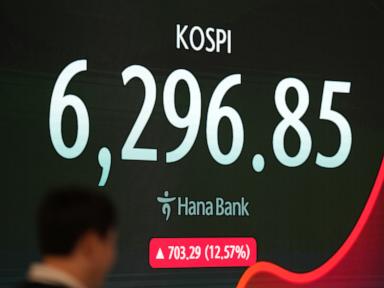
The trading floor in Seoul did not cheer when the opening bell rang. They simply stared at screens flashing numbers that defied traditional financial gravity. South Korea's benchmark Kospi index rocketed upward by nearly 18 percent in a single session, marking the most violent single-day reversal in the market's modern history. Heavyweight pillars Samsung Electronics and SK Hynix logged gains of 28 percent and 30 percent respectively, clawing back territory that had vanished during a brutal multi-day liquidation.
This was not a standard market correction. It was a violent correction of a correction, exposing the hyper-nervous plumbing of the global artificial intelligence supply chain. Weeks prior, the Kospi had touched peaks above 9,000, fueled by an insatiable global appetite for high-bandwidth memory chips required by Western cloud infrastructure. Then came the panic. Over three punishing sessions, more than 17 percent was sheared off the index as institutional desks panicked over whispered warnings of a looming technology bubble and aggressive competition rising from mainland Chinese fabrication plants.
To understand why Seoul's equity market behaves like a coiled spring, one must look past standard macroeconomic models. The Kospi is no longer just a measure of South Korean corporate health. It has become a leveraged proxy for the capital expenditure cycles of a handful of American mega-corporations. When Wall Street catches a cold, Seoul runs a high fever. When U.S. tech giants report stronger-than-expected cloud revenues, South Korean semiconductor fabrication plants experience an immediate, multi-billion-dollar shockwave of buying pressure.
The Anatomy of a Semiconductor Whip-Saw
Markets hate a vacuum. When sentiment shifts, institutional algorithms move faster than human logic can parse.
The July rout was triggered by mounting anxiety over return on investment. Wall Street analysts began questioning whether the hundreds of billions of dollars funneled into data centers would ever yield proportional cash flows. For South Korea, the psychological impact was immediate. Foreign capital fled local equities, dumping shares under the assumption that the artificial intelligence infrastructure buildout was hitting a brick wall. Local retail investors, who hold immense sway over daily trading volumes in Seoul, were caught in the crossfire, forced out of positions as margin calls cascaded through brokerages.
Yet the turnaround proved equally sudden. Strong earnings reports from American hyperscalers recalibrated the narrative overnight. The underlying reality of the semiconductor market had not actually changed over a seventy-two-hour span, but the perception of risk had completely inverted.
Why Memory Chips Dictate National Fortunes
Standard logic dictates that diversified economies cushion themselves against sector-specific shocks. South Korea long ago hitched its wagon to a different reality.
Memory architecture is notoriously cyclical. Unlike customized logic processors, standard DRAM and high-bandwidth memory chips function closer to commodities, subject to intense pricing pressures and inventory gluts. However, the current generational shift toward advanced artificial intelligence workloads turned memory chips into elite choke points. SK Hynix secured a dominant position supplying advanced high-bandwidth memory to primary artificial intelligence accelerator designers, transforming a traditional cyclical manufacturer into a high-margin growth engine.
When investors panic about an artificial intelligence bubble, they do not sell software companies first. They sell the hardware layer at the bottom of the stack. Because South Korea houses the primary manufacturing base for the world's high-performance memory, liquidating tech exposure globally means liquidating Seoul.
The Invisible Hand of Insider Signaling
Markets do not recover on corporate earnings alone. They recover when conviction returns to the boardroom.
Days before the historic rebound, SK Hynix chairman Chey Tae-won executed an open-market purchase of company shares, committing millions of dollars of personal capital to backstop tumbling valuations. In corporate governance circles, such moves are often dismissed as theatrical gestures. In the context of Korean chaebols, where executive actions carry profound signaling weight, the purchase served as a concrete floor under sliding stock prices.
Institutional investors tracking the chaos noted the divergence between retail panic selling and insider accumulation. While algorithmic funds were programmatically shedding risk based on macro headlines, domestic industry leaders were quietly absorbing the discounted float. By the time American tech earnings cleared the air, the institutional machinery was already positioned to reverse course.
The Structural Vulnerability Beneath the Bounce
A single-day surge of 18 percent offers psychological relief, but it does nothing to resolve the structural pressures facing South Korea's industrial core.
Geopolitical friction remains an unquantifiable risk factor. The rapid advancement of domestic semiconductor capabilities in China threatens to erode the technological moat that South Korean firms have spent decades constructing. While current-generation high-bandwidth memory remains out of reach for many competitors, the race for next-generation nodes is relentless. Capital expenditures required to maintain technological superiority run into the tens of billions of dollars annually, requiring uninterrupted demand from Western buyers to justify the outlay.
Furthermore, domestic demographic headwinds continue to cast a long shadow over long-term equity valuations in Seoul. A rapidly aging population and slowing domestic consumption mean that the structural growth of Korean corporations depends almost entirely on external export markets. When global liquidity tightens or foreign demand stutters, the local exchange absorbs the full force of the contraction.
The violent swing from a 17 percent loss to an 18 percent gain is a symptom of a market operating at maximum velocity. The infrastructure boom is real, but the margin for error has vanished entirely. Every quarterly earnings report from an American cloud provider now functions as a referendum on the entire South Korean industrial base.
The recovery has bought time, but it has not altered the underlying equation. As long as Seoul remains the primary engine room for global artificial intelligence hardware, the ride will remain terrifyingly steep.