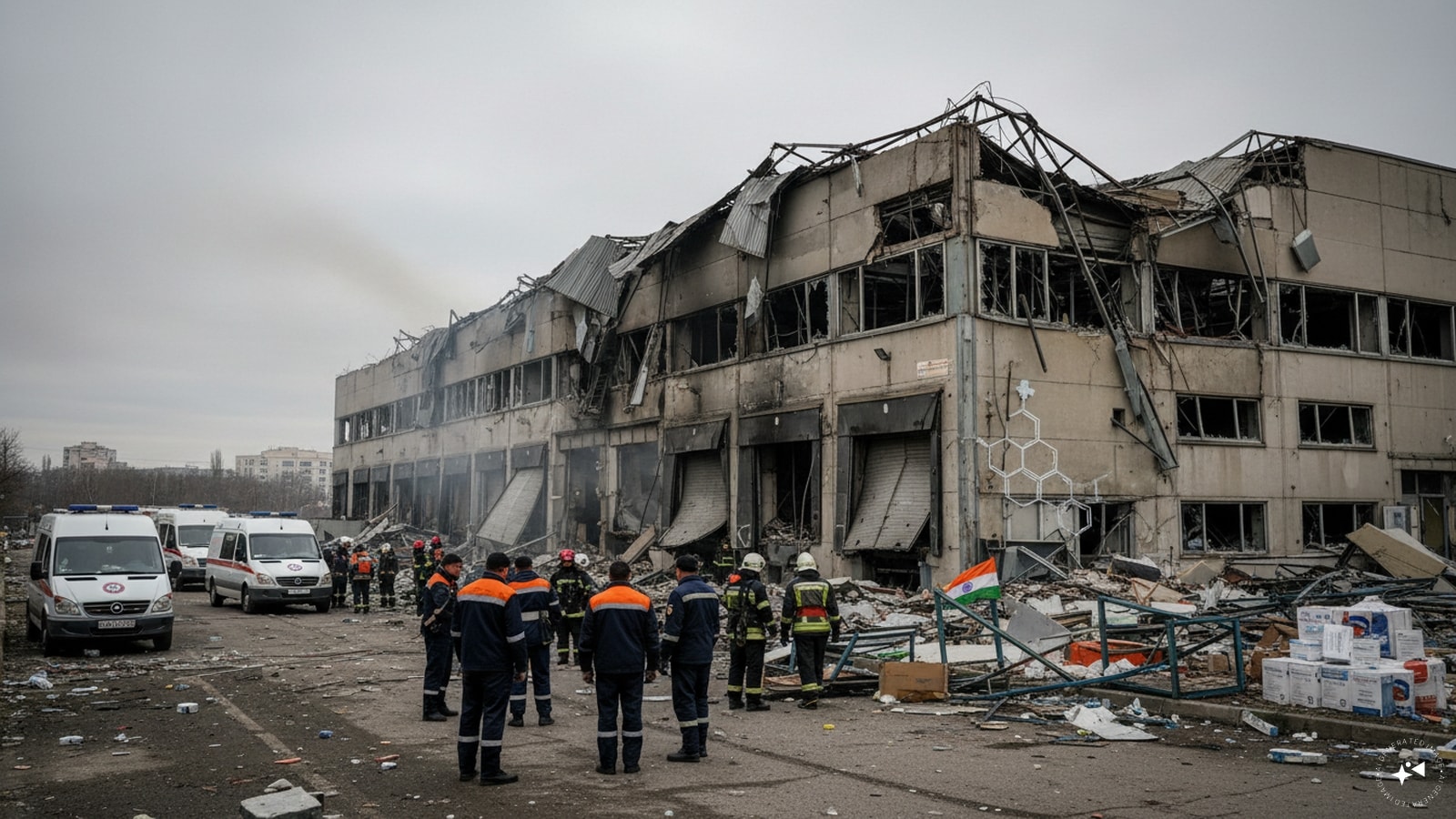
The airstrike that leveled the Kusum Group pharmaceutical facility in Sumy did not just destroy brick, mortar, and millions of rupees worth of generic drug manufacturing infrastructure. It tore open a fragile calculus regarding foreign commercial assets operating inside active combat zones. When a swarm of Russian attack drones targeted the northeastern Ukrainian hub, resulting in one fatality and extensive devastation, the incident highlighted a harsh reality of modern industrialized warfare. Neutral or foreign-owned commercial property offers no immunity when the theater of conflict turns indiscriminate.
For months, international analysts have watched multinational enterprises grapple with an impossible choice. Abandon billions in capital investment or keep production lines running under the constant shriek of air raid sirens. The Kusum Group, an enterprise with deep Indian roots that built its manufacturing footprint in Sumy back in 2009, chose the latter path. They maintained operations to supply critical medicines to a population starved of stable supply chains. That decision ended in catastrophic structural failure, with preliminary loss estimates crossing the Rs 400 crore threshold.
The Logistics of Risk Under Drone Warfare
Understanding why a pharmaceutical warehouse becomes a casualty requires examining the mechanics of saturation drone attacks. Modern air defense systems deployed by Ukraine face an unprecedented saturation challenge. When waves of dozens of loitering munitions—including faster jet-powered variants—swarm regional airspace, interceptor missile inventory depletes rapidly. Critical infrastructure takes priority, leaving industrial zones on the periphery exposed.
In Sumy, located dangerously close to the border, warning times are measured in seconds rather than minutes. A facility producing generic medications cannot easily be packed into a suitcase or moved underground. Massive cleanrooms, cold-chain storage units, and automated packaging lines require stationary industrial footprints. Consequently, fixed assets become permanent targets in a war where proximity to contested zones dictates vulnerability.
This dynamic exposes the profound limitations of corporate continuity planning during total war. Insurance markets abandoned war-risk coverage in Ukraine early on, leaving foreign investors entirely exposed to sovereign destruction. Every day a factory stays open in Sumy or Kharkiv is a calculated gamble against probability. Eventually, the math catches up.
Diplomatic Aftershocks and Economic Realities
The destruction of the plant triggered sharp diplomatic reactions. Representatives from the Ukrainian embassy did not mince words, pointing out the absurdity of civilian manufacturing hubs absorbing frontline military grade assaults. Yet, the incident also places New Delhi in a delicate diplomatic posture. India has maintained a careful balancing act throughout the conflict, refusing to join Western-led sanctions against Moscow while attempting to preserve trade ties and champion humanitarian stability.
When an Indian-managed asset is reduced to ash by Russian ordinance, the diplomatic insulation thins. It forces a reassessment in corporate boardrooms across developing economies that expanded into Eastern Europe during the post-Soviet manufacturing boom. Foreign direct investment relies on predictability. When state actors treat commercial supply chains as collateral damage, the cost-benefit analysis of rebuilding evaporates.
Reconstruction is a luxury of peacetime. In a city like Sumy, where power grids flicker and air raid alerts are a constant soundtrack, pouring capital back into concrete and steel is an untenable gamble. The Kusum Group's predicament illustrates the broader economic decoupling happening quietly across the region. International capital is retreating not just from Russia, but from the frontlines of Ukraine, leaving behind empty shells and broken supply lines.
The smoke clearing over the Sumy facility marks the end of an era where foreign enterprises believed economic neutrality could insulate them from geopolitical gravity. As long as long-range munitions dictate terms on the ground, civilian infrastructure remains acutely vulnerable.
Fubu Toy review
This video provides visual context and coverage regarding the second drone strike on the Indian-owned pharmaceutical plant in Sumy, detailing the extent of the damage and the operational challenges faced by the company.


