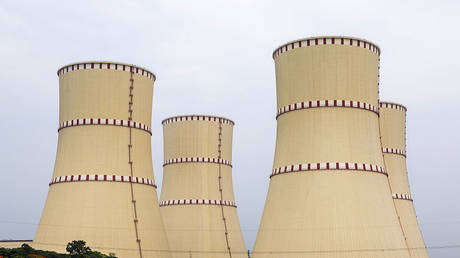
Bangladesh has officially synchronized its first nuclear reactor at the Rooppur power plant to the national grid, marking a monumental shift for a South Asian economy long starved of reliable energy. Built by Russia's state atomic energy corporation, Rosatom, the 1.2-gigawatt VVER-1200 reactor began delivering initial trial batches of electricity, injecting roughly 350 megawatts into local transmission lines. This milestone materializes after more than a decade of complex construction schedules, financial maneuvering, and heavy diplomatic navigation on the banks of the Padma River.
Yet beneath the ribbon-cutting ceremonies lies a web of heavy financial liabilities, deep foreign dependencies, and high-stakes technical integration challenges that will test Dhaka's institutional resilience for decades.
The Anatomy of a Mega-Project Burden
Carrying a price tag of roughly $12.65 billion, the Rooppur complex represents the single largest infrastructure undertaking in Bangladeshi history. Approximately ninety percent of the funding is financed through a Russian state credit line, structured to be repaid by Dhaka once commercial operations reach a mature phase. For an economy striving to balance foreign exchange reserves against volatile global fossil fuel prices, this debt configuration introduces long-term exposure.
The financial mechanics are further complicated by shifting global currency dynamics. Payment disputes and currency conversion hurdles between Moscow and various international trading partners over recent years have forced both nations to establish alternative settlement channels. While Rosatom remains contractually bound to complete the dual-reactor site—with the second 1.2-gigawatt unit trailing close behind—managing the servicing of multi-billion-dollar sovereign debt requires precise macroeconomic planning.
Navigating the Technical and Safety Horizon
Nuclear infrastructure is notoriously unforgiving of administrative shortcuts. The Bangladesh Atomic Energy Regulatory Authority (BAERA) issued the operational license for Unit 1 following exhaustive cold and hot functional tests overseen by international safety evaluators. Fuel loading concluded mid-year, paving the way for the core to achieve criticality before this latest grid synchronization phase.
However, translating trial generation into a stable baseload supply involves overcoming severe domestic grid bottlenecks. Bangladesh's national transmission network has historically suffered from distribution losses and instability. Injecting massive blocks of power from a single remote location in the Pabna district demands simultaneous grid modernization. Without parallel investments in high-voltage substations and smart load-balancing systems, localized grid congestion could force plant operators to throttle output, reducing the economic efficiency of the capital-intensive asset.
Geopolitical Realities in the Global South
For Moscow, executing the Rooppur venture successfully under international scrutiny serves as a vital commercial showcase. Rosatom continues to market its VVER-1200 generation III+ pressurized water reactors across developing nations as a reliable alternative to Western or East Asian nuclear vendors. Securing a foothold in South Asia validates Russia's export resilience despite sweeping Western sanctions targeting other sectors of its economy.
For Dhaka, the project fulfills an urgent imperative to diversify away from rapidly depleting domestic natural gas reserves. Natural gas has historically accounted for half of the nation's power generation, but declining fields and expensive liquefied natural gas imports have battered public finances. Atom power is projected to supply upward of nine to eleven percent of the country's total electricity demand once both units hit full commercial stride, stabilizing heavy industrial corridors.
The transition from a construction site to an active nuclear facility transforms Bangladesh into the newest member of the global atomic club. Managing the spent fuel, maintaining strict regulatory independence, and servicing foreign debt will dictate whether this technological leap becomes a sustainable engine of industrial growth or a cautionary tale of over-extension. The current grid synchronization proves the engineering works, but the real test of institutional endurance is only just beginning.