Orthopedic trauma has long been a brutal exercise in spatial geometry and brute force. When a patient arrives at an emergency department with a shattered pelvis, the medical team faces a terrifying cascade of physiological threats. Massive internal hemorrhaging, neurovascular damage, and high mortality rates turn the operating room into a high-stakes theater. Traditional open surgery requires massive incisions exceeding ten centimeters, extensive tissue dissection, and manual manipulation of bone fragments using heavy metal clamps and mallets. Blood loss during these conventional procedures frequently reaches a liter or more. For elderly patients or those with diminished physiological reserves, the sheer trauma of the operation can be as lethal as the initial accident.
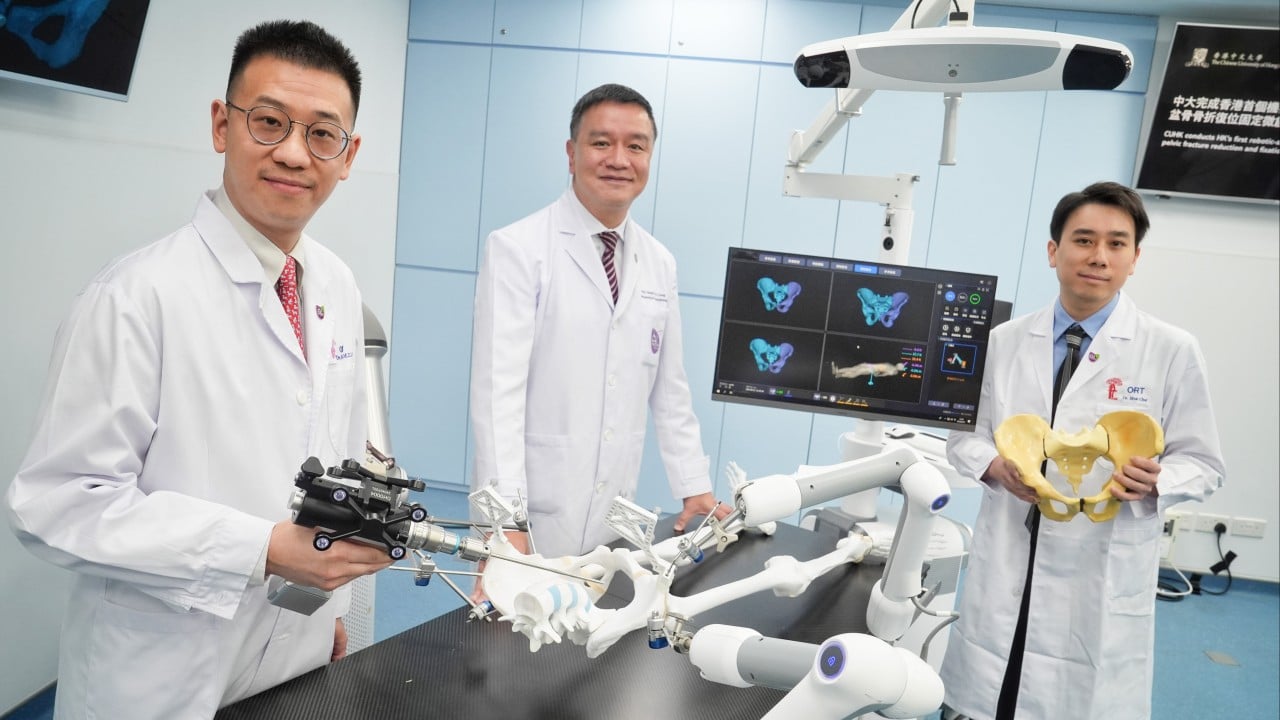
Surgeons at the Chinese University of Hong Kong recently completed the city's first robotic-assisted pelvic fracture reduction and fixation procedures at the Prince of Wales Hospital. Utilizing an advanced orthopaedic robotic system, the clinical team successfully treated complex trauma cases through tiny incisions measuring under two centimeters. Intraoperative blood loss dropped from the traditional threshold of a full liter down to a remarkably low ten to twenty milliliters. This ninety percent reduction in bleeding is not merely an incremental upgrade. It represents an fundamental shift in how surgical teams handle fragile, high-risk patients who previously had few viable options for safe intervention.
The mechanics behind this breakthrough rely on a marriage of three-dimensional computed tomography mapping and active robotic arm guidance. Prior to entering the operating room, medical teams generate detailed virtual models of the patient's pelvic anatomy to plan exact fracture reduction pathways and screw trajectories. During the operation itself, the robotic system integrates real-time navigation data to direct mechanical arms with sub-millimeter accuracy. This closed approach bypasses the need for wide-open dissection. By stabilizing and aligning bone fragments through pinpoint percutaneous entries, the technique protects surrounding soft tissues and dramatically lowers post-operative infection risks.
Yet, the integration of surgical robotics into emergency trauma workflows introduces distinct operational hurdles. Unlike elective joint replacements where schedules can be optimized weeks in advance, acute pelvic fractures present unpredictably at all hours of the night. Training specialized surgical staff to operate complex robotic platforms under emergency conditions requires significant institutional investment and continuous simulation practice. Furthermore, the financial cost of acquiring and maintaining advanced orthopaedic robotic hardware creates severe disparities between major academic medical centers and regional community hospitals.
Beyond hardware constraints lies the challenge of trajectory planning. The position, combination, and number of orthopedic screws determine the structural stability of the repaired pelvis. Poor placement risks catastrophic damage to adjacent nerves and major blood vessels, while excessive screw usage inflicts unnecessary trauma on the bone. To solve this bottleneck, researchers are developing artificial intelligence models designed to instantly compute optimal screw configurations from spatial imaging data. This computational assistance accelerates pre-operative planning, shrinking the window between patient arrival and definitive surgical intervention.
The transition from manual orthopedic hammering to computer-guided robotic manipulation signals a permanent evolution in trauma care. As clinical trials expand and long-term recovery data accumulates, the medical community must address the economic and logistical barriers keeping these tools confined to elite research hospitals. Precision medicine cannot remain a privilege reserved for premier tertiary centers. The future of surgery demands that advanced robotic systems become standard equipment in every major trauma unit, shifting high-risk orthopedic procedures from hazardous endurance tests into calculated, predictable interventions.