A volatile crisis is unfolding in the heart of Orange County, California, where a failing industrial storage tank has forced the evacuation of more than 40,000 residents across six cities. The threat centers on a compromised containment vessel holding roughly 7,000 gallons of methyl methacrylate at a GKN Aerospace manufacturing facility in Garden Grove. Emergency officials have dropped all bureaucratic euphemisms, openly warning the public that the structure is guaranteed to fail. The only remaining question is whether it will crack and spill its toxic contents onto the pavement or trigger a catastrophic thermal runaway explosion.
The sweeping emergency orders now encompass parts of Garden Grove, Cypress, Stanton, Anaheim, Buena Park, and Westminster. Schools have been shuttered, neighborhoods emptied, and emergency shelters established as hazardous materials teams engage in a desperate race against physics.
The Science of a Runaway Reaction
Industrial accidents are rarely the result of a single isolated failure. They are almost always a cascade of compounding errors, and what is happening in Garden Grove is a textbook demonstration of chemical vulnerability.
The substance in question, methyl methacrylate, is a highly reactive liquid monomer used extensively in the aerospace industry to fabricate high-strength resins, acrylic plastics, and aircraft canopies. By its very design, the chemical wants to link its molecules together to form solid polymers. This process of polymerization is intensely exothermic, meaning it generates its own heat. Under normal operating conditions, large-scale storage tanks rely on continuous, active mechanical cooling systems to keep the liquid stabilized well below its boiling point.
When an active cooling system fails, the temperature begins to climb. As the liquid heats up, the rate of polymerization accelerates, which in turn releases even more heat into the closed environment. This is the definition of thermal runaway.
[Cooling Failure] ──> [Temperature Rises] ──> [Accelerated Polymerization] ──> [Intense Heat Release] ──> [Pressure Spike / Explosion]
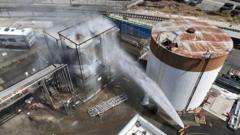
Once a chemical matrix enters this self-sustaining loop, stopping it from the outside becomes monumentally difficult. At the GKN Aerospace plant, the internal temperature of the tank spiked hours after the initial hazmat response. Although a built-in safety sprinkler system activated to douse the exterior shell, a damaged valve on the tank created a secondary operational roadblock. That broken component effectively blocked emergency crews from safely draining or neutralizing the product, locking the hazard in place.
The Best Case Scenario is a Disaster
Public safety officials are currently managing the crisis under a grim binary framework. Orange County Fire Authority Division Chief Craig Covey summarized the reality plainly, noting that the time for preventive maintenance has long since passed.
"We are setting up these evacuations in preparation for these two options: it fails, or it blows up."
The preferred outcome among emergency responders is for the structural integrity of the tank to give way via cracking rather than exploding. If the vessel cracks, it will release thousands of gallons of the raw monomer directly into the surrounding facility parking lot. To prepare for this scenario, crews have spent hours erecting extensive sandbag perimeters and containment barriers around the site. The goal is to isolate the liquid before it can migrate into Southern California's complex network of storm drains and river channels, which dump directly into the Pacific Ocean.
Yet, even a controlled spill presents severe environmental and public health hazards. Methyl methacrylate is highly volatile and heavier than air. As it pools, it releases a dense, toxic vapor cloud that settles close to the ground rather than dispersing into the upper atmosphere.
According to guidelines from the U.S. Environmental Protection Agency, acute inhalation of these vapors causes immediate irritation to the mucous membranes, severe respiratory distress, coughing, dizziness, and neurological symptoms. It is an active threat to anyone left in the immediate vicinity, which explains why local law enforcement is moving door-to-door through what has effectively become a ghost town.
The Reality of Chemical Placement in Urban Centers
This incident exposes a broader, systemic issue that plagues aging industrial zones across the United States. The GKN Aerospace facility sits on Western Avenue in Garden Grove. It is located roughly 35 miles southeast of downtown Los Angeles and less than a mile from Disneyland's major theme park properties.
When many of these manufacturing plants were established decades ago, they were situated in relatively isolated industrial parks. Over the intervening years, rapid suburban development and population growth squeezed residential neighborhoods directly against the fence lines of facilities processing hazardous materials.
+------------------------------------+
|   GKN Aerospace Tank Facility      |
+------------------------------------+
                 |
        (Less than 1 mile)
                 v
+------------------------------------+
|  Dense Residential Neighborhoods   |
|  & High-Traffic Tourist Corridors  |
+------------------------------------+
This close proximity turns a localized mechanical failure into a regional logistics nightmare. Evacuating 40,000 citizens from a densely packed, multi-ethnic urban environment requires flawless coordination across multiple municipal police departments, fire divisions, and transit authorities. In Garden Grove, which hosts one of the largest Vietnamese-American communities in the nation, information must be translated and broadcast across non-English media networks in real time to ensure compliance.
Despite these efforts, local officials confirmed that a notable percentage of residents within the hot zone have actively refused to leave their properties, betting their lives that the tank will be stabilized. It is a dangerous gamble.
The Engineering Blind Spot
As drones equipped with thermal imaging cameras circle the compromised tank to monitor internal hot spots, questions are inevitably shifting toward operational accountability. GKN Aerospace, a major subsidiary of a British aerospace conglomerate, operates under strict regulatory oversight due to its role in manufacturing commercial and military aircraft components. The facility's safety protocols, maintenance logs, and risk-management plans will undoubtedly face intense federal scrutiny once the immediate danger subsides.
The presence of redundant safety systems is supposed to prevent this exact scale of escalation. Industrial storage tanks for highly reactive monomers are typically engineered with multiple layers of defense:
- Primary mechanical chillers to regulate baseline temperatures.
- Secondary backup power generators to maintain cooling during electrical grid failures.
- Chemical inhibitors designed to be injected into the tank to kill the polymerization reaction entirely.
- Physical pressure-relief valves to vent excess vapor safely before structural failure occurs.
The breakdown in Garden Grove suggests a catastrophic intersection of failures. A cooling malfunction allowed the initial temperature spike to occur. Then, the physical distortion or mechanical failure of a critical valve physically prevented technicians from utilizing traditional mitigation tactics, such as pumping the chemical out or introducing neutralizing agents.
Emergency workers are currently using unmanned high-volume water monitors to continuously drench the exterior of the tank, hoping to strip away enough heat to stall the runaway reaction. This approach is a temporary holding action, not a cure. The cooling water keeps the metal skin from softening, but it does little to stop the exothermic chemistry occurring deep within the core of the fluid mass.
A definitive resolution hinges on whether the internal chemical energy spends itself before the structural steel of the tank reaches its thermal breaking point. If the internal pressure outpaces the cooling capacity of the exterior water streams, the neighborhood will experience a mechanical overpressure explosion that could easily damage adjacent storage vessels containing fuels and complementary industrial chemicals.
Responders have established a strict perimeter based on the calculated blast radius of a full-vessel rupture. No one is allowed near the machine except for specialized remote equipment and tactical hazmat units operating under short-duration windows. The situation remains completely unstable, serving as a stark reminder of the volatile industrial infrastructure operating silently beneath the surface of modern suburban life.