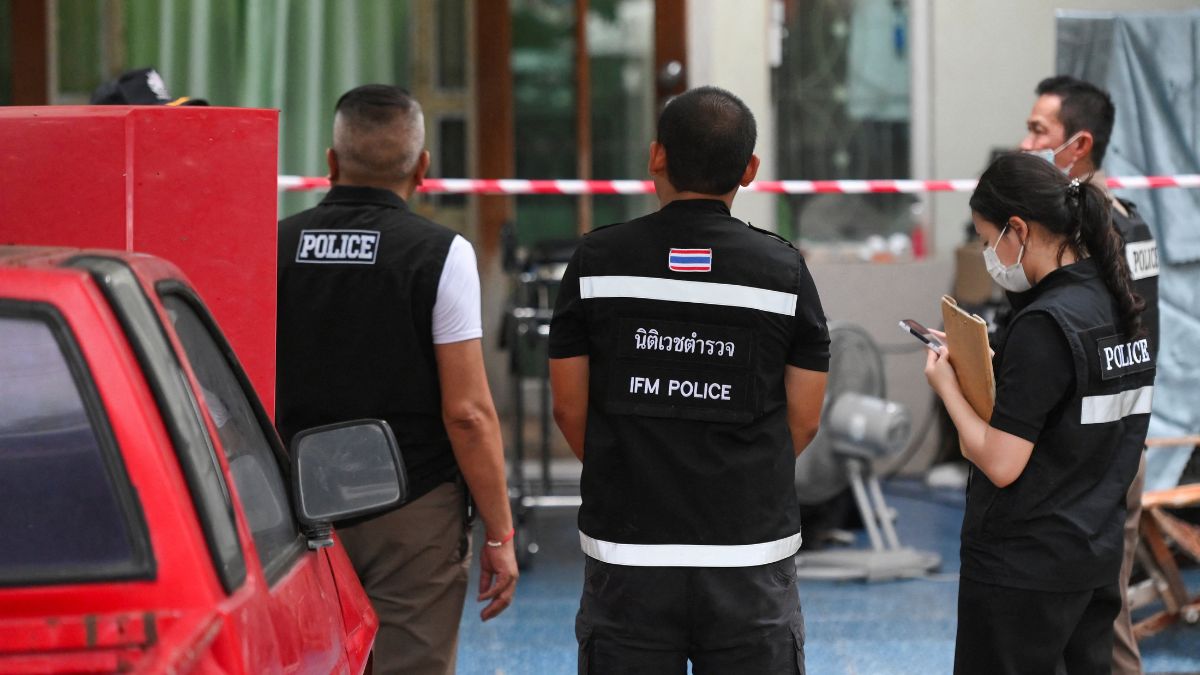
When a 14-year-old student walked into Debsirin Nonthaburi School on a Friday morning, the violence he unleashed shattered the illusion that Southeast Asia's recurring mass casualty incidents are isolated anomalies. Leaving a trail of blood that claimed the lives of his grandparents and multiple school staff members before he died by suicide, the teenager executed an assault that left over thirty people injured. Officials rushed to categorize the tragedy through the convenient lens of academic pressure, pointing to acute stress as the primary catalyst. That explanation is dangerously incomplete. Reducing a meticulously prepared tactical assault to teenage frustration ignores the structural failures, easy access to lethal firearms, and systemic blind spots plaguing modern institutions.
The Anatomy of an Engineered Attack
To label the Nonthaburi massacre spontaneous is to misread every physical indicator collected at the scene. Investigators recovered a weapon belonging to the boy's grandfather, alongside dozens of unspent rounds of ammunition. Witnesses described a calculated cadence to the violence, noting that the shooter moved with chilling precision.
Stress does not manufacture tactical competence. It does not provide the cold logic required to transition from a domestic murder scene to a multi-room institutional slaughter. Peers later noted the suspect's fixation on tactical media, firearms, and security profiles. Yet, institutional authorities consistently fail to connect these behavioral markers to physical risk until it is too late. When a minor accesses a registered firearm kept unsecured in a domestic residence, the breakdown extends far beyond a bad grade or a difficult social climate at school.
The Myth of the Sudden Snap
Public discourse routinely relies on the narrative of the sudden psychological break. Society prefers to imagine that stable individuals cross an invisible threshold into violence due to an overwhelming moment of pressure. Decades of behavioral analysis show a different reality. Targeted violence is almost always a process of escalation, rehearsal, and grievance cultivation.
The suspect did not simply wake up on Friday morning and decide to end multiple lives. He planned. He secured access to a handgun. He targeted his primary guardians first before shifting his operational theater to the school campus. Prime Minister Anutin Charnvirakul noted that friends confirmed the teenager had been under pressure regarding his schooling, but framing this pressure as the root cause misdiagnoses the pathology. Millions of adolescents experience academic stress. An infinitesimal fraction respond by engineering mass shootings. Blaming stress treats the symptom while ignoring the instrument of death.
The Structural Failure of Regional Gun Access
Thailand maintains one of the highest rates of civilian firearm ownership in the region, with millions of weapons circulating through public and private hands. Despite previous legislative promises following earlier tragedies—such as the devastating 2022 massacre at a northern nursery—enforcement and storage regulations remain porous.
When firearms are treated as standard household property rather than high-risk tactical implements, accessibility becomes inevitable. Education Minister Prasert Jantararuangtong openly admitted that institutional security levels across the country are minimal, noting that routine bag checks for weapons are rarely performed. If schools remain soft targets while residential properties double as unsecured armories, these incidents will recur. No amount of post-crisis psychological counseling can compensate for a lack of basic physical security and irresponsible weapon storage.
The Cost of Institutional Blindness
Classmates described the shooter as a troubled youth who experienced targeted peer harassment. In many educational environments, bullying is treated as a routine rite of passage rather than a security threat indicator. When social isolation intersects with unmonitored digital radicalization and effortless access to lethal force, the result is a predictable catastrophe.
The deployment of mental health crisis teams to Nonthaburi is a necessary immediate response, but it represents retroactive damage control. Society continues to invest in reaction rather than prevention. Until lawmakers confront the cultural normalization of loose gun storage and the systemic failure to intervene in escalating adolescent alienation, the cycle of violence will persist unchecked.